Abrogation of Article 370 will help curb terrorism, says European Parliament member

Agencies
September 2, 2019

Brussels, Sept 2: A Member of the European Parliament (MEP) has said that the abrogation of Article 370 will help in rooting out several terrorist organisations operating in Kashmir.

In an article published in the European Parliament's monthly newspaper EP Today, MEP Tomas Zdechovsky said that "such terrorist groups are spreading violence in the Kashmir valley and Pakistan occupied Kashmir (PoK)".

These armed groups were reportedly responsible for attacks on persons affiliated or associated with political organisations in Jammu and Kashmir, including in the killings of at least six political party workers and a separatist leader.

In the lead up to the local elections in October 2018, these armed groups threatened Kashmiris who were attempting to participate in the elections, and warned of "dire consequences" if those running for elections did not immediately withdraw their nomination papers and publicly apologised for their actions.

"While armed groups have sporadically threatened political workers in previous elections, the number of attacks in 2018 is amongst the highest in recent times," said Tomas.

Pakistan-based armed groups that operate mostly in Kashmir have also been accused of harassing and threatening nationalist and pro-independence political workers in PoK.

On August 2, last year, members of an unknown armed group attacked and burned down at least 12 schools in Gilgit-Baltistan's Diamer district. At least half of these were girls school.

On February 14, this year, a suicide bombing targetting the Indian security forces in Pulwama, was claimed by Jaish-e-Mohammed (JeM).

"India blamed Pakistan for continuing to support the group's activities. Pakistan foreign minister Shah Mehmood Qureshi confirmed to an international news organisation that JeM founder Masood Azhar was present in Pakistan," the article read.

On May 1, the United Nations Security Council Da'esh and al-Qaida Sanctions Committee announced that it had added Azhar to its list of individuals or entities subject to assets freeze, travel ban and arms embargo.

Pakistan's endorsed engagement and support of state-sponsored terrorism has also been confirmed by the Financial Action Task Force (FATF). (The FATF is an inter-governmental organisation that monitors money laundering and terrorist financing.)

The organisation had stated in February that Pakistan "does not demonstrate a proper understanding of the Terror financing risks posed by Da'esh, al-Qaida, Jamaat-ud-Dawa (JuD), Falah-i-Insaniyat Foundation (FIF), Lashkar-e -Taiba (LeT), Jaish-e-Mohammed (JeM), Haqqani Network (HQN), and persons affiliated with the Taliban."

It urged Pakistan to address its "strategic deficiencies" and complete its action plan.

The 2019 report of the Office of the United Nations High Commissioner for Human Rights (OHCHR) on the human rights situation in Kashmir and PoK covering the period from May 2018 to April 2019, noted that "since the late 1980s, a variety of armed groups have been actively operating in the Indian state of Jammu and Kashmir, and there has been documented evidence of these groups committing a wide range of human rights abuses, including kidnappings, killings of civilians, and sexual violence.

The UN report said, "while in the 1990s there were reportedly over a dozen armed groups operating in Kashmir, in recent years, four major armed groups are believed to be operational in this region: Lashkar-e-Taiba, Jaish-e-Mohammed, Hizbul Mujahideen and Harakat Ul-Mujahidin. All four are believed to be based in Pakistan-administered Kashmir."

Furthermore, the report states that "two armed groups have been accused of recruiting and deploying child soldiers in Kashmir."

The MEP said in his article, "In its fight against terrorism, and against acts of violence in Kashmir and also in India by Pakistani based terrorists and armed groups, Prime Minister of India, Narendra Modi had to act. His choice of action, whilst harsh and direct, was criticised by many who failed to understand his motive. On the August 5, this year, PM Modi revoked Article 370 through a Presidential Order and the passage of a resolution in Parliament."

Article 370 of the Indian constitution gives a special status to Jammu and Kashmir, thereby allowing it to have a separate constitution, a state flag and autonomy over the internal administration of the state.

This article, along with Article 35A, defined that the Jammu and Kashmir state's residents live under a separate set of laws, including those related to citizenship, ownership of property, and fundamental rights, as compared to the residents of other Indian states.

"The removal, temporarily or permanently of these articles, should be seen as a global stance against terrorist activities, where today terrorists exploit the principles of democracy, freedom of speech and human rights practised by the majority, whilst at the same time imposing fear, violence and killings as justification for their causes," said the MEP. PM Modi understood the challenge he was undertaking with his sudden revocation of Article 370, although for those following his election campaign, he had already committed to undertake this initiative if his electorate were to appoint him.

Tomas Zdechovsky said, "With his landslide victory, his focus on genuinely protecting his people by prioritising the fight against terrorism remains unshaken... providing almost immediate justification to his actions, on 6th August, the day after his announcement to revoke Article 370, the Pakistani Prime Minister Imran Khangave a dramatic speech that invited and incited further terrorist activity in India."

"Incidents like Pulwama are bound to happen again, I can already predict this will happen," Khan said, calling to his Parliament, people and Pakistan based terrorist groups. At the same time his Army Chief, General Qamar Javed Bajwa, stated that Pakistan's military will "go to any extent" to protect Kashmir.

Masood Azhar, chief of the Jihadi group, further explained that "now is the time that Kashmiris need to come out with unity so that the enemy will beg for peace and negotiations."

"It is hoped that by the equal inclusion of Jammu and Kashmir state under the same constitution as India's other twenty-eight states, India can ensure that its values of free and fair elections without intimidation, its values of diversity and religious harmony, and its fight against terrorism, can provide greater stability and security not only for the people of India, but for those throughout South Asia," Zdechovsky concluded.

Comments

Add new comment

  • Coastaldigest.com reserves the right to delete or block any comments.
  • Coastaldigset.com is not responsible for its readers’ comments.
  • Comments that are abusive, incendiary or irrelevant are strictly prohibited.
  • Please use a genuine email ID and provide your name to avoid reject.
News Network
November 27,2025

DKSvokkaliga.jpg

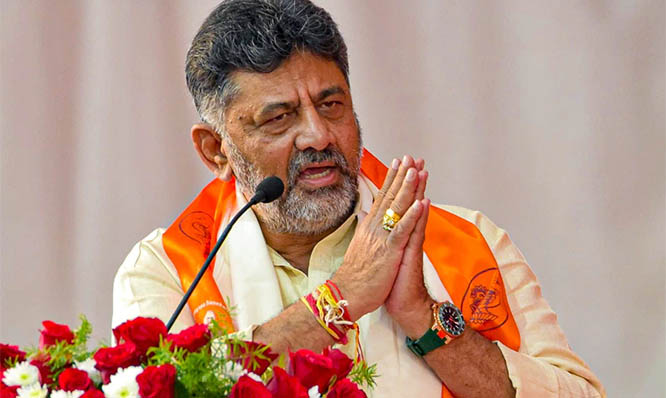
Bengaluru: The Vokkaligara Sangha on Thursday issued a stern warning to the Congress, saying the party could face serious electoral repercussions if Deputy Chief Minister D.K. Shivakumar is not appointed as Chief Minister.

The warning follows the public backing of Shivakumar’s chief ministerial ambition by top Vokkaliga pontiff Nirmalanandanatha Swami, who urged the Congress high command to honor his claim.

“The community supported Congress in the 2023 Assembly elections only because Shivakumar had a real chance to become CM. If he is cheated, we’ll teach the party a big lesson,” said newly elected Sangha president L. Srinivas. He added that Vokkaligas would organize protests under the guidance of community leaders.

General Secretary C.G. Gangadhar pointed out that Congress won more seats in the Vokkaliga-dominated Old Mysuru region due to Shivakumar’s influence, adding, “If Congress wants to retain power, Shivakumar should be made the CM.”

Outgoing president Kenchappa Gowda emphasized Shivakumar’s contribution to Congress’ victory. “Our community voted for Congress thinking he would become CM. Siddaramaiah has also served the party well, but Shivakumar should now be given a chance,” he said.

Former general-secretary Konappa Reddy appealed to Sonia and Rahul Gandhi to recognize Shivakumar’s loyalty and service, saying, “Congress is known to keep its promises. We hope it won’t break the promise made to him.”

Comments

Add new comment

  • Coastaldigest.com reserves the right to delete or block any comments.
  • Coastaldigset.com is not responsible for its readers’ comments.
  • Comments that are abusive, incendiary or irrelevant are strictly prohibited.
  • Please use a genuine email ID and provide your name to avoid reject.
News Network
December 2,2025

DKSsiddu.jpg

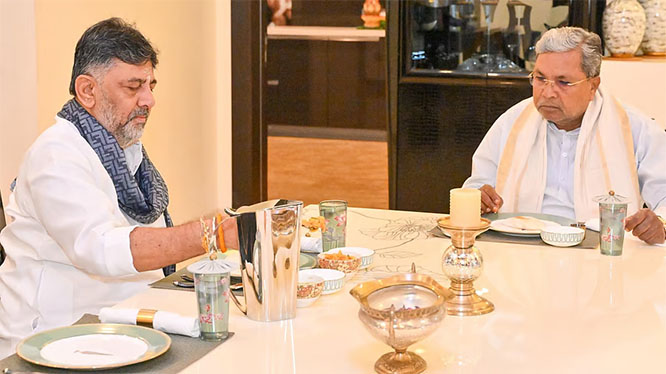
Bengaluru: 'Nati koli saaru' (country chicken curry) considered one of Chief Minister Siddaramaiah’s favourites along with steaming hot idlis was on the breakfast menu at Deputy CM D K Shivakumar’s residence on Tuesday, according to official sources.

The spread also included 'nati koli' fry, vada and pongal, among other items, they said.

In an apparent show of unity, Siddaramaiah visited Shivakumar’s residence for breakfast, just days after the two leaders shared a meal amid a simmering power tussle in the state Congress.

Siddaramaiah drove to the Deputy CM’s residence in Sadashivanagar, where he was received by Shivakumar and his brother D K Suresh, who is a former Congress MP.

Suresh and Kunigal MLA H D Ranganath, a relative of Shivakumar, joined them for breakfast, which featured a mix of vegetarian and non-vegetarian dishes.

Speaking to reporters later, Siddaramaiah said Shivakumar had invited him during his visit to the CM’s residence for breakfast on Saturday.

Asked about the difference between the two meals, the chief minister said, "At his (Shivakumar’s) house it was non-veg, while at my house it was veg. He is a vegetarian, I am a non-vegetarian. I had not prepared non-veg. I told DK to get chicken from the village as you won’t get the original in Bengaluru."

Shivakumar said he had initially invited Siddaramaiah to his residence, but the CM had suggested visiting his place first and reciprocating later. "It was a vegetarian breakfast at the CM’s house on Saturday," he noted.

"Today, I invited him (the CM) to my house. He enjoyed the breakfast, which had his Mysuru taste," Shivakumar added. At this point, Siddaramaiah remarked that Shivakumar’s wife is also from Mysuru.

Saturday’s breakfast at Siddaramaiah’s official residence, held as part of efforts by the Congress high command to ease tensions in the leadership dispute between the two, reportedly included idlis and sambar, according to official sources.

Comments

Add new comment

  • Coastaldigest.com reserves the right to delete or block any comments.
  • Coastaldigset.com is not responsible for its readers’ comments.
  • Comments that are abusive, incendiary or irrelevant are strictly prohibited.
  • Please use a genuine email ID and provide your name to avoid reject.
News Network
December 3,2025

indigo.jpg

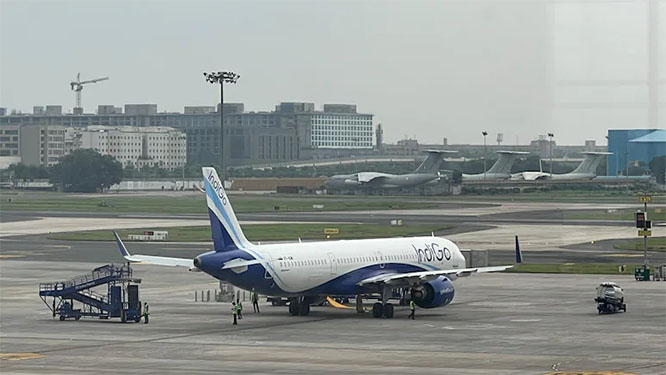
IndiGo, India’s largest airline, is battling one of its worst operational disruptions in recent years, with hundreds of delays and cancellations throwing domestic travel into chaos.

Government data on Tuesday showed its on-time performance plunging to 35%, an unusual dip for a carrier long associated with punctuality.

By Wednesday afternoon, airports in Delhi, Mumbai, Bengaluru and Hyderabad had collectively reported close to 200 cancellations, stranding travellers across the country.

Crew Shortage After New Duty Norms

A major trigger behind the meltdown is a severe crew shortage, especially among pilots, following the rollout of revised Flight Duty Time Limitation (FDTL) norms last month.

The rules mandate longer rest hours and more humane rosters — a shift IndiGo has struggled to incorporate across its vast network.

Sources said several flights were grounded due to lack of cabin crew, while some delays stretched upwards of eight hours.

With IndiGo controlling over 60% of India’s domestic aviation market, the ripple effect has impacted airports nationwide.

IndiGo Issues Apology, Lists “Compounding Factors”

In a statement, IndiGo acknowledged the large-scale disruption:

“We sincerely apologise to customers. A series of unforeseen operational challenges — technology glitches, winter schedule changes, adverse weather, system congestion and updated FDTL norms — created a compounding impact that could not have been anticipated.”

To stabilise operations, the airline has begun calibrated schedule adjustments for the next 48 hours, aiming to restore punctuality. Affected passengers are being offered refunds or alternate travel arrangements, IndiGo said.

What the FDTL Rules Require

The FDTL norms, designed to reduce pilot fatigue, cap duty and flying hours as follows:
•    Maximum 8 hours of flying per day
•    35 hours per week
•    125 hours per month
•    1,000 hours per year

Crew must also receive rest equalling twice the flight duration, with a minimum 10-hour rest period in any 24-hour window.

The DGCA introduced these limits to enhance flight safety.

Hyderabad: 33 Flights Cancelled, Long Queues Reported

Hyderabad’s Rajiv Gandhi International Airport saw heavy early-morning crowds as 33 IndiGo flights (arrivals and departures) were cancelled.

The airport clarified on X that operations were normal, advising passengers to contact IndiGo directly for latest flight status.

Cancellations included flights to and from Visakhapatnam, Goa, Ahmedabad, Delhi, Bengaluru, Chennai, Madurai, Hubli, Bhopal and Bhubaneswar.

Bengaluru: 42 Flights Disrupted

Bengaluru’s Kempegowda International Airport recorded 42 cancellations — 22 arrivals and 20 departures — affecting routes to Delhi, Mumbai, Chennai, Hyderabad, Goa, Kolkata and Lucknow.

Passengers Vent on Social Media

Irate travellers took to X to share their experiences. One passenger stranded in Hyderabad wrote: “I have been here since 3 a.m. and missed an important meeting.”

Another said: “My flight was pushed from 1:55 PM to 2:55 PM and now 4:35 PM. I was informed only three minutes before entering the airport.”

Delhi Airport Hit by Tech Glitch

At Delhi Airport, the disruption deepened due to a slowdown in the Amadeus system — used for reservations, check-ins and departure control.

The technical issue led to longer queues and sluggish processing, adding to delays already worsened by staff shortages.

Comments

Add new comment

  • Coastaldigest.com reserves the right to delete or block any comments.
  • Coastaldigset.com is not responsible for its readers’ comments.
  • Comments that are abusive, incendiary or irrelevant are strictly prohibited.
  • Please use a genuine email ID and provide your name to avoid reject.