Airports across India struggling to cope with massive passenger surge

Agencies
March 19, 2018

Mumbai, Mar 19: India’s airports are struggling to cope with a massive surge in passenger numbers and billions of dollars must be spent to boost their capacity, analysts have warned.

The country is witnessing a huge boom in air travel as its growing middle class increasingly takes to the skies but experts say infrastructure is failing to keep up.

“There’s an urgent need for capacity building in major Indian airports as they are bursting at the seams and close to saturation,” Binit Somaia, South Asia Director at the Centre for Aviation (CAPA), said.

India has witnessed a six-fold increase in passenger numbers over the past decade as citizens take advantage of better connectivity and cheaper fares thanks to a host of low-cost airlines.

Indian airports handled 265 million domestic passengers in 2016 and will cross 300 million this year, according to CAPA. The country’s entire airport network is only capable of handling 317 million passengers, it says.

According to data compiled by the Directorate General of Civil Aviation (DGCA), an Indian regulatory body, there were just 44 million Indians travelling by plane in 2008.

Now CAPA predicts India will overtake Britain as the world’s third-largest market by 2025 and will have 478 million flyers by 2036.

Aviation experts say the government faces a race against time to build the infrastructure to handle the soaring congestion.

“Some top airports have reached saturation. In the next five to seven years, the top 30 to 40 airports in India will be performing beyond their capacity,” said Somaia of the Sydney-based CAPA.

Flights have increased by around 20 per cent every year over the last three years, stretching many airports to breaking point.

Travellers can snap up tickets sometimes for as little as 1,000 rupees ($15) — cheaper than many fares on the country’s rickety train network.

Ten Indian airports — including Dehradun, Jaipur, Guwahati, Mangalore, Srinagar and Pune — are already operating beyond their capacity, CAPA said in a report released last month. Others are nearing their limit.

The aviation body predicts that New Delhi’s Indira Gandhi International Airport and Chennai’s International Airport will reach their handling capacity within four to six years.

World record

The situation is even more pressing at Mumbai’s Chhatrapati Shivaji International Airport (CSIA). CAPA says it is at 94 per cent capacity and is “close to saturation”.

Earlier this year, the airport said it had broken its own world record for handling the most number of arrivals and departures on a single runway in one day. Some 980 flights landed and took off within a 24-hour period.

Domestic travellers flying into India’s financial capital regularly complain of flights having to circle for up to half an hour before the plane is given a slot to land.

The airport is surrounded by slum settlements, making it impossible to increase the number of runways and highlighting the problem of acquiring space for infrastructure projects in India’s heavily congested cities.

The government is building a new airport at Navi Mumbai, 30 kilometres away, to ease the burden. It has been repeatedly delayed due to land disputes and is currently scheduled to open in 2023.

“The situation at CSIA will worsen until the new airport is operational,” Amber Dubey, India head of aerospace and defence at global consultancy KPMG, told AFP, describing the delays as “unacceptable”.

Prime Minister Narendra Modi has made making air travel accessible to all a key priority since his election in 2014. He recently launched a scheme to connect remote regions of the country by air.

In the budget last month, Finance Minister Arun Jaitley allocated $613 million to the Airports Authority of India to expand facilities.

CAPA estimates that India needs to invest $45 billion by 2030 to keep up with demand.

“The government needs to ensure we have infrastructure to manage [the] growth rate,” Manish Agarwal, an infrastructure expert at PricewaterhouseCoopers, said.


Comments

Add new comment

  • Coastaldigest.com reserves the right to delete or block any comments.
  • Coastaldigset.com is not responsible for its readers’ comments.
  • Comments that are abusive, incendiary or irrelevant are strictly prohibited.
  • Please use a genuine email ID and provide your name to avoid reject.
Media Release
November 24,2025

novel2.jpg

Sharjah, UAE: Ayisha Basheer Esra, a talented young writer hailing from Aramboor in Dakshina Kannada’s Sullia taluk, marked a significant milestone in her burgeoning literary career with the launch of her debut novel, The Betrayal of the Kingdom, at the Sharjah International Book Fair. The prestigious event, recognized as the world’s largest book fair, provided a fitting stage for the unveiling of Esra’s work.

The official release ceremony was conducted by Sheikh Abdullah bin Mohammed Al Qasimi, Director of the Religious Affairs Office of the Sharjah Government and a distinguished member of the royal family, underscoring the significance of Esra’s achievement. Mrs. Lini Shivaprasad, Principal of GEMS Millennium School, Sharjah, had the honor of receiving the first copy of the novel.

The event was graced by the presence of numerous distinguished guests, reflecting the widespread recognition of Esra’s literary talent and the anticipation surrounding her debut novel. Among the notable attendees were Syed Panakkad Munawwarali Shihab Tangal, Dr. Mariam Al Shenasi, the UAE’s renowned writer and Head of Dar Al Yasmin Publications, Dr. K. K. N. Kurup, Retired Vice Chancellor of Calicut University and Historian, Sharjah Businessman Shamsuddin Bin Mohideen, Nizar Talangara, President of the Sharjah Indian Association, V. T Salim, Director of Silver Home Real Estate, Munir Al Wafa, MD of Lipi Publication Akbar, and other esteemed individuals.

At the remarkably young age of eight, Esra has already established herself as a prolific writer, authoring and publishing collections of short stories in addition to her newly released full-length novel. Her dedication to writing and her exceptional talent have positioned her as one of the youngest authors to achieve such literary success. 

Esra is the daughter of Basheer and Haseena, residents of Aramboor, Sullia, and currently a student at Sharjah’s GEMS Millennium School. Her early accomplishments serve as an inspiration to aspiring young writers and a testament to the power of nurturing creativity from a young age.

novel1.jpg

Comments

Add new comment

  • Coastaldigest.com reserves the right to delete or block any comments.
  • Coastaldigset.com is not responsible for its readers’ comments.
  • Comments that are abusive, incendiary or irrelevant are strictly prohibited.
  • Please use a genuine email ID and provide your name to avoid reject.
News Network
December 3,2025

indigo.jpg

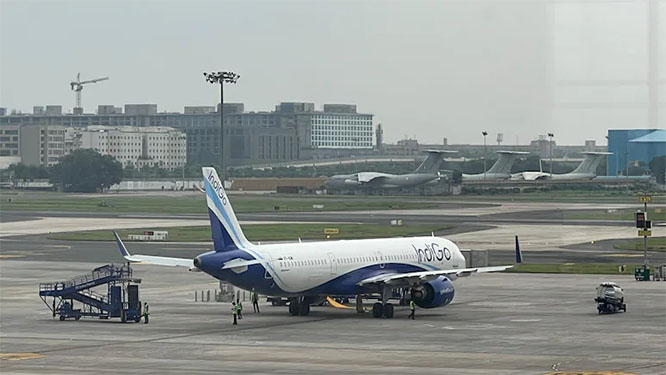
IndiGo, India’s largest airline, is battling one of its worst operational disruptions in recent years, with hundreds of delays and cancellations throwing domestic travel into chaos.

Government data on Tuesday showed its on-time performance plunging to 35%, an unusual dip for a carrier long associated with punctuality.

By Wednesday afternoon, airports in Delhi, Mumbai, Bengaluru and Hyderabad had collectively reported close to 200 cancellations, stranding travellers across the country.

Crew Shortage After New Duty Norms

A major trigger behind the meltdown is a severe crew shortage, especially among pilots, following the rollout of revised Flight Duty Time Limitation (FDTL) norms last month.

The rules mandate longer rest hours and more humane rosters — a shift IndiGo has struggled to incorporate across its vast network.

Sources said several flights were grounded due to lack of cabin crew, while some delays stretched upwards of eight hours.

With IndiGo controlling over 60% of India’s domestic aviation market, the ripple effect has impacted airports nationwide.

IndiGo Issues Apology, Lists “Compounding Factors”

In a statement, IndiGo acknowledged the large-scale disruption:

“We sincerely apologise to customers. A series of unforeseen operational challenges — technology glitches, winter schedule changes, adverse weather, system congestion and updated FDTL norms — created a compounding impact that could not have been anticipated.”

To stabilise operations, the airline has begun calibrated schedule adjustments for the next 48 hours, aiming to restore punctuality. Affected passengers are being offered refunds or alternate travel arrangements, IndiGo said.

What the FDTL Rules Require

The FDTL norms, designed to reduce pilot fatigue, cap duty and flying hours as follows:
•    Maximum 8 hours of flying per day
•    35 hours per week
•    125 hours per month
•    1,000 hours per year

Crew must also receive rest equalling twice the flight duration, with a minimum 10-hour rest period in any 24-hour window.

The DGCA introduced these limits to enhance flight safety.

Hyderabad: 33 Flights Cancelled, Long Queues Reported

Hyderabad’s Rajiv Gandhi International Airport saw heavy early-morning crowds as 33 IndiGo flights (arrivals and departures) were cancelled.

The airport clarified on X that operations were normal, advising passengers to contact IndiGo directly for latest flight status.

Cancellations included flights to and from Visakhapatnam, Goa, Ahmedabad, Delhi, Bengaluru, Chennai, Madurai, Hubli, Bhopal and Bhubaneswar.

Bengaluru: 42 Flights Disrupted

Bengaluru’s Kempegowda International Airport recorded 42 cancellations — 22 arrivals and 20 departures — affecting routes to Delhi, Mumbai, Chennai, Hyderabad, Goa, Kolkata and Lucknow.

Passengers Vent on Social Media

Irate travellers took to X to share their experiences. One passenger stranded in Hyderabad wrote: “I have been here since 3 a.m. and missed an important meeting.”

Another said: “My flight was pushed from 1:55 PM to 2:55 PM and now 4:35 PM. I was informed only three minutes before entering the airport.”

Delhi Airport Hit by Tech Glitch

At Delhi Airport, the disruption deepened due to a slowdown in the Amadeus system — used for reservations, check-ins and departure control.

The technical issue led to longer queues and sluggish processing, adding to delays already worsened by staff shortages.

Comments

Add new comment

  • Coastaldigest.com reserves the right to delete or block any comments.
  • Coastaldigset.com is not responsible for its readers’ comments.
  • Comments that are abusive, incendiary or irrelevant are strictly prohibited.
  • Please use a genuine email ID and provide your name to avoid reject.
News Network
December 2,2025

DKSsiddu.jpg

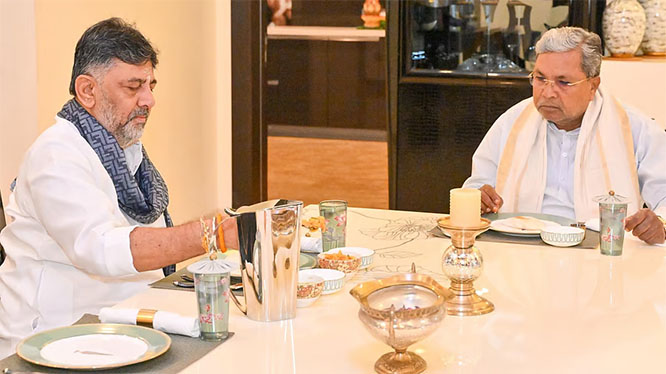
Bengaluru: 'Nati koli saaru' (country chicken curry) considered one of Chief Minister Siddaramaiah’s favourites along with steaming hot idlis was on the breakfast menu at Deputy CM D K Shivakumar’s residence on Tuesday, according to official sources.

The spread also included 'nati koli' fry, vada and pongal, among other items, they said.

In an apparent show of unity, Siddaramaiah visited Shivakumar’s residence for breakfast, just days after the two leaders shared a meal amid a simmering power tussle in the state Congress.

Siddaramaiah drove to the Deputy CM’s residence in Sadashivanagar, where he was received by Shivakumar and his brother D K Suresh, who is a former Congress MP.

Suresh and Kunigal MLA H D Ranganath, a relative of Shivakumar, joined them for breakfast, which featured a mix of vegetarian and non-vegetarian dishes.

Speaking to reporters later, Siddaramaiah said Shivakumar had invited him during his visit to the CM’s residence for breakfast on Saturday.

Asked about the difference between the two meals, the chief minister said, "At his (Shivakumar’s) house it was non-veg, while at my house it was veg. He is a vegetarian, I am a non-vegetarian. I had not prepared non-veg. I told DK to get chicken from the village as you won’t get the original in Bengaluru."

Shivakumar said he had initially invited Siddaramaiah to his residence, but the CM had suggested visiting his place first and reciprocating later. "It was a vegetarian breakfast at the CM’s house on Saturday," he noted.

"Today, I invited him (the CM) to my house. He enjoyed the breakfast, which had his Mysuru taste," Shivakumar added. At this point, Siddaramaiah remarked that Shivakumar’s wife is also from Mysuru.

Saturday’s breakfast at Siddaramaiah’s official residence, held as part of efforts by the Congress high command to ease tensions in the leadership dispute between the two, reportedly included idlis and sambar, according to official sources.

Comments

Add new comment

  • Coastaldigest.com reserves the right to delete or block any comments.
  • Coastaldigset.com is not responsible for its readers’ comments.
  • Comments that are abusive, incendiary or irrelevant are strictly prohibited.
  • Please use a genuine email ID and provide your name to avoid reject.