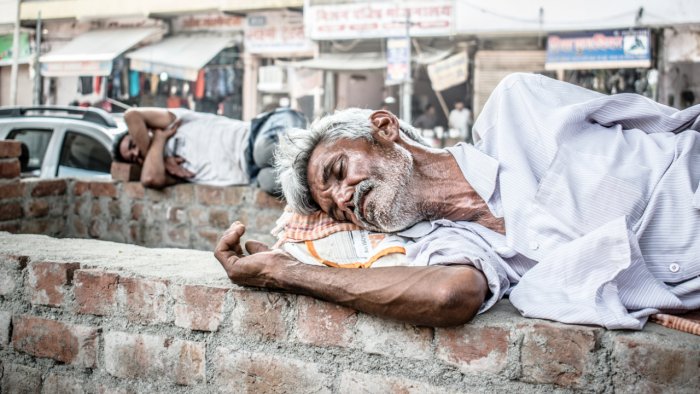
Tens of millions plunge into poverty in Modi-led India

Agencies
May 8, 2021

poverty.jpg

After dipping into his savings to weather India’s snap pandemic lockdown last March, Manoj Kumar was just getting his head above water again earning 600 rupees ($8) a day as a construction worker in the tourist hotspot of Goa. He’d squirreled away enough for a trip last month to his native village in Bihar some 1,490 miles away for a wedding. He’s still there, stuck in one of the nation’s least developed states, as a fierce second Covid-19 wave triggers the world’s worst health crisis and prevents his return.

On a lucky day, he’ll land some odd jobs that fetch him as much as 300 rupees. But there aren’t too many of those chores left. So he’s taking loans to feed and clothe his wife and three kids.

“It is all in God’s hands now,” said Kumar, who’s told his wife to curtail spending on items such as lentils, cooking oil and clothes. “I don’t know when I will return. My family is worried and doesn’t want me to go back as the cases are also rising in Goa.”

Kumar, 40, is one of the millions of migrant workers who form part of India’s vast unreported informal sector, which accounts for half of its $2.9 trillion, domestic demand-driven economy.

A protracted Covid-19 wave is shrinking incomes and wiping out savings of people like Kumar, posing the risk of a double whammy for Asia’s third-largest economy that’s still struggling to recover from last year’s pandemic-induced recession.

The government estimates India’s gross domestic product shrank 8% in the year ended March, its biggest contraction since 1952.

Many economists are cutting their forecasts for the current fiscal year as rising unemployment and dwindling savings dim the chances of a double-digit growth. Shaun Roache, chief economist for Asia Pacific at S&P Global Ratings, slashed his prediction to 9.8% from 11% earlier.

Fitch Solutions sees the economy expanding by 9.5%, a projection that’s below the Bloomberg consensus of around 11%. “A drawn-out Covid-19 outbreak will impede India’s economic recovery,” Singapore-based Roache said.

 “The country already faces a permanent loss of output versus its pre-pandemic path, suggesting a long-term production deficit equivalent to about 10% of GDP.”

With the latest surge caused by a new coronavirus strain, total infections in India have risen to 21.5 million, a third of which were added just in the past three weeks alone.

Experts have warned the crisis has the potential to worsen in the coming weeks, with one model predicting as many as 1,018,879 deaths by the end of July, quadrupling from the current official count of 234,083.

Harsh and Sudden

As new travel restrictions are put in place in some of the nation’s biggest economic centers to contain the outbreak, India’s poor are likely to bear the brunt again, just as they did in 2020.

They have yet to recover from the lockdown ordered by Prime Minister Narendra Modi in late March last year. The harsh and sudden measure sparked an exodus of migrant workers from cities such as Mumbai and New Delhi, as they trekked hundreds of miles to reach home.

People like Kumar typically work without contracts and often for a pittance. The so-called informal economy in India employs approximately 411 million workers, according to calculations by Jeemol Unni, a professor of economics at Ahmedabad University, who relied on surveys by the government’s National Statistical Office to arrive at the number.

While the low-paying farm sector employs the bulk of them, construction comes second with about 56 million.

Unprotected by unions and politicians, these laborers often miss out on handouts from governments. After meeting daily expenses, they are left with little to pay for health care and medicines -- a risky situation especially when a pathogen is taking lives and sending thousands to intensive care at overcrowded hospitals running short of beds.

Dip in Savings

Economists warn depleting household savings and falling incomes will have an impact on domestic consumption, which accounts for almost 60% of GDP. A study by Nikhil Gupta, an economist at Mumbai-based brokerage Motilal Oswal Financial Services Ltd., found that India’s household savings dropped to 22.1% of GDP in the quarter through December, from 28.1% in the three months ended June last year. Full-year numbers show India’s savings growth lagged behind the likes of the US, the UK and Japan, he said.

“A slower rise in household savings, coupled with similar or slower decline in consumption, confirms weak income growth in India,” Gupta said. “If so, the contribution of pent-up demand in growth recovery would also be limited in India compared with other nations.”

Data showed April jobless rate increased to nearly 8% from 6.5% in March, with more than seven million exiting the workforce last month, according to data from Center for Monitoring Indian Economy Pvt., a private research firm.
 
As a result of all the turmoil that started last year, income inequality is deepening in India. A study by Pew Research Center has shown an estimated 75 million people slipped into poverty since the pandemic began. The second wave is set to crush some more. For the study, Pew considered daily incomes of 150 rupees or less as poor, 151 to 750 rupees as low income and 3,750 rupees and above as high income.

A study by the Azim Premji University in Bangalore showed even more alarming numbers. About 230 million individuals slid below the national daily minimum wage threshold of 375 rupees during the pandemic, it said.

Though India could still emerge as one of the fastest growing economies in the world, it will also be one of the most unequal countries, Oxfam, a non-profit organization said.

Duvvuri Subbarao, a former governor of India’s central bank, said the strife faced by the informal-economy workers could hurt India’s long-term growth prospects. “Inequalities have intensified because the formal sector has nearly normalized while the informal sector remains distressed,” he said.

Slower growth would be bad news for workers like A.K. Singh, who was a cook for a monthly salary of about 20,000 rupees in a restaurant in Mumbai. He fled recently to his home town of Gorakhpur in northern India to start a tire business, for which he’s waiting for a loan.

“I used some of my savings and money I received from my last salary,” he said. “But there’s a lockdown here too for the past week. My shop was hardly open for two days during the week. What will we earn out of that?

 

Comments

MOHAMED S SULTAN
 - 
Saturday, 8 May 2021

Keep this actor away from administration.

At least please remember not to allow him or any one like him to sit on the responsible seat.
There is another dangerous guy is so called Yogi.

Identify those guys to blacklist from cheating you again

Add new comment

  • Coastaldigest.com reserves the right to delete or block any comments.
  • Coastaldigset.com is not responsible for its readers’ comments.
  • Comments that are abusive, incendiary or irrelevant are strictly prohibited.
  • Please use a genuine email ID and provide your name to avoid reject.
News Network
November 30,2025

girlnomore.jpg

Mangaluru, Nov 30: A 22-year-old college student succumbed to her injuries at a private hospital in Mangaluru today, days after she was hit by a goods tempo while crossing a road in Padubidri.

The deceased has been identified as Preksha, a resident of Nadsalu Billitota in Padubidri. The fatal incident occurred as Preksha, who was returning home after completing her examination, attempted to cross the service road towards Mangaluru. She was struck by a goods tempo approaching from the Udupi side, causing her to fall and sustain a severe head injury.

Prompt action from local residents ensured she received immediate first aid before being rushed to a hospital in Mangaluru for specialised treatment. Despite medical efforts, she passed away while undergoing care.

Preksha was a student at Karavali College, Vamanjoor on the outskirts of Mangaluru city. The tragedy is compounded by the fact that she belonged to a financially vulnerable family, having previously lost her father. She is survived by her mother and brother.

A case related to the accident has been registered at the Padubidri police station, and an investigation is underway to determine the exact circumstances that led to the collision. The incident highlights the growing concerns over road safety, particularly on busy service roads, and serves as a tragic reminder of the human cost of traffic accidents.

Comments

Add new comment

  • Coastaldigest.com reserves the right to delete or block any comments.
  • Coastaldigset.com is not responsible for its readers’ comments.
  • Comments that are abusive, incendiary or irrelevant are strictly prohibited.
  • Please use a genuine email ID and provide your name to avoid reject.
News Network
December 5,2025

indigoCEO.jpg

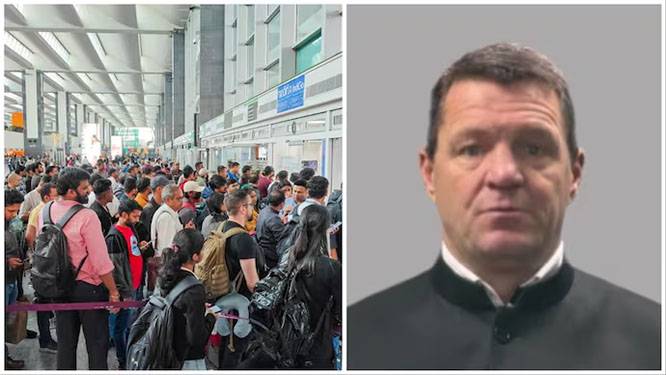
New Delhi, Dec 5: IndiGo CEO Pieter Elbers issued a public apology this evening after more than a thousand flights were cancelled today, making it the "most severely impacted day" in terms of cancellations. The biggest airline of the country cancelled "more than half" of its daily number of flights on Friday, said Elbers. He also said that even though the crisis will persist on Saturday, the airline anticipates fewer than 1,000 flight cancellations.

"Full normalisation is expected between December 10 and 15, though IndiGo cautions that recovery will take time due to the scale of operations," the IndiGo CEO said. 

IndiGo operates around 2,300 domestic and international flights daily.

Pieter Elbers, while apologising for the major inconvenience due to delays and cancellations, said the situation is a result of various causes.

The crisis at IndiGo stems from new regulations that boost pilots' weekly rest requirements by 12 hours to 48 and allow only two night-time landings per week, down from six. IndiGo has attributed the mass cancellations to "misjudgment and planning gaps".

Elbers also listed three lines of action that the airline will adopt to address the issue.

"Firstly, customer communication and addressing your needs, for this, messages have been sent on social media. And just now, a more detailed communication with information, refunds, cancellations and other customer support measures was sent," he said.

The airline has also stepped up its call centre capacity.

"Secondly, due to yesterday's situation, we had customers stranded mostly at the nation's largest airports. Our focus was for all of them to be able to travel today itself, which will be achieved. For this, we also ask customers whose flights are cancelled not to come to the airports as notifications are sent," the CEO said.

"Thirdly, cancellations were made for today to align our crew and planes to be where they need to start tomorrow morning afresh. Earlier measures of the last few days, regrettable, have proven not to be enough, but we have decided today to reboot all our systems and schedules, resulting in the highest numbers of cancellations so far, but imperative for progressive improvements starting from tomorrow," he added.

As airports witnessed chaotic scenes, the Directorate General of Civil Aviation (DGCA) stepped in to grant IndiGo a temporary exemption from stricter night duty rules for pilots. It also allowed substitution of leaves with a weekly rest period. 

Civil Aviation Minister Ram Mohan Naidu has said a high-level inquiry will be ordered and accountability will be fixed.

Comments

Add new comment

  • Coastaldigest.com reserves the right to delete or block any comments.
  • Coastaldigset.com is not responsible for its readers’ comments.
  • Comments that are abusive, incendiary or irrelevant are strictly prohibited.
  • Please use a genuine email ID and provide your name to avoid reject.
News Network
December 6,2025

pilot.jpg

New Delhi: IndiGo, India’s largest airline, faced major operational turbulence this week after failing to prepare for new pilot-fatigue regulations issued by the Directorate General of Civil Aviation (DGCA). The stricter rules—designed to improve flight safety—took effect in phases through 2024, with the latest implementation on November 1. IndiGo has acknowledged that inadequate roster planning led to widespread cancellations and delays.

Below are the key DGCA rules that affected IndiGo’s operations:

1. Longer Mandatory Weekly Rest

Weekly rest for pilots has been increased from 36 hours to 48 hours.

The government says the extended break is essential to curb cumulative fatigue. This rule remains in force despite the current crisis.

2. Cap on Night Landings

Pilots can now perform only two night landings per week—a steep reduction from the earlier limit of six.

Night hours, defined as midnight to early morning, are considered the least alert period for pilots.

Given the disruptions, this rule has been temporarily relaxed for IndiGo until February 10.

3. Reduced Maximum Night Flight Duty

Flight duty that stretches into the night is now capped at 10 hours.

This measure has also been kept on hold for IndiGo until February 10 to stabilize operations.

4. Weekly Rest Cannot Be Replaced With Personal Leave

Airlines can no longer count a pilot’s personal leave as part of the mandatory 48-hour rest.

Pilots say this closes a loophole that previously reduced actual rest time.

Currently, all airlines are exempt from this rule to normalise travel.

5. Mandatory Fatigue Monitoring

Airlines must submit quarterly fatigue reports along with corrective actions to DGCA.

This system aims to create a transparent fatigue-tracking framework across the industry.

The DGCA has stressed that these rules were crafted to strengthen flight safety and align India with global fatigue-management standards. The temporary relaxations are expected to remain until February 2025, giving IndiGo time to stabilise its schedules and restore normal air travel.

Comments

Add new comment

  • Coastaldigest.com reserves the right to delete or block any comments.
  • Coastaldigset.com is not responsible for its readers’ comments.
  • Comments that are abusive, incendiary or irrelevant are strictly prohibited.
  • Please use a genuine email ID and provide your name to avoid reject.