Donald Trump pledges Mideast peace plan within months

Agencies
September 27, 2018

United Nations, Sep 27: President Donald Trump vowed Wednesday to present a "very fair" Middle East peace plan by the end of the year and endorsed a two-state solution, apparently confident that the Palestinians would return to talks despite his unwavering support for Israel.

Holding talks with Israeli Prime Minister Benjamin Netanyahu in New York, Trump said it was a "dream" of his to bring about a peaceful solution to a conflict that has eluded several of his predecessors.

While Trump said he expected Israel to make concessions in any final settlement of the decades-old conflict, the Palestinians said his administration's policies in the Middle East were destroying hopes of peace.

Jared Kushner, who is Trump's son-in-law as well as a senior advisor in the White House, has been working on a peace plan for more than a year, but there have been few clues to date on what he is expected to propose.

"I would say over the next two to three to four months," Trump said, referring to his prospective timetable for presenting a plan.

Trump, who met with Netanyahu on the sidelines of the UN General Assembly, said explicitly for the first time that he backed a two-state solution, saying: "That's what I think works best, that's my feeling." "I really believe something will happen. It is a dream of mine to be able to get that done prior to the end of my first term," added Trump, who was elected to serve four years through January 2021.

"Jared, who's so involved, he loves Israel but he's also going to be very fair with the Palestinians," the US president later told a news conference.

"I think probably two-state is more likely but if they do a single, if they do a double, I'm okay with it if they're both happy. If they're both happy, I'm okay with either. I think the two-state is more likely," he said.

Middle East peace efforts effectively stalled when the Palestinians broke off contacts with the Trump administration last year in protest at Trump's landmark decision to recognize Jerusalem as the capital of Israel.

Palestinian foreign affairs minister Riyad al-Maliki was unimpressed with Trump's remarks, saying the US president chose his tone because he was appearing with Netanyahu.

Maliki -- speaking after meeting in New York with representatives from 40 countries but not Kushner or other US officials -- said Trump needed to state clearly that a two-state solution would include a return to borders from before the 1967 Six-Day War and that east Jerusalem is occupied rather than part of Israel.

"These are important statements that President Trump has to say in order just to convince anyone that he is committed to real peace in our region," Maliki told reporters.

Maliki said that the Palestinians met more than 40 times with Trump's envoys only "to discover that they have opted to open that war against the Palestinians to inflict the most damage." 

Relations between the Palestinian Authority and the United States plummeted even lower in recent weeks after Washington cut off all funding to a UN agency that helps millions of Palestinian refugees, triggering a budget panic.

Trump said, however, that he was in no doubt that the Palestinians would soon return to the negotiating table. "Absolutely, 100 percent," he said.

"Lots of good things are happening," said Trump, before adding: "Israel will have to do something that will be good for the other side." 

Israeli media quoted Netanyahu as saying that Israel must retain security control in any peace deal with the Palestinians west of Jordan to the Mediterranean -- which includes the occupied West Bank.

"Israel will not relinquish security control west of Jordan. This will not happen so long as I am prime minister and I think the Americans understand that," he reportedly said.

Several of Trump's predecessors have played leading roles in trying to bring an end to the conflict, including Jimmy Carter, who brokered the 1978 Camp David agreement, which saw Egypt formally recognize Israel.

Bill Clinton oversaw the Oslo peace accords in 1993 which spelled out the aim of a two-state solution and allowed for the creation of the Palestinian Authority which is meant to rule over the West Bank and Gaza Strip.

But it left issues such as the borders and status of Jerusalem unresolved.

Egypt and Jordan are still the only Arab nations that formally recognize Israel.

Comments

Add new comment

  • Coastaldigest.com reserves the right to delete or block any comments.
  • Coastaldigset.com is not responsible for its readers’ comments.
  • Comments that are abusive, incendiary or irrelevant are strictly prohibited.
  • Please use a genuine email ID and provide your name to avoid reject.
News Network
November 22,2025

gaza.jpg

The Israeli regime’s forces have killed two Palestinian children in the Gaza Strip every day since the ceasefire began in early October, UNICEF has warned.

The UN children’s agency said on Friday that Israeli forces continue to attack Palestinians in Gaza even though the agreement was meant to stop the killing.

“Since 11 October, while the ceasefire has been in effect, at least 67 children have been killed in conflict-related incidents in the Gaza Strip. Dozens more have been injured. That is an average of almost two children killed every day since the ceasefire took effect,” UNICEF spokesperson Ricardo Pires said in Geneva, reminding that each number in the statistics represents a child whose life had ended violently.

“These are not statistics,” he said. “Each child had a story, a family, and a future that was stolen from them.”

Data from Palestinian factions, human rights groups, and government bodies recorded since the US-brokered ceasefire deal went into effect on October 10 show that Israeli forces have carried out numerous attacks, each constituting a separate ceasefire violation.

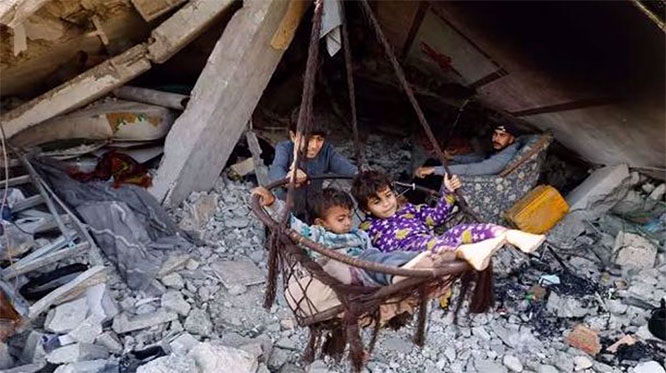
UNICEF teams say they repeatedly continue to witness heart-wrenching scenes of fearful Palestinian children sleeping outdoors with amputated limbs, while others live as orphans in flooded, makeshift shelters.

“I saw this myself in August. There is no safe place for them. The world cannot normalize their suffering,” Pires said, lamenting that the UN could “do a lot more if the aid that is really needed was entering faster.”

The UNICEF spokesperson warned that with the advent of winter, the risks for hundreds of thousands of displaced children will increase.

He warned, “The stakes are incredibly high” for children as winter acts as a threat multiplier, where children have no heating, no insulation, and few blankets. He said respiratory infections rise.

“Too many children have already paid the highest price,” Pires said. “Too many are still paying it, even under a ceasefire. The world promised them it would stop and that we would protect them.”

“Now we must act like it,” the UNICEF spokesperson added.

Since the Israeli regime launched its genocidal war against Palestinians in Gaza in October 2023, it has killed nearly 70,000 people in the territory, most of them women and children, and injured over 170,000 more, while reducing most of the structures in the enclave to rubble.

Comments

Add new comment

  • Coastaldigest.com reserves the right to delete or block any comments.
  • Coastaldigset.com is not responsible for its readers’ comments.
  • Comments that are abusive, incendiary or irrelevant are strictly prohibited.
  • Please use a genuine email ID and provide your name to avoid reject.
News Network
November 22,2025

gaza.jpg

The Israeli regime’s forces have killed two Palestinian children in the Gaza Strip every day since the ceasefire began in early October, UNICEF has warned.

The UN children’s agency said on Friday that Israeli forces continue to attack Palestinians in Gaza even though the agreement was meant to stop the killing.

“Since 11 October, while the ceasefire has been in effect, at least 67 children have been killed in conflict-related incidents in the Gaza Strip. Dozens more have been injured. That is an average of almost two children killed every day since the ceasefire took effect,” UNICEF spokesperson Ricardo Pires said in Geneva, reminding that each number in the statistics represents a child whose life had ended violently.

“These are not statistics,” he said. “Each child had a story, a family, and a future that was stolen from them.”

Data from Palestinian factions, human rights groups, and government bodies recorded since the US-brokered ceasefire deal went into effect on October 10 show that Israeli forces have carried out numerous attacks, each constituting a separate ceasefire violation.

UNICEF teams say they repeatedly continue to witness heart-wrenching scenes of fearful Palestinian children sleeping outdoors with amputated limbs, while others live as orphans in flooded, makeshift shelters.

“I saw this myself in August. There is no safe place for them. The world cannot normalize their suffering,” Pires said, lamenting that the UN could “do a lot more if the aid that is really needed was entering faster.”

The UNICEF spokesperson warned that with the advent of winter, the risks for hundreds of thousands of displaced children will increase.

He warned, “The stakes are incredibly high” for children as winter acts as a threat multiplier, where children have no heating, no insulation, and few blankets. He said respiratory infections rise.

“Too many children have already paid the highest price,” Pires said. “Too many are still paying it, even under a ceasefire. The world promised them it would stop and that we would protect them.”

“Now we must act like it,” the UNICEF spokesperson added.

Since the Israeli regime launched its genocidal war against Palestinians in Gaza in October 2023, it has killed nearly 70,000 people in the territory, most of them women and children, and injured over 170,000 more, while reducing most of the structures in the enclave to rubble.

Comments

Add new comment

  • Coastaldigest.com reserves the right to delete or block any comments.
  • Coastaldigset.com is not responsible for its readers’ comments.
  • Comments that are abusive, incendiary or irrelevant are strictly prohibited.
  • Please use a genuine email ID and provide your name to avoid reject.
News Network
December 6,2025

pilot.jpg

New Delhi: IndiGo, India’s largest airline, faced major operational turbulence this week after failing to prepare for new pilot-fatigue regulations issued by the Directorate General of Civil Aviation (DGCA). The stricter rules—designed to improve flight safety—took effect in phases through 2024, with the latest implementation on November 1. IndiGo has acknowledged that inadequate roster planning led to widespread cancellations and delays.

Below are the key DGCA rules that affected IndiGo’s operations:

1. Longer Mandatory Weekly Rest

Weekly rest for pilots has been increased from 36 hours to 48 hours.

The government says the extended break is essential to curb cumulative fatigue. This rule remains in force despite the current crisis.

2. Cap on Night Landings

Pilots can now perform only two night landings per week—a steep reduction from the earlier limit of six.

Night hours, defined as midnight to early morning, are considered the least alert period for pilots.

Given the disruptions, this rule has been temporarily relaxed for IndiGo until February 10.

3. Reduced Maximum Night Flight Duty

Flight duty that stretches into the night is now capped at 10 hours.

This measure has also been kept on hold for IndiGo until February 10 to stabilize operations.

4. Weekly Rest Cannot Be Replaced With Personal Leave

Airlines can no longer count a pilot’s personal leave as part of the mandatory 48-hour rest.

Pilots say this closes a loophole that previously reduced actual rest time.

Currently, all airlines are exempt from this rule to normalise travel.

5. Mandatory Fatigue Monitoring

Airlines must submit quarterly fatigue reports along with corrective actions to DGCA.

This system aims to create a transparent fatigue-tracking framework across the industry.

The DGCA has stressed that these rules were crafted to strengthen flight safety and align India with global fatigue-management standards. The temporary relaxations are expected to remain until February 2025, giving IndiGo time to stabilise its schedules and restore normal air travel.

Comments

Add new comment

  • Coastaldigest.com reserves the right to delete or block any comments.
  • Coastaldigset.com is not responsible for its readers’ comments.
  • Comments that are abusive, incendiary or irrelevant are strictly prohibited.
  • Please use a genuine email ID and provide your name to avoid reject.