India to boost spending in Budget to beat covid-19 woes

Agencies
January 30, 2021

New Delhi, Jan 30: India will unveil its closely watched budget on Monday, expected to get it back on track as the world’s fastest-growing major economy by boosting spending on job-creation and rural development while battling back the coronavirus.

Finance Minister Nirmala Sitharaman will likely make a generous allocation for development, put more money in the hands of the average taxpayer to boost consumption and ease rules to attract foreign investments when she presents the budget at 11 am in New Delhi.

“Expectations are high, going into this budget,” said Samiran Chakraborty, an economist with Citigroup Inc. “Expenditure profile could move from survival to revival as the focus on infrastructure increases.”

That spending may continue to keep the fiscal deficit far wider than the 3% of gross domestic product mandated by law. The budget gap for the year to March will probably be 7.25% of GDP, according to a Bloomberg survey. The same poll shows the target for the next fiscal year will likely be 5.5%.

Missing deficit goals will be the least of the worries for Prime Minister Narendra Modi’s government. It has to contend with creating jobs for the millions who lost their livelihoods to lockdowns to combat the world’s second-largest coronavirus outbreak, quelling protests by farmers against agriculture reforms and reviving growth in an economy headed for its biggest annual contraction on record.

India’s GDP will shrink 7.7% in the year ending March, according to the statistics ministry. The government estimates GDP will likely expand 11% next fiscal year, a forecast that will make the South Asian nation the world’s fastest-growing major economy ahead of China’s estimated 8.1% pace.

To help achieve this goal, Sitharaman said her budget would be unlike anything seen so far.

A pickup in tax collections in recent months will offer some respite for Sitharaman, who will also seek to raise record amounts by selling state assets in the new financial year starting April after the pandemic all but ruined disinvestment plans in the current year. Her efforts will also get a boost from the annual dividend paid to the government by the central bank, which is expected to also complement fiscal steps with more monetary stimulus when it meets later next week.

Opinion is divided about new tax measures in the budget, with some calling for a tax on the rich to fund pandemic-related expenditure and others opposing any such move.

“A 4% tax on the nation’s 954 richest families could raise the equivalent of 1% of India’s GDP,” Oxfam said in a report released Monday. Economists including Nomura Holdings Inc.’s Sonal Varma think a Covid levy is a bad idea given that the economy is still normalizing after a strict and vast lockdown.

Still, improved tax collections and income from privatization should help the finance minister pare borrowings next fiscal year.

She may announce a gross borrowing plan of 10.6 trillion rupees ($145 billion) for the 12 months starting April, according to a median forecast of 15 analysts surveyed by Bloomberg News. That’s less than the record 13.1 trillion rupees estimated for the current year.

Key Themes

The total spending plan for next fiscal may surpass last year’s 30.4 trillion rupees, with focus likely on expanding a jobs guarantee program to cities and increasing allocation on education, housing, and health as India rolls out a vaccine drive to inoculate 1.3 billion people. Outlay for defense may also see an increase, in a signal to China that India is prepared and capable of dealing with the border standoff.

“Unsurprisingly, many of the key themes in the budget will revolve around Covid-19, either directly on health issues, or regulatory support to sectors most affected” such as hospitality, retail, aviation, said Nomura’s Varma. “Infrastructure, agriculture, the social sector, promotion of domestic manufacturing, alongside incentives to boost construction and housing are likely to be the focus.”

While Modi’s popularity with voters has remained undiminished, there’s an expectation his government may use Monday’s budget to win over protesting farmers. The protesters have been opposing India’s new agriculture laws that they say will hurt incomes and leave them vulnerable to big corporations.

“The government has no choice but to loosen up their purse strings,” said Yamini Aiyar, president and chief executive of Centre for Policy Research in New Delhi. “They will have to be more generous with social security spending like expanding jobs programs to correct rising urban joblessness, health spending, expanded housing and more fiscal support for states and local governments.”


Comments

Add new comment

  • Coastaldigest.com reserves the right to delete or block any comments.
  • Coastaldigset.com is not responsible for its readers’ comments.
  • Comments that are abusive, incendiary or irrelevant are strictly prohibited.
  • Please use a genuine email ID and provide your name to avoid reject.
News Network
December 6,2025

pilot.jpg

New Delhi: IndiGo, India’s largest airline, faced major operational turbulence this week after failing to prepare for new pilot-fatigue regulations issued by the Directorate General of Civil Aviation (DGCA). The stricter rules—designed to improve flight safety—took effect in phases through 2024, with the latest implementation on November 1. IndiGo has acknowledged that inadequate roster planning led to widespread cancellations and delays.

Below are the key DGCA rules that affected IndiGo’s operations:

1. Longer Mandatory Weekly Rest

Weekly rest for pilots has been increased from 36 hours to 48 hours.

The government says the extended break is essential to curb cumulative fatigue. This rule remains in force despite the current crisis.

2. Cap on Night Landings

Pilots can now perform only two night landings per week—a steep reduction from the earlier limit of six.

Night hours, defined as midnight to early morning, are considered the least alert period for pilots.

Given the disruptions, this rule has been temporarily relaxed for IndiGo until February 10.

3. Reduced Maximum Night Flight Duty

Flight duty that stretches into the night is now capped at 10 hours.

This measure has also been kept on hold for IndiGo until February 10 to stabilize operations.

4. Weekly Rest Cannot Be Replaced With Personal Leave

Airlines can no longer count a pilot’s personal leave as part of the mandatory 48-hour rest.

Pilots say this closes a loophole that previously reduced actual rest time.

Currently, all airlines are exempt from this rule to normalise travel.

5. Mandatory Fatigue Monitoring

Airlines must submit quarterly fatigue reports along with corrective actions to DGCA.

This system aims to create a transparent fatigue-tracking framework across the industry.

The DGCA has stressed that these rules were crafted to strengthen flight safety and align India with global fatigue-management standards. The temporary relaxations are expected to remain until February 2025, giving IndiGo time to stabilise its schedules and restore normal air travel.

Comments

Add new comment

  • Coastaldigest.com reserves the right to delete or block any comments.
  • Coastaldigset.com is not responsible for its readers’ comments.
  • Comments that are abusive, incendiary or irrelevant are strictly prohibited.
  • Please use a genuine email ID and provide your name to avoid reject.
News Network
December 2,2025

Puttur: The long-cherished dream of a government medical college in Puttur has moved a decisive step closer to reality, with the Karnataka State Finance Department granting its official approval for the construction of a new 300-bed hospital.

Puttur MLA Ashok Kumar Rai announced the crucial development to reporters on Monday, confirming that the official communication from the finance department was issued on November 27. This 300-bed facility is intended to be the cornerstone for the establishment of the government medical college, a project announced in the state budget.

Fast-Track Implementation

The MLA outlined an aggressive timeline for the project:

•    A Detailed Project Report (DPR) for the hospital is expected to be ready within 45 days.

•    The tender process for the construction will be completed within two months.

Following the completion of the tender process, Chief Minister Siddaramaiah is scheduled to lay the foundation stone for the project.

"Setting up a medical college in Puttur is a historical decision by the Congress government in Karnataka," Rai stated. The project has an estimated budget allocation of Rs 1,000 crore for the medical college.

Focus on Medical Education Department

The MLA highlighted a key strategic move: requesting the government to implement the hospital construction through the Medical Education Department instead of the Health and Family Welfare Department. This is intended to streamline the entire process of establishing the full medical college, ensuring the facilities—including labs, operation theatres, and other necessary infrastructure—adhere to the strict guidelines set by the Medical Council of India (MCI). The proposed site for the project is in Bannur.

Rai also took the opportunity to address political criticism, stating that the government has fulfilled its promise despite "apprehensions" and "mocking and criticising" from opposition parties who had failed to take similar initiatives when they were in power. "Chief Minister Siddaramaiah has kept his word," he added.

Comments

Add new comment

  • Coastaldigest.com reserves the right to delete or block any comments.
  • Coastaldigset.com is not responsible for its readers’ comments.
  • Comments that are abusive, incendiary or irrelevant are strictly prohibited.
  • Please use a genuine email ID and provide your name to avoid reject.
News Network
November 29,2025

DKSsiddu.jpg

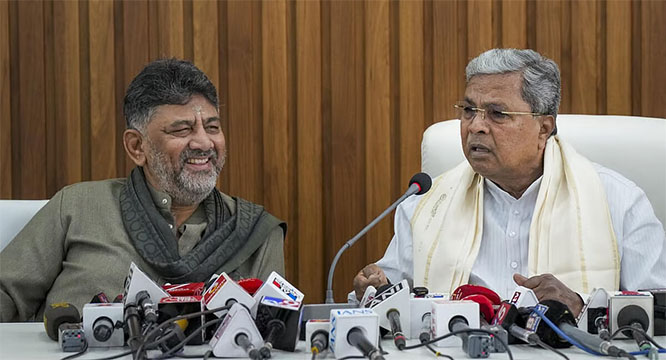
New Delhi: Karnataka chief minister Siddaramaiah and deputy CM DK Shivakumar on Saturday put up a dramatic display of unity at a closely watched joint press briefing, firmly dismissing weeks of speculation about a power-sharing tussle within the Congress. With the high command nudging both leaders to sit together and settle the dust, the meeting became a political spectacle, ending with the duo declaring that there was “no confusion, no differences.”

Calling the reports of a rift “manufactured confusion,” Siddaramaiah said the talks had gone smoothly, even joking about their breakfast. “Breakfast was very good. All three of us enjoyed it,” he said. “We want to end this confusion once and for all. For local elections and for 2028, our mission is clear — Congress must return to power. There is no difference between me and DKS, not now, not before.”

He blamed the media for fuelling rumours and reiterated absolute adherence to the party leadership. “From tomorrow, let there be no confusion. What the high command says, we will follow.”

Siddaramaiah also assured that the Assembly session starting December 8 would run smoothly and vowed that Congress would take on the BJP and JD(S) “together.”

Shivakumar echoed the chief minister word for word, stressing loyalty and discipline. “People have given us a massive mandate. It is our duty to deliver,” he said. “This government was formed under Siddaramaiah’s leadership. We both have complete trust in the high command. If they tell me to wait, I will wait.”

He added that the two leaders had discussed strategy for the 2028 Assembly elections. “Whatever the CM says, I agree. We are loyal soldiers of the party. The party may be facing challenges nationally, but we will keep it strong in Karnataka.”

Shivakumar also said Siddaramaiah would soon visit his home for lunch or dinner — another symbolic gesture meant to underline their unity.

Both leaders later posted on social media describing the breakfast meeting as “productive” and focused on “Karnataka’s priorities.”

The BJP, however, rejected the show of camaraderie as “pure bunkum,” accusing Congress of trying to paper over an internal power struggle. But Siddaramaiah and Shivakumar insisted their united front would continue — and that there was “no confusion” within the state leadership.

Comments

Add new comment

  • Coastaldigest.com reserves the right to delete or block any comments.
  • Coastaldigset.com is not responsible for its readers’ comments.
  • Comments that are abusive, incendiary or irrelevant are strictly prohibited.
  • Please use a genuine email ID and provide your name to avoid reject.