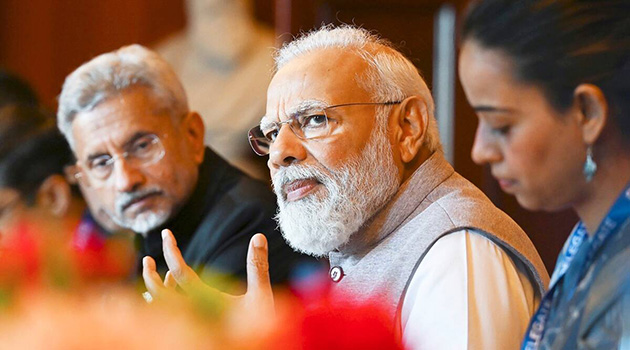
Modi govt slams global ranking firms as India ranks lower than Pak, Afghan in Press Freedom

News Network
May 27, 2023

modiji.jpg

The Bharatiya Janta Party-led government of India plans to push back against the country rankings produced by global agencies on topics like governance and press freedom, a key advisor to Indian Prime Minister Narendra Modi was quoted as saying by news agencies.

Sanjeev Sanyal, a member of Modi's Economic Advisory Council, said India has begun to raise this issue at global forums. He said the indices were being compiled by a "tiny group of think tanks in the North Atlantic," sponsored by three or four funding agencies that are "driving a real-world agenda."

"It is not just narrative building in some diffused way. This has clear direct impact on trade, investment and other activities," Sanyal said.

India ranked lower than Afghanistan and Pakistan in the new World Press Freedom Index released by Reporters Without Borders. It was below Pakistan and Bhutan in an academic freedom index by V-Dem Institute.

Over the past year, Indian government has in various meetings pointed out the flaws in methods used to compile global indices used by institutions like the World Bank, World Economic Forum (WEF) and the United Nations Development Programme (UNDP), Sanyal said.

The "World Bank is involved in this discussion because it takes these opinions from these think tanks and effectively sanctifies it by putting it into something called the world governance index," Sanyal said.

The World Bank, WEF, Reporters Without Borders and V-DEM Institute did not immediately respond to requests for comment. UNDP said it would respond shortly.

Sanyal said the ratings also get hard-wired into decision-making through environmental, social and governance (ESG) norms and sovereign ratings. Multilateral development banks offer subsidised loans to ESG-compliant projects.

"The idea of having some ESG norms is not the problem in itself. The problem relates to how these norms are defined and who certifies or measures compliance to these norms," he said. "As things are currently evolving, developing countries have been completely left out of the conversation."

The matter is being taken up by the Cabinet Secretariat, which has held more than a dozen meetings on the issue this year, a government official said. The Cabinet Secretariat and finance ministry did not immediately respond to requests for comment.

India has said it plans to be an advocate for developing countries under its G20 presidency. Sanyal did not say if India has flagged the issue of country rankings with the G20.

"There are other developing countries who are also concerned about this because effectively this is a form of neo-colonialism," he said, adding that concerned ministries have been asked to establish benchmarks and engage continuously with rating agencies.

Some of the upcoming indices being watched out by India are the financial development index by International Monetary Fund, gender inequality and human development indices by UNDP, logistics performance and worldwide governance indicators by the World Bank, sources said. 

Comments

Add new comment

  • Coastaldigest.com reserves the right to delete or block any comments.
  • Coastaldigset.com is not responsible for its readers’ comments.
  • Comments that are abusive, incendiary or irrelevant are strictly prohibited.
  • Please use a genuine email ID and provide your name to avoid reject.
News Network
December 6,2025

pilot.jpg

New Delhi: IndiGo, India’s largest airline, faced major operational turbulence this week after failing to prepare for new pilot-fatigue regulations issued by the Directorate General of Civil Aviation (DGCA). The stricter rules—designed to improve flight safety—took effect in phases through 2024, with the latest implementation on November 1. IndiGo has acknowledged that inadequate roster planning led to widespread cancellations and delays.

Below are the key DGCA rules that affected IndiGo’s operations:

1. Longer Mandatory Weekly Rest

Weekly rest for pilots has been increased from 36 hours to 48 hours.

The government says the extended break is essential to curb cumulative fatigue. This rule remains in force despite the current crisis.

2. Cap on Night Landings

Pilots can now perform only two night landings per week—a steep reduction from the earlier limit of six.

Night hours, defined as midnight to early morning, are considered the least alert period for pilots.

Given the disruptions, this rule has been temporarily relaxed for IndiGo until February 10.

3. Reduced Maximum Night Flight Duty

Flight duty that stretches into the night is now capped at 10 hours.

This measure has also been kept on hold for IndiGo until February 10 to stabilize operations.

4. Weekly Rest Cannot Be Replaced With Personal Leave

Airlines can no longer count a pilot’s personal leave as part of the mandatory 48-hour rest.

Pilots say this closes a loophole that previously reduced actual rest time.

Currently, all airlines are exempt from this rule to normalise travel.

5. Mandatory Fatigue Monitoring

Airlines must submit quarterly fatigue reports along with corrective actions to DGCA.

This system aims to create a transparent fatigue-tracking framework across the industry.

The DGCA has stressed that these rules were crafted to strengthen flight safety and align India with global fatigue-management standards. The temporary relaxations are expected to remain until February 2025, giving IndiGo time to stabilise its schedules and restore normal air travel.

Comments

Add new comment

  • Coastaldigest.com reserves the right to delete or block any comments.
  • Coastaldigset.com is not responsible for its readers’ comments.
  • Comments that are abusive, incendiary or irrelevant are strictly prohibited.
  • Please use a genuine email ID and provide your name to avoid reject.
News Network
November 30,2025

airportmetro.jpg

Udupi: The pontiffs of Sri Paryaya Puttige Mutt, the sacred seat of Jagadguru Shrimad Madhvacharya Moola Samsthanam, have submitted a proposal to the Prime Minister seeking comprehensive development for Udupi district. 

Proposal for International Airport

A key request is the establishment of an international airport. Highlighting that around 1,000 acres of land are available and suitable, the pontiffs noted that the existing Mangalore Airport provides limited international connectivity. They suggested the airport be developed under a Public-Private Partnership (PPP) or as a Greenfield Airport to boost trade, education, healthcare, and spiritual tourism.

Metro and Rapid Transit Connectivity

The proposal also calls for Metro Rail or Rapid Transit between Mangaluru and Udupi. The 55 km coastal stretch experiences heavy daily commuter traffic, causing congestion. The district administration is ready to prepare an initial project report for a Mass Rapid Transit corridor and requested inclusion under national urban mobility programmes to ensure safe, green, and time-efficient regional transport.

Port and Coastal Development

The pontiffs urged the development of an international-standard port with a cruise terminal along Udupi’s coast. They also requested fast-tracking of pending coastal tourism projects and revising Coastal Regulation Zone (CRZ) norms to encourage sustainable infrastructure and hospitality investment.

IT, AI and Technological Infrastructure

Support was sought for an IT and AI Innovation Park with incubation facilities under Digital India and Startup India initiatives. The proposal also emphasized the need for strengthened data security and cloud computing infrastructure to boost India’s technological independence.

Sports and Education Initiatives

The pontiffs requested national sports status for Kambala, along with financial and infrastructure support. They also sought the establishment of an AIIMS in Udupi, a new IIT campus, and approval for an IIM to promote higher education in the district.

Representation to the Prime Minister

Sri Sugunendra Tirtha Pontiff and Sri Sushrendra Tirtha Swamiji represented the pontiffs in submitting the comprehensive development proposal to the Prime Minister during his recent visit.

Comments

Add new comment

  • Coastaldigest.com reserves the right to delete or block any comments.
  • Coastaldigset.com is not responsible for its readers’ comments.
  • Comments that are abusive, incendiary or irrelevant are strictly prohibited.
  • Please use a genuine email ID and provide your name to avoid reject.
News Network
December 4,2025

indigoflight.jpg

Domestic carrier IndiGo has cancelled over 180 flights from three major airports — Mumbai, Delhi and Bengaluru — on Thursday, December 4, as the airline struggles to secure the required crew to operate its flights in the wake of new flight-duty and rest-period norms for pilots.

While the number of cancellations at Mumbai airport stands at 86 (41 arrivals and 45 departures) for the day, at Bengaluru, 73 flights have been cancelled, including 41 arrivals, according to a PTI report that quoted sources.

"IndiGo cancelled over 180 flights on Thursday at three airports-Mumbai, Delhi and Bengaluru," the source told the news agency.

Besides, it had cancelled as many as 33 flights at Delhi airport for Thursday, the source said, adding, "The number of cancellations is expected to be higher by the end of the day."

The Gurugram-based airline's On-Time Performance (OTP) nosedived to 19.7 per cent at six key airports — Delhi, Mumbai, Chennai, Kolkata, Bengaluru and Hyderabad — on December 3, as it struggled to get the required crew to operate its services, down from almost half of December 2, when it was 35 per cent.

"IndiGo has been facing acute crew shortage since the implementation of the second phase of the FDTL (Flight Duty Time Limitations) norms, leading to cancellations and huge delays in its operations across the airports," a source had told PTI on Wednesday.

Chaos continued at several major airports for the third day on Thursday because of the cancellations.

A spokesperson for the Kempegowda International Airport (KIA) in Bengaluru said that 73 IndiGo flights had been cancelled on Thursday.

At least 150 flights were cancelled and dozens of others delayed on Wednesday, airport sources said, leaving thousands of travellers stranded, according to news agency Reuters.

The Directorate General of Civil Aviation (DGCA) has said it is investigating IndiGo flight disruptions and has asked the airline to submit the reasons for the current situation, as well as its plans to reduce flight cancellations and delays.

It may be mentioned here that the pilots' body, Federation of Indian Pilots (FIP), has alleged that IndiGo, despite getting a two-year preparatory window before the full implementation of new flight duty and rest period norms for cockpit crew, "inexplicably" adopted a "hiring freeze".

The FIP said it has urged the safety regulator, the DGCA, not to approve airlines' seasonal flight schedules unless they have adequate staff to operate their services "safely and reliably" in accordance with the New Flight Duty Time Limitations (FDTL) norms.

In a letter to the DGCA late on Wednesday, the FIP urged the DGCA to consider re-evaluating and reallocating slots to other airlines, which have the capacity to operate them without disruption during the peak holiday and fog season if IndiGo continues to "fail in delivering on its commitments to passengers due to its own avoidable staffing shortages."

Comments

Add new comment

  • Coastaldigest.com reserves the right to delete or block any comments.
  • Coastaldigset.com is not responsible for its readers’ comments.
  • Comments that are abusive, incendiary or irrelevant are strictly prohibited.
  • Please use a genuine email ID and provide your name to avoid reject.