Over 27% students have no access to gadgets for online classes: NCERT

Agencies
August 20, 2020

online-classes.jpg

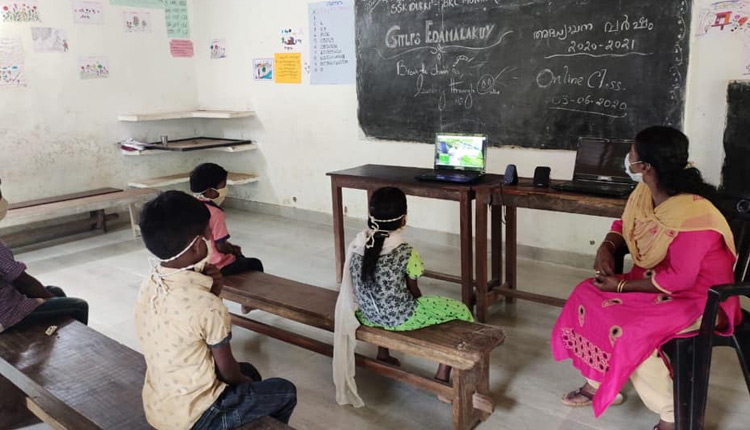
New Delhi, Aug 20: At least 27 per cent students do not have access to smartphones or laptops to attend online classes, while 28 per cent students and parents believe intermittent or lack of electricity is one of the major concerns hindering teaching-learning, according to a survey by the NCERT.

The survey with over 34,000 participants, including students, parents, teachers and school principals from Kendriya Vidyalayas, Navodyaya Vidyalas and CBSE affiliated schools, has pointed out that lack of knowledge of using devices for effective educational purposes and teachers not being well-versed with online teaching methodologies, caused hindrance in the learning process.

"Approximately 27 per cent of the students mentioned the non-availability of smartphones and laptops. The maximum number of stakeholders have opted for mobile phones as a medium for teaching-learning during the Covid-19 period," the survey by the National Council of Educational Research and Training (NCERT) said.

"About 36 per cent of the students used the textbooks and other books available with them. Laptops were the second most favoured option amongst teachers and principals. Television and radio were the least utilized devices for the teaching-learning in the pandemic situation. The absence of enriched interaction between the teacher and the students was one of the reasons as identified by the stakeholders," it added.

The survey noted that almost all of the responsive states use physical (non-digital) mechanisms to track the progress of learners with the majority of them either practising home visit by teachers or systematic parental guidance via phone calls.

"About half of the students stated that they did not have the school textbooks. Although the e-textbooks are available on NCERT website and DIKSHA, the probable reasons behind this feedback are that students are used to studying from the hardcopy of the textbooks, there is lack of awareness regarding the availability of the e-textbook and paucity of devices with students and teachers," it said.

The majority of the stakeholders pointed out that mathematics as a subject was difficult to learn via online medium.

"Since, mathematics contains a number of concepts which require interaction, continuous support, monitoring from the teacher and these aspects were lacking in the online mode of teaching.

"Next to Mathematics, Science was identified as the subject of concern since it contains several concepts and practical experiments which could only be done in the laboratory under the supervision of the teacher. A few stakeholders also found Social Science as a difficult subject to grasp through online classes," the survey said.

It said that around 17 pc of students identified languages as being a difficult subject to learn through online medium.

"Many students and parents felt the need for Physical Education classes through online mode, as physical fitness is the need of the hour to combat this pandemic. Arts education can help to reduce stress and boredom. Around 10 per cent of the stakeholders mentioned art education as a subject of concern," the survey said.

Universities and schools across the country have been closed since March 16, when the Centre announced a countrywide classroom shut down as part of measures to contain the Covid-19 pandemic.

A nationwide lockdown was imposed on March 25. While several restrictions have been eased, schools and colleges continue to be closed.

The prolonged closure of educational institutions has mandated a shift from classroom teaching to online learning.

Based on the NCERT survey findings, the Ministry of Education has formulated Students' Learning Enhancement Guidelines.

"The guidelines will help children, who do not have digital resources to get learning opportunities at their homes, with their teachers or volunteers. Apart from this, it will also help in our efforts to overcome the learning deficiencies of all those students who are learning at home through various alternative ways using radio, television or smartphone," Union Minister of Education, Ramesh Pokhriyal 'Nishank' said.

The minister informed that the guidelines and models are suggested for three types of situations.

"Firstly, in which students do not have any digital resources. Secondly, in which students have limited digital resources available. Lastly, in which students have digital resources available for online education," he said. 

Comments

Add new comment

  • Coastaldigest.com reserves the right to delete or block any comments.
  • Coastaldigset.com is not responsible for its readers’ comments.
  • Comments that are abusive, incendiary or irrelevant are strictly prohibited.
  • Please use a genuine email ID and provide your name to avoid reject.
News Network
December 5,2025

indigoCEO.jpg

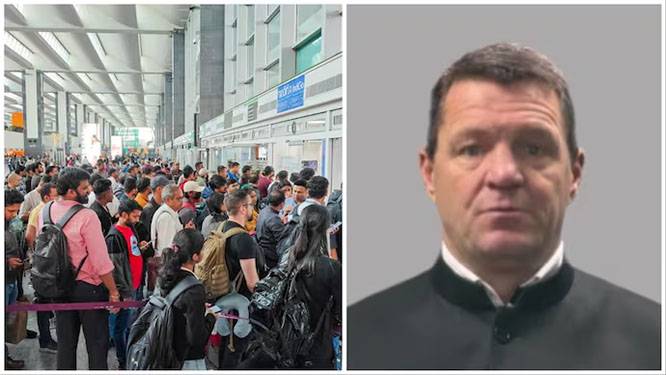
New Delhi, Dec 5: IndiGo CEO Pieter Elbers issued a public apology this evening after more than a thousand flights were cancelled today, making it the "most severely impacted day" in terms of cancellations. The biggest airline of the country cancelled "more than half" of its daily number of flights on Friday, said Elbers. He also said that even though the crisis will persist on Saturday, the airline anticipates fewer than 1,000 flight cancellations.

"Full normalisation is expected between December 10 and 15, though IndiGo cautions that recovery will take time due to the scale of operations," the IndiGo CEO said. 

IndiGo operates around 2,300 domestic and international flights daily.

Pieter Elbers, while apologising for the major inconvenience due to delays and cancellations, said the situation is a result of various causes.

The crisis at IndiGo stems from new regulations that boost pilots' weekly rest requirements by 12 hours to 48 and allow only two night-time landings per week, down from six. IndiGo has attributed the mass cancellations to "misjudgment and planning gaps".

Elbers also listed three lines of action that the airline will adopt to address the issue.

"Firstly, customer communication and addressing your needs, for this, messages have been sent on social media. And just now, a more detailed communication with information, refunds, cancellations and other customer support measures was sent," he said.

The airline has also stepped up its call centre capacity.

"Secondly, due to yesterday's situation, we had customers stranded mostly at the nation's largest airports. Our focus was for all of them to be able to travel today itself, which will be achieved. For this, we also ask customers whose flights are cancelled not to come to the airports as notifications are sent," the CEO said.

"Thirdly, cancellations were made for today to align our crew and planes to be where they need to start tomorrow morning afresh. Earlier measures of the last few days, regrettable, have proven not to be enough, but we have decided today to reboot all our systems and schedules, resulting in the highest numbers of cancellations so far, but imperative for progressive improvements starting from tomorrow," he added.

As airports witnessed chaotic scenes, the Directorate General of Civil Aviation (DGCA) stepped in to grant IndiGo a temporary exemption from stricter night duty rules for pilots. It also allowed substitution of leaves with a weekly rest period. 

Civil Aviation Minister Ram Mohan Naidu has said a high-level inquiry will be ordered and accountability will be fixed.

Comments

Add new comment

  • Coastaldigest.com reserves the right to delete or block any comments.
  • Coastaldigset.com is not responsible for its readers’ comments.
  • Comments that are abusive, incendiary or irrelevant are strictly prohibited.
  • Please use a genuine email ID and provide your name to avoid reject.
News Network
December 2,2025

DKSsiddu.jpg

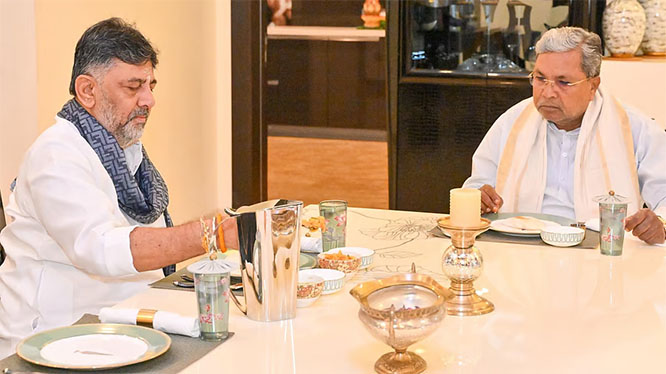
Bengaluru: 'Nati koli saaru' (country chicken curry) considered one of Chief Minister Siddaramaiah’s favourites along with steaming hot idlis was on the breakfast menu at Deputy CM D K Shivakumar’s residence on Tuesday, according to official sources.

The spread also included 'nati koli' fry, vada and pongal, among other items, they said.

In an apparent show of unity, Siddaramaiah visited Shivakumar’s residence for breakfast, just days after the two leaders shared a meal amid a simmering power tussle in the state Congress.

Siddaramaiah drove to the Deputy CM’s residence in Sadashivanagar, where he was received by Shivakumar and his brother D K Suresh, who is a former Congress MP.

Suresh and Kunigal MLA H D Ranganath, a relative of Shivakumar, joined them for breakfast, which featured a mix of vegetarian and non-vegetarian dishes.

Speaking to reporters later, Siddaramaiah said Shivakumar had invited him during his visit to the CM’s residence for breakfast on Saturday.

Asked about the difference between the two meals, the chief minister said, "At his (Shivakumar’s) house it was non-veg, while at my house it was veg. He is a vegetarian, I am a non-vegetarian. I had not prepared non-veg. I told DK to get chicken from the village as you won’t get the original in Bengaluru."

Shivakumar said he had initially invited Siddaramaiah to his residence, but the CM had suggested visiting his place first and reciprocating later. "It was a vegetarian breakfast at the CM’s house on Saturday," he noted.

"Today, I invited him (the CM) to my house. He enjoyed the breakfast, which had his Mysuru taste," Shivakumar added. At this point, Siddaramaiah remarked that Shivakumar’s wife is also from Mysuru.

Saturday’s breakfast at Siddaramaiah’s official residence, held as part of efforts by the Congress high command to ease tensions in the leadership dispute between the two, reportedly included idlis and sambar, according to official sources.

Comments

Add new comment

  • Coastaldigest.com reserves the right to delete or block any comments.
  • Coastaldigset.com is not responsible for its readers’ comments.
  • Comments that are abusive, incendiary or irrelevant are strictly prohibited.
  • Please use a genuine email ID and provide your name to avoid reject.
News Network
December 7,2025

SHRIMP.jpg

Mangaluru, Dec 7: A rare bamboo shrimp has been rediscovered on mainland India more than 70 years after it was last reported, confirming for the first time the presence of Atyopsis spinipes in the country. The find was made by researchers from the Centre for Climate Change Studies at Sathyabama Institute of Science and Technology, Chennai, during surveys in Karnataka and Odisha.

The team — shrimp expert Dr S Prakash, PhD scholar K Kunjulakshmi, and Mangaluru-based researcher Maclean Antony Santos — combined field surveys, ecological assessments and DNA analysis to identify the elusive species. Their findings, published in Zootaxa, resolve decades of taxonomic confusion stemming from a 1951 report that misidentified the species as Atyopsis moluccensis without strong evidence.

The shrimp has now been confirmed at two locations: the Mulki–Pavanje estuary near Mangaluru and the Kuakhai River in Bhubaneswar. Historical specimens from the Andaman Islands, previously labelled as A. moluccensis, were also found to be misidentified and actually belong to A. spinipes.

The rediscovery began after an aquarium hobbyist in Odisha spotted a shrimp in 2022, prompting systematic surveys across Udupi, Karwar and Mangaluru. Four female specimens were collected in Mulki and one in Odisha, all genetically matching.

Researchers warn the species may exist in very small, vulnerable populations as freshwater habitats face increasing pressure from pollution, sand mining and infrastructure development. All verified specimens have been deposited with the Zoological Survey of India for future reference.

Comments

Add new comment

  • Coastaldigest.com reserves the right to delete or block any comments.
  • Coastaldigset.com is not responsible for its readers’ comments.
  • Comments that are abusive, incendiary or irrelevant are strictly prohibited.
  • Please use a genuine email ID and provide your name to avoid reject.