



Second phase of Covid-19 vaccination drive begins

Agencies
March 1, 2021

New Delhi, Mar 1: The second phase of the nationwide Covid-19 vaccination drive for age-appropriate population groups began on Monday with the Union Health Ministry calling out eligible people to get an appointment at respective hospitals in the country.

Prime Minister Narendra Modi was among the first ones to receive the Covid-19 vaccine on Monday as vaccination opened for the general population, beginning with people above 60 and those with co-morbidities above 45.

Citizens will be able to register and book an appointment for vaccination, anytime and anywhere, using the COWIN 2.0 portal or through other IT (information technology) applications such as Arogya Setu, etc.

The Central government released a new framework for Co-WIN2.0 on Sunday.
According to the new framework, the schedule of vaccination of eligible beneficiaries will be closely linked with the availability of vaccine doses. The states and Union Territories will determine the target number of doses to be administered in a vaccination cycle.

"The target number of doses is to be determined considering the available stocks and the requirement of further vaccine stocks for the second dose since, when a beneficiary is being vaccinated with the first dose, Co-WIN will automatically confirm the appointment of the beneficiary for the second dose at the same vaccination centre," the government said.

To avoid confusion and problems in physical queue management at COVID-19 Vaccination Centre (CVC), the central government has recommended that one particular CVC may be either fully reserved or their full capacity is opened for online self-appointment.
On the other hand, if a CVC has both reserved and open slots, session timings for open slots must be carefully selected to avoid overlap of beneficiaries.

On Saturday, the government informed that from March 1, the nationwide vaccination program is now to be exponentially expanded to all citizens above 60 years of age, and those within the age bracket of 45 to 59 years with specified co-morbidities.

"Health Departments of State governments have already initiated dialogue with these private hospitals so that they can be encouraged to participate in this drive as CVCs. A list of all these private hospitals has been uploaded on the website of the Ministry of Health and Family Welfare and the National Health Authority," the government said in a release.

In addition, there would be government health facilities that will be used as CVCs such as medical college hospitals, district hospitals, sub-divisional hospitals, CHCs, PHCs, Health Sub Centres and Health and Wellness Centres. Geo reference maps with GPS coordinates of all these health facilities have been prepared that will serve as CVCs and these Geo referenced maps are being shared with the states, the release said.

The Central government also said that states were informed about the three methods of registration, i.e., advance self-registration, onsite registration and facilitated cohort registration.

States have been informed that private hospitals functioning as CVCs can charge subject to a ceiling of Rs 250 per person per dose along with the electronic and financial management mechanism in this regard. User names and passwords to be provided to the private facilities to facilitate effective use of Co-WIN 2.0, were also discussed during the meeting.

In addition, mapping of private facilities with the nearest cold chain points to ensure a seamless flow of vaccines to them was explained to the states.

The simplified system of certifying people with 20 co-morbidities within the 45-59 years age group was also explained to the states. The simplified one-page certificate is to be signed by any registered medical practitioner. The certificate can either be uploaded on Co-WIN2.0 by the beneficiary while self-registering or a hard copy can be carried by the beneficiary to the CVC.

The countrywide vaccination drive was rolled out on January 16, 2021. The vaccination of the frontline workers started on February 2.

Comments

Add new comment

  • Coastaldigest.com reserves the right to delete or block any comments.
  • Coastaldigset.com is not responsible for its readers’ comments.
  • Comments that are abusive, incendiary or irrelevant are strictly prohibited.
  • Please use a genuine email ID and provide your name to avoid reject.
News Network
December 4,2025

Mangaluru: Chaos erupted at Mangaluru International Airport (MIA) after IndiGo flight 6E 5150, bound for Mumbai, was repeatedly delayed and ultimately cancelled, leaving around 100 passengers stranded overnight. The incident highlights the ongoing country-wide operational disruptions affecting the airline, largely due to the implementation of new Flight Duty Time Limitations (FDTL) norms for crew.

The flight was initially scheduled for 9:25 PM on Tuesday but was first postponed to 11:40 PM, then midnight, before being cancelled around 3:00 AM. Passengers expressed frustration over last-minute communication and the lack of clarity, with elderly and ailing travellers particularly affected. “Though the airline arranged food, there was no proper communication, leaving us confused,” said one family member.

An IndiGo executive at MIA cited the FDTL rules, designed to prevent pilot fatigue by limiting crew working hours, as the cause of the cancellation. While alternative arrangements, including hotel stays, were offered, about 100 passengers chose to remain at the airport, creating tension. A replacement flight was arranged but also faced delays due to the same constraints, finally departing for Mumbai around 1:45 PM on Wednesday. Passengers either flew, requested refunds, or postponed their travel.

The Mangaluru delay is part of a broader crisis for IndiGo. The airline has been forced to make “calibrated schedule adjustments”—a euphemism for widespread cancellations and delays—after stricter FDTL norms came into effect on November 1.

While an IndiGo spokesperson acknowledged unavoidable flight disruptions due to technology issues, operational requirements, and the updated crew rostering rules, the DGCA has intervened, summoning senior airline officials to explain the chaos and outline corrective measures.

The ripple effect has been felt across the country, with major hubs like Bengaluru and Mumbai reporting numerous cancellations. The Mangaluru incident underscores the systemic operational strain currently confronting India’s largest carrier, leaving passengers nationwide grappling with uncertainty and delays.

Comments

Add new comment

  • Coastaldigest.com reserves the right to delete or block any comments.
  • Coastaldigset.com is not responsible for its readers’ comments.
  • Comments that are abusive, incendiary or irrelevant are strictly prohibited.
  • Please use a genuine email ID and provide your name to avoid reject.
News Network
December 6,2025

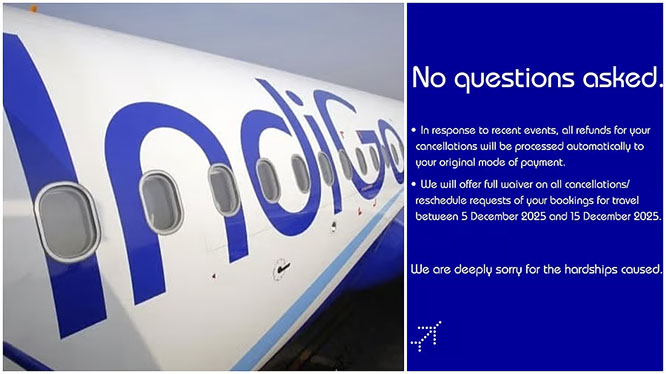
indigoticket.jpg

With IndiGo flight disruptions impacting thousands of passengers, the airline on Saturday said that it will offer full waiver on all cancellations/reschedule requests for travel bookings between December 5, 2025 and December 15, 2025.

Earlier in the day, the civil aviation ministry had directed the airline to complete the ticket refund process for the cancelled flights by Sunday evening, as well as ensure baggage separated from the travellers are delivered in the next two days.

In a post on X, titled 'No questions asked', IndiGo wrote, "In response to recent events, all refunds for your cancellations will be processed automatically to your original mode of payment."

"We are deeply sorry for the hardships caused," it further added.

Several passengers, however, complained of not getting full refund as promised by the airline.

Netizens have shared screenchots of getting charged for airline cancellation fee and convenience fee.

"Please tell me why u have did this airline cancellation charges when u say full amount will be refunded (sic)," a user wrote sharing a screenshot of the refund page.

"Well, but you have still debited the convenience charges," wrote another.

Passengers have also raised concerns about the "cancel" option being disabled on the IndiGo app. "First enable the 'Cancel' button on your App & offer full refund on tickets cancelled by customers between the said dates," wrote a user.

A day after the country's largest airline, IndiGo, cancelled more than 1,000 flights and caused disruptions for the fifth day on Saturday, the ministry said that any delay or non-compliance in refund processing will invite immediate regulatory action.

The refund process for all cancelled or disrupted flights must be completed by 8 pm on Sunday, the ministry said in a statement.

"Airlines have also been instructed not to levy any rescheduling charges for passengers whose travel plans were affected by cancellations," it said.

On Saturday, more than 400 flights were cancelled at various airports.

IndiGo has also been instructed to set up dedicated passenger support and refund facilitation cells.

Comments

Add new comment

  • Coastaldigest.com reserves the right to delete or block any comments.
  • Coastaldigset.com is not responsible for its readers’ comments.
  • Comments that are abusive, incendiary or irrelevant are strictly prohibited.
  • Please use a genuine email ID and provide your name to avoid reject.
News Network
December 6,2025

pilot.jpg

New Delhi: IndiGo, India’s largest airline, faced major operational turbulence this week after failing to prepare for new pilot-fatigue regulations issued by the Directorate General of Civil Aviation (DGCA). The stricter rules—designed to improve flight safety—took effect in phases through 2024, with the latest implementation on November 1. IndiGo has acknowledged that inadequate roster planning led to widespread cancellations and delays.

Below are the key DGCA rules that affected IndiGo’s operations:

1. Longer Mandatory Weekly Rest

Weekly rest for pilots has been increased from 36 hours to 48 hours.

The government says the extended break is essential to curb cumulative fatigue. This rule remains in force despite the current crisis.

2. Cap on Night Landings

Pilots can now perform only two night landings per week—a steep reduction from the earlier limit of six.

Night hours, defined as midnight to early morning, are considered the least alert period for pilots.

Given the disruptions, this rule has been temporarily relaxed for IndiGo until February 10.

3. Reduced Maximum Night Flight Duty

Flight duty that stretches into the night is now capped at 10 hours.

This measure has also been kept on hold for IndiGo until February 10 to stabilize operations.

4. Weekly Rest Cannot Be Replaced With Personal Leave

Airlines can no longer count a pilot’s personal leave as part of the mandatory 48-hour rest.

Pilots say this closes a loophole that previously reduced actual rest time.

Currently, all airlines are exempt from this rule to normalise travel.

5. Mandatory Fatigue Monitoring

Airlines must submit quarterly fatigue reports along with corrective actions to DGCA.

This system aims to create a transparent fatigue-tracking framework across the industry.

The DGCA has stressed that these rules were crafted to strengthen flight safety and align India with global fatigue-management standards. The temporary relaxations are expected to remain until February 2025, giving IndiGo time to stabilise its schedules and restore normal air travel.

Comments

Add new comment

  • Coastaldigest.com reserves the right to delete or block any comments.
  • Coastaldigset.com is not responsible for its readers’ comments.
  • Comments that are abusive, incendiary or irrelevant are strictly prohibited.
  • Please use a genuine email ID and provide your name to avoid reject.
