



Wealth amassed by 100 richest Indians during covid-19 can give 13.8 crore poorest Rs 94,000 each: Oxfam

Agencies
January 25, 2021

Wealth amassed by 100 richest Indians during pandemic can give 13.8 crore  poorest Rs 94,000 each - OrissaPOST

New Delhi, Jan 25: India's 100 top billionaires have seen their fortunes increase by Rs 12,97,822 crore since March last year when the Covid-19 pandemic hit the country and this amount is enough to give 13.8 crore poorest Indians a cheque for Rs 94,045 each.

The latest India supplement of the Oxfam report 'The Inequality Virus' said it would take an unskilled worker 10,000 years to make what businessman Mukesh Ambani made in an hour during the pandemic and three years to make what he made in a second.

The report has been released on the opening day of the World Economic Forum's 'Davos Dialogues'.

Calling the coronavirus pandemic the world's worst public health crisis in a hundred years, the report said it triggered an economic crisis comparable in scale only with the Great Depression of the 1930s.

"India's 100 billionaires have seen their fortunes increase by Rs 12,97,822 crores since March last year which is enough to give every one of the 138 million poorest Indians a cheque for Rs 94,045 each," the report said.

The new global survey of 295 economists from 79 countries, commissioned by Oxfam, reveals that 87 per cent of respondents, including Jeffrey Sachs, Jayati Ghosh and Gabriel Zucman, expect an "increase" or a "major increase" in income inequality in their country as a result of the pandemic.

"India has the world's fourth lowest health budget in terms of its share of government expenditure," it said. "If India's top 11 billionaires are taxed at just 1 per cent on the increase in their wealth during the pandemic, it will be enough to increase the allocation of Jan Aushadi Scheme by 140 times, which provides affordable medicines to the poor and marginalized."

India introduced one of the earliest and most stringent lockdowns in the face of the pandemic and its enforcement brought the economy to a standstill, triggering unemployment, hunger, distress migration and untold hardship in its wake, the report said.

"The rich were able to escape the pandemic's worst impact; and while the white-collar workers isolated themselves and worked from home, a majority of the not-so-fortunate Indians lost their livelihood," it said.

The report noted that billionaires like Gautam Adani, Shiv Nadar, Cyrus Poonawalla, Uday Kotak, Azim Premji, Sunil Mittal, Radhakrishan Damani, Kumar Manglam Birla and Laxmi Mittal working in sectors like coal, oil, telecom, medicines, pharmaceutical, education and retail increased their wealth exponentially since March 2020 when India announced world's biggest Covid-19 lockdown and economy came to standstill.

On the other hand, data has shown that 170,000 people lost their jobs every hour in the month of April 2020, the report said.

Findings of the report showed that rich got richer during the pandemic.

"Data shows what Ambani earned during the pandemic would keep the 40 crore informal workers that are at risk of falling into poverty due to Covid-19 above the poverty line for at least 5 months," the report said.

The wealth of Indian billionaires increased by 35 per cent during the lockdown and by 90 per cent since 2009 to USD 422.9 billion, ranking India sixth in the world after the US, China, Germany, Russia and France, it said.

In fact, the report said the increase in wealth of the top 11 billionaires of India during the pandemic could sustain the rural job scheme MGNREGA for 10 years or the Health Ministry for 10 years.

Noting that the informal sector had been the worst hit, the report said out of a total 12.2 crore people who lost their jobs, 75 per cent, which accounts for 9.2 crore jobs, were lost in the informal sector.

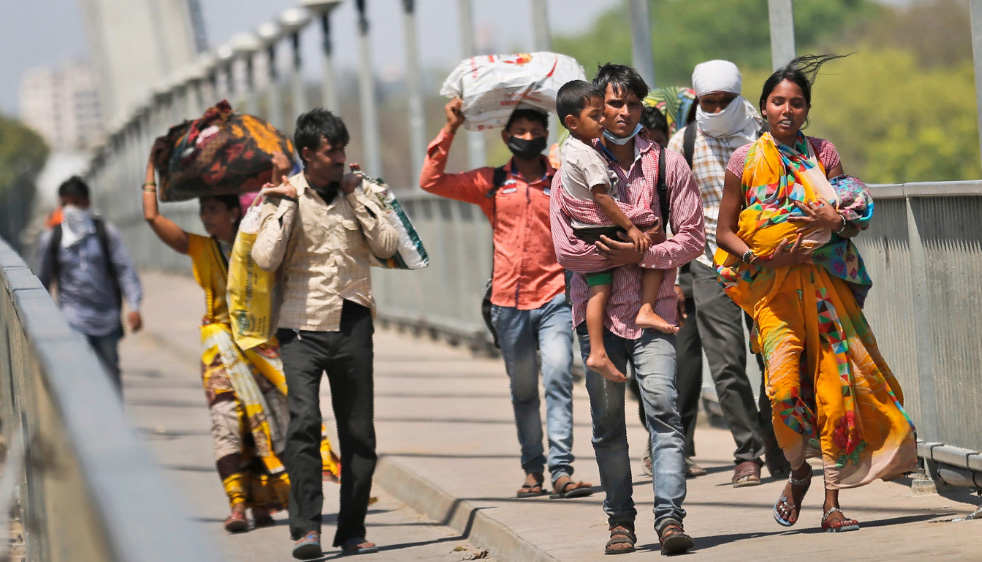
"The mass exodus on foot triggered by the sudden lockdown and the inhuman beating, disinfection and quarantine conditions the informal workers were subjected to turned a health emergency into a humanitarian crisis," it said.

"Over 300 informal workers died due to the lockdown, with reasons ranging from starvation, suicides, exhaustion, road and rail accidents, police brutality and denial of timely medical care. The National Human Rights Commission recorded over 2,582 cases of human rights violation as early as in the month of April 2020," the report added.

It noted that the long disruption of schooling risked doubling the rate of out of school, especially among the poor.

"Only 4 per cent of rural households had a computer and less than 15 per cent rural households had an internet connection," it said.

On health inequalities, the report said only 6 per cent of the poorest 20 per cent has access to non-shared sources of improved sanitation, compared to 93.4 per cent of the top 20 per cent. It added that 59.6 per cent of India's population lives in a room or less.

The report said 1.7 crore women lost their job in April 2020 and unemployment for women rose by 15 per cent from a pre-lockdown level.

Oxfam India CEO Amitabh Behar said if not addressed immediately, the crisis could worsen.

"Extreme inequality is not inevitable, but a policy choice. The fight against inequality must be at the heart of economic rescue and recovery efforts now," Behar said.

"Newer and creative ways of catering to the needs of the masses is possible if governments are committed to the needs of its people. It is time for the government of India to take specific and concrete actions that will build a better future, more equal and just a future for everyone," he said.

Comments

Add new comment

  • Coastaldigest.com reserves the right to delete or block any comments.
  • Coastaldigset.com is not responsible for its readers’ comments.
  • Comments that are abusive, incendiary or irrelevant are strictly prohibited.
  • Please use a genuine email ID and provide your name to avoid reject.
News Network
November 26,2025

Mangaluru, Nov 26: Assembly Speaker and local MLA U.T. Khader has initiated a high-level push to resolve one of Mangaluru’s longest-standing traffic headaches: the narrow, high-density stretch of National Highway-66 between Nanthoor and Talapady.

He announced on Tuesday that a formal proposal has been submitted to the Union Ministry of Road Transport and Highways (MoRTH) seeking approval to prepare a Detailed Project Report (DPR) for the widening of this crucial corridor.

The plan specifically aims to expand the existing 45-meter road width to a full 60 meters, coupled with the construction of dedicated service roads. Khader highlighted that land for a 60-meter highway was originally acquired during the initial four-laning project, but only 45 meters were developed, leading to a perpetual bottleneck.

"With vehicle density rising sharply, the expansion has become unavoidable," Khader stated, stressing that the upgrade is essential for ensuring smoother traffic flow and improving safety at the city's main entry and exit points.

The stretch between Nanthoor and Talapady is a vital link on the busy Kochi-Panvel coastal highway and connects to major city junctions. The move to utilize the previously acquired land for the full 60-meter width is seen as a necessary measure to catch up with the region's rapid vehicular growth and prevent further traffic gridlocks.

Comments

Add new comment

  • Coastaldigest.com reserves the right to delete or block any comments.
  • Coastaldigset.com is not responsible for its readers’ comments.
  • Comments that are abusive, incendiary or irrelevant are strictly prohibited.
  • Please use a genuine email ID and provide your name to avoid reject.
News Network
November 24,2025

Mangaluru, Nov 24: The original departure time of 11.10 pm was a distant memory for scores of Dammam-bound passengers at Mangaluru International Airport last Friday night, as their Air India Express flight was abruptly cancelled at the eleventh hour, sparking hours of frustration and chaos.

The flight, IX 885, initially scheduled to depart at 11.10 pm on November 22, was subject to two back-to-back reschedules—first pushed to 11.45 pm and then significantly postponed to 1.40 am—before the final, crushing announcement of cancellation was made. For the travellers, many of whom are likely expatriate workers with tight schedules, the last-minute change marked the beginning of a distressing ordeal.

"There was no drinking water, no food, and absolutely no proper guidance. We were left stranded like refugees," complained a stranded passenger.

According to multiple passenger accounts, the airline's ground staff failed to provide adequate support or essential amenities following the cancellation. Complaints poured in about the total absence of drinking water, food provisions, and any reliable guidance from the carrier's representatives. Travellers alleged they were left stranded for a considerable period, with no immediate arrangements or clear communication offered regarding accommodation or alternative travel to send them back home.

The incident has highlighted serious concerns over the carrier's contingency planning and customer service protocols during flight disruptions at one of India's key international gateways. The airline is yet to issue a comprehensive statement addressing the alleged lapse in passenger care.
 

Comments

Add new comment

  • Coastaldigest.com reserves the right to delete or block any comments.
  • Coastaldigset.com is not responsible for its readers’ comments.
  • Comments that are abusive, incendiary or irrelevant are strictly prohibited.
  • Please use a genuine email ID and provide your name to avoid reject.
News Network
November 26,2025

students.jpg

Bengaluru, Nov 26: Karnataka is taking its first concrete steps towards lifting a three-decade-old ban on student elections in colleges and universities. Deputy Chief Minister D.K. Shivakumar announced Wednesday that the state government will form a small committee to study the reintroduction of campus polls, a practice halted in 1989 following incidents of violence.

Speaking at a 'Constitution Day' event organised by the Karnataka Congress, Mr. Shivakumar underscored the move's aim: nurturing new political leadership from the grassroots.

"Recently, (Leader of the Opposition in Lok Sabha) Rahul Gandhi wrote a letter to me and Chief Minister (Siddaramaiah) asking us to think about restarting student elections," Shivakumar stated. "I'm announcing today that we'll form a small committee and seek a report on this."

Student elections were banned in Karnataka in 1989, largely due to concerns over violence and the infiltration of political party affiliates into campus life. The ban effectively extinguished vibrant student bodies and the pipeline of young leaders they often produced.

Mr. Shivakumar, who also serves as the Karnataka Congress president, said that former student leaders will be consulted to "study the pros and cons" of the re-introduction.

Acknowledging the history of the ban, he added, "There were many criminal activities taking place back then. We’ll see how we can conduct (student) elections by regulating such criminal activities."

The Deputy CM reminisced about his own journey, which began on campus. He recalled his political activism at Sri Jagadguru Renukacharya College leading to his first Assembly ticket in 1985 at the age of 23. "That's how student leadership was at the time. Such leadership has gone today. College elections have stopped," he lamented, adding that for many, college elections were "like a big movement" where leaders were forged.

The move, driven by the Congress high command's push to cultivate young talent, will face scrutiny from academics and university authorities who have, in the past, expressed concern that the return of polls could disrupt the peaceful academic environment and turn campuses into political battlegrounds.

Comments

Add new comment

  • Coastaldigest.com reserves the right to delete or block any comments.
  • Coastaldigset.com is not responsible for its readers’ comments.
  • Comments that are abusive, incendiary or irrelevant are strictly prohibited.
  • Please use a genuine email ID and provide your name to avoid reject.