



World worried as 2nd wave of covid shifts India from mass vaccine exporter to importer

Agencies
April 16, 2021

After gifting and selling crores of Covid-19 vaccine doses abroad, India suddenly finds itself short of shots as new infections surge in the world's second-most populous country.

India breached 2,00,000 daily infections for the first time on Thursday, and is trying to inoculate more of its population using domestically produced shots.

Facing soaring cases and overflowing hospitals after lockdown restrictions were eased, it also abruptly changed the rules to allow it to fast-track vaccine imports, having earlier rebuffed foreign drugmakers like Pfizer.

It will import Russia's Sputnik V vaccine starting this month to cover as many as 12.5 crore people.

The reversal in fortunes could hamper not only India's battle to contain the pandemic, but also vaccination campaigns in more than 60 poorer countries, mainly in Africa, for months.

The COVAX programme, backed by the World Health Organization and Gavi vaccine alliance, aims at equitable vaccine access around the world, and is relying heavily on supplies from India, Asia's pharmaceutical powerhouse.

But so far this month India has only exported around 12 lakh vaccine doses. That compares with 6.4 crore doses shipped abroad between late January and March, according to data from the foreign ministry.

An official with knowledge of India's vaccine strategy said that available shots would be used domestically while the country faced an "emergency situation".

"There is no commitment to other countries," he said.

India's foreign ministry, which oversees vaccine deals with other countries, said last week that Indian demand would dictate the level of exports.

Resulting shortages are already being felt in some countries in the COVAX scheme, and a UN health official involved in the vaccine rollout in Africa said: "To be so reliant on one manufacturer is a massive concern."

The director of the Africa Centers for Disease Control and Prevention, John Nkengasong, said earlier this month delays in supplies from India could be "catastrophic".

MISSTEPS

Four sources involved in discussions on vaccine supplies and procurement said factors including delays by India and COVAX in placing firm orders, a lack of investment in production, raw material shortages and underestimating the coronavirus surge at home had contributed to vaccine shortages.

The Serum Institute of India (SII), the world's biggest vaccine manufacturer, had vowed to deliver at least 200 crore Covid-19 shots to low and middle-income countries, with nearly half of that by the end of 2021.

But it has also come under pressure to meet the needs of other governments, including Britain, Canada and Saudi Arabia, amid AstraZeneca's global production problems.

The United States, meanwhile, ring-fenced the supply of key equipment and raw materials for its own vaccine makers, limiting SII's operations and delaying by months its goal of raising monthly output to 10 crore from up to 7 crore now, said one of the sources.

A further initial hurdle to SII's supply ambitions was India's hesitation in placing firm orders, two sources said.

That could have allowed it to boost output of the AstraZeneca vaccine early, even though regulators had yet to approve it.

India spent months discussing the final price per dose, and inked an initial purchase order roughly two weeks after India's drug regulator approved the AstraZeneca shot, according to the sources.

At one point, SII ran out of space to store produced doses.

"That is why I chose not to pack more than 5 crore doses, because I knew if I packed more than that, I would have to store it in my house," SII Chief Executive Adar Poonawalla told media in January.

He said he had spent 2,000 crore rupees ($272 million) on the 5 crore doses that the company started stockpiling since around October.

Even now, the government only makes ad-hoc purchases from SII instead of agreeing a longer-term supply schedule, said one of the sources.

SII has sought more than $400 million from the government to increase capacity, but no commitment has yet been made.

The health department and foreign ministry did not respond to requests for comment on issues of funding, purchasing delays and other aspects of India's vaccination rollout.

COVAX CONUNDRUM

COVAX also did not green-light shipments to participating countries from SII until after the shot received WHO clearance in mid-February, said a source involved in the COVAX initiative.

The source said those delays meant crores of additional doses that the SII could have produced between October and February never materialised.

Gavi defended its decision to wait for proper approvals before going ahead with firm orders. And while it is looking for more suppliers, it conceded that much still depended on India's vaccine makers who account for some 60% of global supplies.

COVAX has a deal to buy 100 crore-plus doses from the SII. But it has received less than a fifth of the 10 crore or so doses of the SII-made AstraZeneca vaccine it had expected by May. SII is also supposed to make a large number of doses of the Novavax shot for COVAX.

Gavi had hoped SII would fully resume vaccine deliveries to COVAX in May, but on Wednesday it said India's Covid-19 crisis could affect that.

"We understand the ferocity of the virus in India at the current time, nevertheless we hope and expect deliveries to resume as soon as possible," it said.

On Thursday India reported 2,00,739 infections over the past 24 hours, a seventh daily record in the last eight days, while 1,038 deaths took its toll to 1,73,123. Its tally of 1.4 crore infections is second only to the United States.

Having originally aimed to cover 30 crore of its highest-risk people by August, or just over a fifth of its 135 crore population, the government has now expanded that by another 10 crore, with the promise to widen it further.

Comments

Add new comment

  • Coastaldigest.com reserves the right to delete or block any comments.
  • Coastaldigset.com is not responsible for its readers’ comments.
  • Comments that are abusive, incendiary or irrelevant are strictly prohibited.
  • Please use a genuine email ID and provide your name to avoid reject.
News Network
November 26,2025

Mangaluru, Nov 26: Assembly Speaker and local MLA U.T. Khader has initiated a high-level push to resolve one of Mangaluru’s longest-standing traffic headaches: the narrow, high-density stretch of National Highway-66 between Nanthoor and Talapady.

He announced on Tuesday that a formal proposal has been submitted to the Union Ministry of Road Transport and Highways (MoRTH) seeking approval to prepare a Detailed Project Report (DPR) for the widening of this crucial corridor.

The plan specifically aims to expand the existing 45-meter road width to a full 60 meters, coupled with the construction of dedicated service roads. Khader highlighted that land for a 60-meter highway was originally acquired during the initial four-laning project, but only 45 meters were developed, leading to a perpetual bottleneck.

"With vehicle density rising sharply, the expansion has become unavoidable," Khader stated, stressing that the upgrade is essential for ensuring smoother traffic flow and improving safety at the city's main entry and exit points.

The stretch between Nanthoor and Talapady is a vital link on the busy Kochi-Panvel coastal highway and connects to major city junctions. The move to utilize the previously acquired land for the full 60-meter width is seen as a necessary measure to catch up with the region's rapid vehicular growth and prevent further traffic gridlocks.

Comments

Add new comment

  • Coastaldigest.com reserves the right to delete or block any comments.
  • Coastaldigset.com is not responsible for its readers’ comments.
  • Comments that are abusive, incendiary or irrelevant are strictly prohibited.
  • Please use a genuine email ID and provide your name to avoid reject.
News Network
November 28,2025

ministerPM.jpg

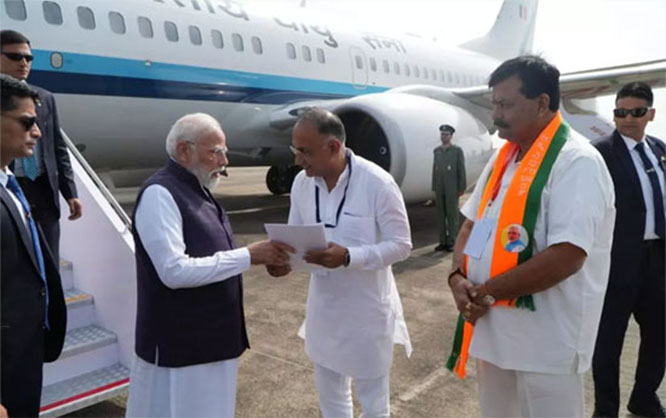
Mangaluru, Nov 28: Karnataka Health Minister and Dakshina Kannada district in-charge minister Dinesh Gundu Rao on Friday handed over Chief Minister Siddaramaiah’s letter to Prime Minister Narendra Modi, highlighting the severe distress faced by farmers due to crashing crop prices.

PM Modi arrived at the Mangaluru International Airport en route to Udupi, where Gundu Rao welcomed him and submitted the letter. The chief minister’s message stressed that farmers are suffering heavy losses because maize and green gram are being bought far below the Minimum Support Price (MSP). The state urged the Centre to immediately begin procurement at MSP.

According to the letter, Karnataka has a bumper harvest this year—over 54.74 lakh metric tons of maize and 1.98 lakh metric tons of green gram—yet farmers are unable to secure fair prices. Against the MSP of ₹2,400/MT for maize and ₹8,768/MT for green gram, market rates have plunged to ₹1,600–₹1,800 and ₹5,400 respectively.

The chief minister has requested the Centre to:

• Direct NAFED, FCI and NCCF to start MSP procurement immediately.
• Ensure ethanol units purchase maize directly from farmers or FPOs.
• Increase Karnataka’s ethanol allocation, citing high production capacity.
• Stop maize imports, which have depressed domestic prices.
• Relax quality norms for green gram, allowing up to 10% discoloration due to rains.

The letter stresses that MSP is crucial for farmer dignity and income stability and calls for swift central intervention to prevent a deepening crisis.

Comments

Add new comment

  • Coastaldigest.com reserves the right to delete or block any comments.
  • Coastaldigset.com is not responsible for its readers’ comments.
  • Comments that are abusive, incendiary or irrelevant are strictly prohibited.
  • Please use a genuine email ID and provide your name to avoid reject.
News Network
December 4,2025

indigoflight.jpg

Domestic carrier IndiGo has cancelled over 180 flights from three major airports — Mumbai, Delhi and Bengaluru — on Thursday, December 4, as the airline struggles to secure the required crew to operate its flights in the wake of new flight-duty and rest-period norms for pilots.

While the number of cancellations at Mumbai airport stands at 86 (41 arrivals and 45 departures) for the day, at Bengaluru, 73 flights have been cancelled, including 41 arrivals, according to a PTI report that quoted sources.

"IndiGo cancelled over 180 flights on Thursday at three airports-Mumbai, Delhi and Bengaluru," the source told the news agency.

Besides, it had cancelled as many as 33 flights at Delhi airport for Thursday, the source said, adding, "The number of cancellations is expected to be higher by the end of the day."

The Gurugram-based airline's On-Time Performance (OTP) nosedived to 19.7 per cent at six key airports — Delhi, Mumbai, Chennai, Kolkata, Bengaluru and Hyderabad — on December 3, as it struggled to get the required crew to operate its services, down from almost half of December 2, when it was 35 per cent.

"IndiGo has been facing acute crew shortage since the implementation of the second phase of the FDTL (Flight Duty Time Limitations) norms, leading to cancellations and huge delays in its operations across the airports," a source had told PTI on Wednesday.

Chaos continued at several major airports for the third day on Thursday because of the cancellations.

A spokesperson for the Kempegowda International Airport (KIA) in Bengaluru said that 73 IndiGo flights had been cancelled on Thursday.

At least 150 flights were cancelled and dozens of others delayed on Wednesday, airport sources said, leaving thousands of travellers stranded, according to news agency Reuters.

The Directorate General of Civil Aviation (DGCA) has said it is investigating IndiGo flight disruptions and has asked the airline to submit the reasons for the current situation, as well as its plans to reduce flight cancellations and delays.

It may be mentioned here that the pilots' body, Federation of Indian Pilots (FIP), has alleged that IndiGo, despite getting a two-year preparatory window before the full implementation of new flight duty and rest period norms for cockpit crew, "inexplicably" adopted a "hiring freeze".

The FIP said it has urged the safety regulator, the DGCA, not to approve airlines' seasonal flight schedules unless they have adequate staff to operate their services "safely and reliably" in accordance with the New Flight Duty Time Limitations (FDTL) norms.

In a letter to the DGCA late on Wednesday, the FIP urged the DGCA to consider re-evaluating and reallocating slots to other airlines, which have the capacity to operate them without disruption during the peak holiday and fog season if IndiGo continues to "fail in delivering on its commitments to passengers due to its own avoidable staffing shortages."

Comments

Add new comment

  • Coastaldigest.com reserves the right to delete or block any comments.
  • Coastaldigset.com is not responsible for its readers’ comments.
  • Comments that are abusive, incendiary or irrelevant are strictly prohibited.
  • Please use a genuine email ID and provide your name to avoid reject.