There may not be a second peak of Covid-19 in India, say experts

Agencies
December 19, 2020

own12.jpg

New Delhi, Dec 19: Healthcare experts have said that there may not be a second peak of Covid-19 in the country, and even if it occurs, it is unlikely to be as strong as the first one.

The comments come as the country's Covid-19 caseload surpassed the one crore mark, though the number of daily cases and daily fatalities have been continuously coming down.

Noted virologist Dr Shahid Jameel said India's curve for daily cases is on a downward slope since a peak in mid-September.

"At this time, we are getting about 25,500 cases daily compared to over 93,000 cases per day in mid-September. I believe the worst is over. But there will be small peaks in the future just as we witnessed in late November," he said.

"I don't think there would be a second peak as we have gone through the festive season (Dussehra to Diwali) and a state election without a significant jump. What is the reason for this? If we go by the second national serosurvey, likely cases were 16 times confirmed cases. By that factor, India would have 160 million cases now," he told PTI.

It is possible that by now there are over 300-400 million infections in the country, Jameel said.

"By that token, we are seeing large parts of the population getting protected and breaking transmission of the virus," he said.

"Unexposed and susceptible people will continue to get infected. If immunity lasts a year or less, then we may have small peaks at regular intervals for the next few years. Good vaccine coverage will control this effectively," he said.

When asked about a possible second peak of Covid-19, noted clinical scientist Dr Gagandeep Kang opined the transmission will not be as rapid as was seen the first time and the peak will not be as high.

"I don't think the exposure is enough to say that we have herd immunity and won't need to worry about it again, but I think it is enough to ensure that we will have some level of protection so that the transmission will not be as rapid as was seen the first time and the peak will also be not as high," she said.

"The problem has not gone away it will not go away with herd immunity, but I don't think necessarily we will see second higher peaks as has been seen in the West," Kang said.

Dr K K Agarwal, an eminent cardiologist, said there is still 30-40 percent population in India which has not been infected by Covid-19.

He said India, Argentina and Poland are the three countries among the 15 nations having the highest number of Covid cases that are not showing a second peak.

"By all probability, India may not have a second peak, and if the second peak comes, it will only come due to the 501 new variant. Two of them have been described, one in south of England and one in South Africa.

"If you don't get that strain, then there will not be a second peak. If India starts its vaccination programme by the end of this month and vaccinates around 30 crore people, we should be able to control this disease by March 25," Agarwal told PTI.

However, if there is a second wave , he said, then it would be a new variant of the virus which will mean more cases but lesser mortality and the second peak will help in building herd immunity.

Asked if the worst was over for India, Dr Samiran Panda, the Head of Epidemiology and Communicable Diseases at the Indian Council of Medical Research, said the epidemiological curve has come down for some states, while there is a fluctuation for others.

"In more states, we have seen effective control while in some of the states we need to be mindful and watchful. The state scenarios are different from each other," Panda told PTI.

India on Saturday crossed the somber milestone of one crore Covid-19 cases, adding 10 lakh infections in nearly a month, even as the virus spread slowed and recoveries surged to over 95.50 lakh, according to Union Health Ministry data.

The health ministry's data updated at 8 AM on Saturday showed that the total number of cases mounted to 1,00,04,599, and the death toll to 1,45,136 with the virus claiming 347 more lives in a span of 24 hours.

India reported its first Covid-19 case 323 days ago on January 30 in Kerala, while the first death was reported on March 10 in Karnataka.


Comments

Add new comment

  • Coastaldigest.com reserves the right to delete or block any comments.
  • Coastaldigset.com is not responsible for its readers’ comments.
  • Comments that are abusive, incendiary or irrelevant are strictly prohibited.
  • Please use a genuine email ID and provide your name to avoid reject.
News Network
December 6,2025

pilot.jpg

New Delhi: IndiGo, India’s largest airline, faced major operational turbulence this week after failing to prepare for new pilot-fatigue regulations issued by the Directorate General of Civil Aviation (DGCA). The stricter rules—designed to improve flight safety—took effect in phases through 2024, with the latest implementation on November 1. IndiGo has acknowledged that inadequate roster planning led to widespread cancellations and delays.

Below are the key DGCA rules that affected IndiGo’s operations:

1. Longer Mandatory Weekly Rest

Weekly rest for pilots has been increased from 36 hours to 48 hours.

The government says the extended break is essential to curb cumulative fatigue. This rule remains in force despite the current crisis.

2. Cap on Night Landings

Pilots can now perform only two night landings per week—a steep reduction from the earlier limit of six.

Night hours, defined as midnight to early morning, are considered the least alert period for pilots.

Given the disruptions, this rule has been temporarily relaxed for IndiGo until February 10.

3. Reduced Maximum Night Flight Duty

Flight duty that stretches into the night is now capped at 10 hours.

This measure has also been kept on hold for IndiGo until February 10 to stabilize operations.

4. Weekly Rest Cannot Be Replaced With Personal Leave

Airlines can no longer count a pilot’s personal leave as part of the mandatory 48-hour rest.

Pilots say this closes a loophole that previously reduced actual rest time.

Currently, all airlines are exempt from this rule to normalise travel.

5. Mandatory Fatigue Monitoring

Airlines must submit quarterly fatigue reports along with corrective actions to DGCA.

This system aims to create a transparent fatigue-tracking framework across the industry.

The DGCA has stressed that these rules were crafted to strengthen flight safety and align India with global fatigue-management standards. The temporary relaxations are expected to remain until February 2025, giving IndiGo time to stabilise its schedules and restore normal air travel.

Comments

Add new comment

  • Coastaldigest.com reserves the right to delete or block any comments.
  • Coastaldigset.com is not responsible for its readers’ comments.
  • Comments that are abusive, incendiary or irrelevant are strictly prohibited.
  • Please use a genuine email ID and provide your name to avoid reject.
News Network
December 4,2025

indigoflight.jpg

Domestic carrier IndiGo has cancelled over 180 flights from three major airports — Mumbai, Delhi and Bengaluru — on Thursday, December 4, as the airline struggles to secure the required crew to operate its flights in the wake of new flight-duty and rest-period norms for pilots.

While the number of cancellations at Mumbai airport stands at 86 (41 arrivals and 45 departures) for the day, at Bengaluru, 73 flights have been cancelled, including 41 arrivals, according to a PTI report that quoted sources.

"IndiGo cancelled over 180 flights on Thursday at three airports-Mumbai, Delhi and Bengaluru," the source told the news agency.

Besides, it had cancelled as many as 33 flights at Delhi airport for Thursday, the source said, adding, "The number of cancellations is expected to be higher by the end of the day."

The Gurugram-based airline's On-Time Performance (OTP) nosedived to 19.7 per cent at six key airports — Delhi, Mumbai, Chennai, Kolkata, Bengaluru and Hyderabad — on December 3, as it struggled to get the required crew to operate its services, down from almost half of December 2, when it was 35 per cent.

"IndiGo has been facing acute crew shortage since the implementation of the second phase of the FDTL (Flight Duty Time Limitations) norms, leading to cancellations and huge delays in its operations across the airports," a source had told PTI on Wednesday.

Chaos continued at several major airports for the third day on Thursday because of the cancellations.

A spokesperson for the Kempegowda International Airport (KIA) in Bengaluru said that 73 IndiGo flights had been cancelled on Thursday.

At least 150 flights were cancelled and dozens of others delayed on Wednesday, airport sources said, leaving thousands of travellers stranded, according to news agency Reuters.

The Directorate General of Civil Aviation (DGCA) has said it is investigating IndiGo flight disruptions and has asked the airline to submit the reasons for the current situation, as well as its plans to reduce flight cancellations and delays.

It may be mentioned here that the pilots' body, Federation of Indian Pilots (FIP), has alleged that IndiGo, despite getting a two-year preparatory window before the full implementation of new flight duty and rest period norms for cockpit crew, "inexplicably" adopted a "hiring freeze".

The FIP said it has urged the safety regulator, the DGCA, not to approve airlines' seasonal flight schedules unless they have adequate staff to operate their services "safely and reliably" in accordance with the New Flight Duty Time Limitations (FDTL) norms.

In a letter to the DGCA late on Wednesday, the FIP urged the DGCA to consider re-evaluating and reallocating slots to other airlines, which have the capacity to operate them without disruption during the peak holiday and fog season if IndiGo continues to "fail in delivering on its commitments to passengers due to its own avoidable staffing shortages."

Comments

Add new comment

  • Coastaldigest.com reserves the right to delete or block any comments.
  • Coastaldigset.com is not responsible for its readers’ comments.
  • Comments that are abusive, incendiary or irrelevant are strictly prohibited.
  • Please use a genuine email ID and provide your name to avoid reject.
News Network
December 6,2025

indigoticket.jpg

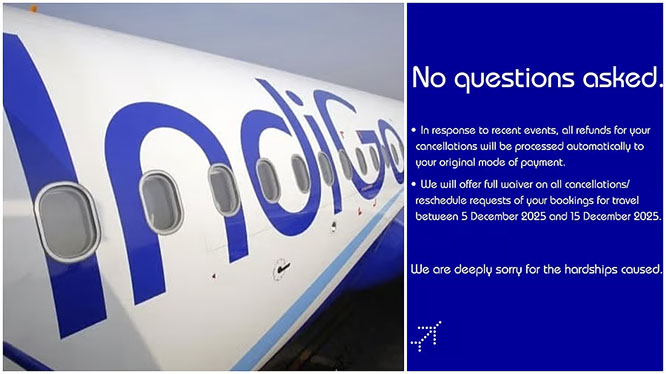
With IndiGo flight disruptions impacting thousands of passengers, the airline on Saturday said that it will offer full waiver on all cancellations/reschedule requests for travel bookings between December 5, 2025 and December 15, 2025.

Earlier in the day, the civil aviation ministry had directed the airline to complete the ticket refund process for the cancelled flights by Sunday evening, as well as ensure baggage separated from the travellers are delivered in the next two days.

In a post on X, titled 'No questions asked', IndiGo wrote, "In response to recent events, all refunds for your cancellations will be processed automatically to your original mode of payment."

"We are deeply sorry for the hardships caused," it further added.

Several passengers, however, complained of not getting full refund as promised by the airline.

Netizens have shared screenchots of getting charged for airline cancellation fee and convenience fee.

"Please tell me why u have did this airline cancellation charges when u say full amount will be refunded (sic)," a user wrote sharing a screenshot of the refund page.

"Well, but you have still debited the convenience charges," wrote another.

Passengers have also raised concerns about the "cancel" option being disabled on the IndiGo app. "First enable the 'Cancel' button on your App & offer full refund on tickets cancelled by customers between the said dates," wrote a user.

A day after the country's largest airline, IndiGo, cancelled more than 1,000 flights and caused disruptions for the fifth day on Saturday, the ministry said that any delay or non-compliance in refund processing will invite immediate regulatory action.

The refund process for all cancelled or disrupted flights must be completed by 8 pm on Sunday, the ministry said in a statement.

"Airlines have also been instructed not to levy any rescheduling charges for passengers whose travel plans were affected by cancellations," it said.

On Saturday, more than 400 flights were cancelled at various airports.

IndiGo has also been instructed to set up dedicated passenger support and refund facilitation cells.

Comments

Add new comment

  • Coastaldigest.com reserves the right to delete or block any comments.
  • Coastaldigset.com is not responsible for its readers’ comments.
  • Comments that are abusive, incendiary or irrelevant are strictly prohibited.
  • Please use a genuine email ID and provide your name to avoid reject.