Mike Pompeo to Seek Stronger Strategic Ties with India despite Trade Tensions

Agencies
June 22, 2019

Washington, Jun 22: U.S. Secretary of State Mike Pompeo will seek to further strengthen strategic ties with India during a visit next week despite increasing frictions over trade, data flows and arms from Russia, officials said.
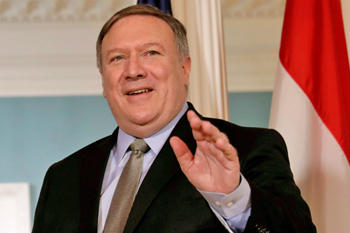
Mr Pompeo arrives in New Delhi on Tuesday for talks that are aimed at laying the ground for a meeting between U.S. President Donald Trump and Indian Prime Minister Narendra Modi later in the week at a G20 meeting in Japan.

India is embroiled in disputes with the United States over tariffs, Indian price caps on imported medical devices, most from the United States, and Indian rules on e-commerce that impose conditions on the operations of major U.S. companies such as Amazon and Walmart.

Another issue that has alarmed India is the possibility of U.S. restrictions on work visas for Indian professionals in retaliation for India's insistence on local data storage by big foreign firms, even though the State Department said on Thursday it had no such plan.

"U.S.-India trade ties, at least between our capitals, are certainly worsening. We both have leaders who look at trade as a zero-sum game," said Richard Rossow, a U.S.-India expert at Washington's the Center for Strategic and International Studies.

The Indian government led by PM Modi, who was re-elected last month with a big majority, says it has been trying to negotiate solutions to the disputes with the United States but that, as a developing country, it has to protect the interests of its people.

Donald Trump has repeatedly criticised India for its high tariffs and last month raised the stakes with the withdrawal of a decades-old trade privilege.

Indian and U.S. officials said trade would be addressed during Mike Pompeo's visit but emphasised the broader political and security relationship.

"There will be certain issues between us that will be on the table at all points of time," an Indian government official said. "But it should not detract from the overall direction of the relationship, which is positive."

Both countries are wary of the growing might of China.

U.S. officials said Mr Pompeo will seek to advance the U.S. strategic partnership with India.

"India is a crucial partner in the Trump administration's vision for a free and open Indo-Pacific region; It shares our concerns about challenges to our shared interests in the region," a senior official of the U.S. State Department told reporters on Friday.

The official said Mr Pompeo would "talk specifically ... about expanding security, energy and space cooperation," and noted that the two countries were gearing up for their first-ever tri-service military exercises in the Bay of Bengal later this year.

At the same time, the U.S. side was hoping the visit would provide a "kick-start" to move quickly to resolve longstanding irritants over trade and market access for U.S. firms.

"A serious process, a credible process and a candid process is going to be critical," the official said. "We need to get a conversation started quickly."

India and the United States eyed each other warily over decades of Cold War suspicion, when India was closer to the then Soviet Union.

But the United States has become one of India's top arms suppliers over the past decade, selling more than $15 billion of weapons such as transport planes, long-range submarine hunters and helicopter gunships.

U.S. firms Lockheed Martin and Boeing are in the race for a contract to build 110 fighter planes in a deal estimated at $20 billion.

In 2016, the United States declared India a major defence partner, opening the way for sales of high-tech military equipment seen as part of a U.S. aim to build up the country as a counterweight to China in the region.

But here too, new strains have emerged over an Indian plan to buy S-400 surface-to-air missile systems from Russia, which can trigger U.S. sanctions under the Countering American Adversaries Through Sanctions Act (CAATSA), prohibiting any engagement with Russia's defence sector.

India, which signed the deal with Russia last year, has been hoping for a waiver, but that has not been forthcoming.

U.S. principal deputy assistant secretary for South and Central Asia, Alice Wells, told Congress this month Washington had "serious concerns" about the possible Indian purchase and there was no available CAATSA waiver when it came to the S-400.

"We are continuing our conversations about how the U.S. or other defence providers could assist India," she added.

Comments

Add new comment

  • Coastaldigest.com reserves the right to delete or block any comments.
  • Coastaldigset.com is not responsible for its readers’ comments.
  • Comments that are abusive, incendiary or irrelevant are strictly prohibited.
  • Please use a genuine email ID and provide your name to avoid reject.
News Network
December 7,2025

envoy.jpg

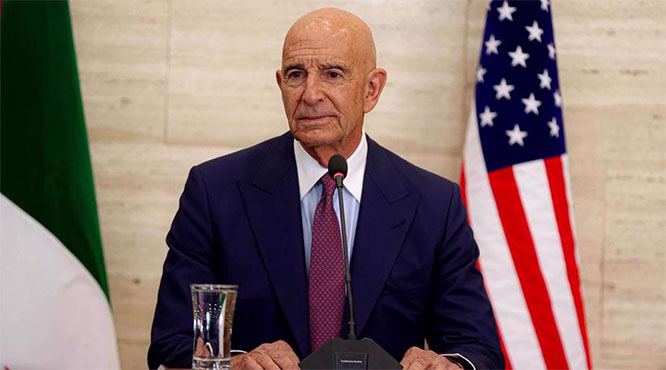
Since 1946, the United States has attempted 93 coups or “regime change” operations across the world — including two in Iran, US Special Envoy for Syria Tom Barrack has admitted.

Speaking to the UAE-based IMI Media Group, in remarks published by The National, Barrack said Washington tried twice to overthrow the Iranian government but failed both times. 

“For (Trump) then to be imputed with regime change — we had two regime changes in Iran already. Neither one worked. So I think wisely leave it to the region to solve,” said Barrack, who also serves as the US ambassador to Turkey.

His comments come six months after the US joined Israel in airstrikes against Iran during ongoing indirect nuclear negotiations between Tehran and Washington.

On June 13, Israel launched an attack on Iran that killed at least 1,064 people and hit civilian infrastructure. Days later, the United States targeted three nuclear facilities — Fordow, Natanz and Isfahan — in what Iran called a clear violation of international law. Iranian retaliation eventually forced a halt to the assault on June 24.

Barrack further claimed that US President Donald Trump and Foreign Secretary Marco Rubio are “not into regime change” and prefer a regional approach driven by Middle Eastern countries themselves. According to him, regional dialogue and non-interference by outside powers offer a more durable path forward.

He added that Washington is still open to an agreement with Tehran if Iranian authorities show “seriousness” and willingness to engage constructively.

However, Iran maintains the US has not shown readiness for meaningful talks. In an interview with Japan’s Kyodo News, Iranian Foreign Minister Abbas Araghchi said negotiations could advance only if Washington acknowledges Iran’s right to peaceful nuclear energy and lifts unilateral sanctions.

Comments

Add new comment

  • Coastaldigest.com reserves the right to delete or block any comments.
  • Coastaldigset.com is not responsible for its readers’ comments.
  • Comments that are abusive, incendiary or irrelevant are strictly prohibited.
  • Please use a genuine email ID and provide your name to avoid reject.
News Network
November 24,2025

israelsyra.jpg

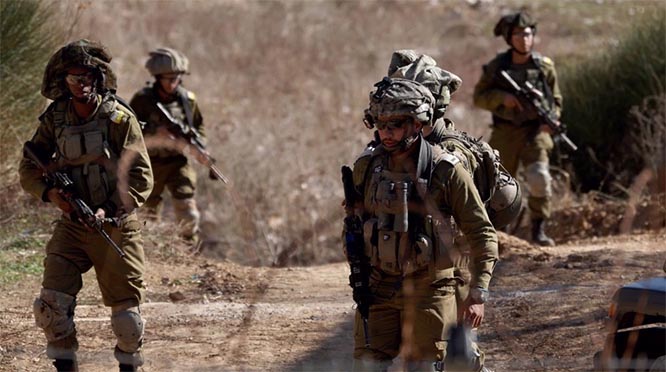
Israeli forces have pushed over the Syrian frontier, erecting a checkpoint and stopping vehicles in the southwestern city of Quneitra, in yet another breach of the Arab country’s sovereignty.

The violation took place on Sunday, when the troops made their way across the border, setting up the outpost near the Ain al-Bayda junction in northern Quneitra, Syrian outlets reported.

According to the al-Ikhbariya paper, an Israeli detachment positioned itself at the junction, halting cars and conducting searches.

The Syrian Arab News Agency (SANA) reported that three Israeli military vehicles then moved further into the northern countryside, deploying between the town of Jubata al-Khashab and the villages of Ofaniya and Ain al-Bayda. The agency added that a separate Israeli unit mounted a new incursion in the central region, approaching the villages of Umm Batina and al-Ajraf.

Residents said such activities have surged in recent months, pointing to Israeli advances onto farmland, leveling of extensive forested areas, arrests, and spread of mobile checkpoints.

The Israeli regime began markedly increasing its military aggression against Syria last year.

The escalation coincided with increasingly ferocious onslaughts throughout the country by the so-called Hay'at Tahrir al-Sham (HTS) Takfiri terrorist group, which the government of President Bashar al-Assad had confined to northwestern Syria. The HTS, however, managed to overthrow the government as the Israeli attacks would pummel the country’s civilian and defensive infrastructure.

Various reports have shown that, during the escalation, the regime conducted more than 1,000 airstrikes on the Syrian territory and over 400 ground raids into the south.

Following the collapse of the Assad government, Tel Aviv also widened its grip over the occupied Golan Heights by taking control of a demilitarized buffer zone, in defiance of a 1974 Disengagement Agreement. Earlier this month, senior Israeli officials, including Prime Minister Benjamin Netanyahu, visited the buffer zone, prompting expressions of alarm on the part of the United Nations.

The United States, the regime’s biggest ally, has, meanwhile, been fraternizing the HTS head Abu Mohammed al-Jolani amid the widely reported prospect of rapprochement with Tel Aviv.

Comments

Add new comment

  • Coastaldigest.com reserves the right to delete or block any comments.
  • Coastaldigset.com is not responsible for its readers’ comments.
  • Comments that are abusive, incendiary or irrelevant are strictly prohibited.
  • Please use a genuine email ID and provide your name to avoid reject.