



Parties vie for Vokkaliga vote that's crucial in nearly 100 Assembly seats in Karnataka

News Network
April 9, 2023

Bengaluru, Apr 9: As Vokkaligas (15 per cent of the population) are considered to be the second politically significant major community of Karnataka after Lingayats (17 per cent), the focus is on how whether there would be a shift in their voting stance in the May 10 assembly election as the ruling BJP has aggressively tried to woo them.

One can gauge the role Vokkaligas play in Karnataka politics from the fact that it has given seven Chief Ministers to Karnataka since independence and a PM.

As a retired IAS officer puts it, this is a community which has rich political awareness. “Of the 17 Chief Ministers Karnataka had, seven were from the Vokkaliga community. K Chengalaraya Reddy, Kengal Hanumanthaiah and Kadidal Manjappa, the first three chief ministers of the state, were from the Vokkaliga Community,” the officer said.

He added that H D Deve Gowda, a Vokkaliga, became the first person from Karnataka to occupy the post of Prime Minister.

The Old Mysuru region, the community's stronghold, comprises Ramanagara, Mandya, Mysuru, Chamarajanagar, Kodagu, Kolar, Tumakuru and Hassan districts. The region has 58 assembly constituencies, which is more than one-fourth of the total number of seats in the 224-member House.

JD(S) represented 24 seats, Congress 18 and BJP 15 in this region in the current assembly. This apart, the community is present in sizeable numbers in Bengaluru Urban district comprising 28 constituencies, Bengaluru Rural district (four constituencies), and Chikkaballapura (eight constituencies).

A political activist Raje Gowda claimed that Vokkaligas dominate in all the 27 out of 28 assembly constituencies of Bengaluru urban district barring Anekal. In the Bengaluru rural district and Chikkaballapura, they hold sway, he added.

“We are scattered ideologically and do not vote en masse like certain other communities. This shows we are liberal in choosing our leaders, which can be seen either as our weakness or our strength,” Raje Gowda quipped.

H D Deve Gowda-headed JD (S) counts the Vokkaligas as its main vote base in the Old Mysuru region, where it's main fight is with the Congress though of late the BJP has been able to make some inroads.

Apparently, seeking to expand its base among this community, the BJP government came up with its 'reservation engineering' making the 2B category of four per cent reservation, exclusively for 'other backward Muslims' redundant and distributed the two per cent equally among Lingayats and Vokkaligas. With this, reservation for Vokkaligas has gone up from four per cent to six per cent.

The move pleased the revered seer of Vokkaliga community, AdiChunchanagiri Math pontiff Swami Nirmalanandanatha, who praised the BJP government.

As part of its Vokkaliga "appeasement" exercise, the BJP built a 108-ft tall Nada Prabhu Kempe Gowda's statue, the founder of Bengaluru and 16th century chieftain of Vijayanagara dynasty, near the Bengaluru International Airport.

Recently, Karnataka Minister Munirathna, who is also a filmmaker, came up with a plan to make a movie 'Uri Gowda-Nanje Gowda' based on a fake story. The fake story is based on a belief among a section of people that there were two Vokkaliga chieftains in erstwhile Mysuru kingdom by name Uri Gowda and Nanje Gowda. It was not the colonial British army but these two chieftains who killed the 18th century Mysuru ruler Tipu Sultan, a claim supported by even some BJP Ministers.

However, Munirathna dropped the plan after Swami Nirmalanandanatha asked him not to proceed with the project saying that there was no historical basis behind the story and it would only create confusion among people.

A Vokkaliga Sangha office-bearer said requesting anonymity that had the movie been made, it would have helped the BJP to garner more votes. “The 'Uri Gowda Nanje Gowda' project might have been dumped, but it is still discussed among Vokkaligas. Further, the increase in reservation will also have a bearing on the election, it seems,” he said.

Comments

Add new comment

  • Coastaldigest.com reserves the right to delete or block any comments.
  • Coastaldigset.com is not responsible for its readers’ comments.
  • Comments that are abusive, incendiary or irrelevant are strictly prohibited.
  • Please use a genuine email ID and provide your name to avoid reject.
News Network
November 22,2025

The Karnataka government has announced a 50% rebate on pending traffic and transport fines. The discount is available from November 21 to December 12.

The rebate applies to all traffic e-challans and violation cases booked by the RTO between 1991–92 and 2019–20. Officials clarified that the offer is not applicable to pending tax dues and is restricted only to traffic-violation fines.

Across Karnataka, more than 4 lakh RTO cases remain pending, including those involving transport vehicles. While thousands of vehicle owners have already cleared their dues, the department expects to generate substantial revenue through this limited-period rebate.

How to Pay and Avail the Discount

There are three ways to check and pay your pending fines:

1. Through Mobile Apps
Available on both Play Store and App Store:
•    Karnataka State Police (KSP) app
•    KarnatakaOne app
•    ASTraM app

Steps:
•    Enter your vehicle number in any of the above apps
•    Verify the photo/details of your vehicle
•    Pay the fine with the 50% discount applied

2. Visit a Traffic Police Station

You can pay your pending fine at any nearby traffic police station.

3. Visit the Traffic Management Centre (TMC)

•    Location: First Floor, Infantry Road, near Indian Express, Bengaluru

Transport Commissioner Yogeesh A M said, “We don't issue e-challans, so there's no online payment system.”

The department estimates ₹52 crore in pending RTO fines up to March 2020. “With the 50% rebate, we expect to collect around ₹25 crore if all dues are cleared,” he added.

Comments

Add new comment

  • Coastaldigest.com reserves the right to delete or block any comments.
  • Coastaldigset.com is not responsible for its readers’ comments.
  • Comments that are abusive, incendiary or irrelevant are strictly prohibited.
  • Please use a genuine email ID and provide your name to avoid reject.
News Network
November 30,2025

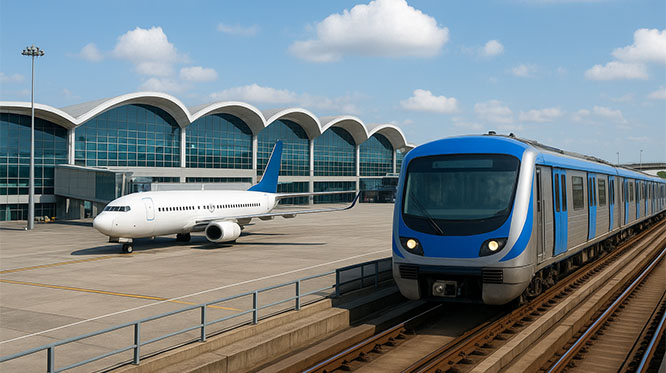
airportmetro.jpg

Udupi: The pontiffs of Sri Paryaya Puttige Mutt, the sacred seat of Jagadguru Shrimad Madhvacharya Moola Samsthanam, have submitted a proposal to the Prime Minister seeking comprehensive development for Udupi district. 

Proposal for International Airport

A key request is the establishment of an international airport. Highlighting that around 1,000 acres of land are available and suitable, the pontiffs noted that the existing Mangalore Airport provides limited international connectivity. They suggested the airport be developed under a Public-Private Partnership (PPP) or as a Greenfield Airport to boost trade, education, healthcare, and spiritual tourism.

Metro and Rapid Transit Connectivity

The proposal also calls for Metro Rail or Rapid Transit between Mangaluru and Udupi. The 55 km coastal stretch experiences heavy daily commuter traffic, causing congestion. The district administration is ready to prepare an initial project report for a Mass Rapid Transit corridor and requested inclusion under national urban mobility programmes to ensure safe, green, and time-efficient regional transport.

Port and Coastal Development

The pontiffs urged the development of an international-standard port with a cruise terminal along Udupi’s coast. They also requested fast-tracking of pending coastal tourism projects and revising Coastal Regulation Zone (CRZ) norms to encourage sustainable infrastructure and hospitality investment.

IT, AI and Technological Infrastructure

Support was sought for an IT and AI Innovation Park with incubation facilities under Digital India and Startup India initiatives. The proposal also emphasized the need for strengthened data security and cloud computing infrastructure to boost India’s technological independence.

Sports and Education Initiatives

The pontiffs requested national sports status for Kambala, along with financial and infrastructure support. They also sought the establishment of an AIIMS in Udupi, a new IIT campus, and approval for an IIM to promote higher education in the district.

Representation to the Prime Minister

Sri Sugunendra Tirtha Pontiff and Sri Sushrendra Tirtha Swamiji represented the pontiffs in submitting the comprehensive development proposal to the Prime Minister during his recent visit.

Comments

Add new comment

  • Coastaldigest.com reserves the right to delete or block any comments.
  • Coastaldigset.com is not responsible for its readers’ comments.
  • Comments that are abusive, incendiary or irrelevant are strictly prohibited.
  • Please use a genuine email ID and provide your name to avoid reject.
News Network
December 6,2025

pilot.jpg

New Delhi: IndiGo, India’s largest airline, faced major operational turbulence this week after failing to prepare for new pilot-fatigue regulations issued by the Directorate General of Civil Aviation (DGCA). The stricter rules—designed to improve flight safety—took effect in phases through 2024, with the latest implementation on November 1. IndiGo has acknowledged that inadequate roster planning led to widespread cancellations and delays.

Below are the key DGCA rules that affected IndiGo’s operations:

1. Longer Mandatory Weekly Rest

Weekly rest for pilots has been increased from 36 hours to 48 hours.

The government says the extended break is essential to curb cumulative fatigue. This rule remains in force despite the current crisis.

2. Cap on Night Landings

Pilots can now perform only two night landings per week—a steep reduction from the earlier limit of six.

Night hours, defined as midnight to early morning, are considered the least alert period for pilots.

Given the disruptions, this rule has been temporarily relaxed for IndiGo until February 10.

3. Reduced Maximum Night Flight Duty

Flight duty that stretches into the night is now capped at 10 hours.

This measure has also been kept on hold for IndiGo until February 10 to stabilize operations.

4. Weekly Rest Cannot Be Replaced With Personal Leave

Airlines can no longer count a pilot’s personal leave as part of the mandatory 48-hour rest.

Pilots say this closes a loophole that previously reduced actual rest time.

Currently, all airlines are exempt from this rule to normalise travel.

5. Mandatory Fatigue Monitoring

Airlines must submit quarterly fatigue reports along with corrective actions to DGCA.

This system aims to create a transparent fatigue-tracking framework across the industry.

The DGCA has stressed that these rules were crafted to strengthen flight safety and align India with global fatigue-management standards. The temporary relaxations are expected to remain until February 2025, giving IndiGo time to stabilise its schedules and restore normal air travel.

Comments

Add new comment

  • Coastaldigest.com reserves the right to delete or block any comments.
  • Coastaldigset.com is not responsible for its readers’ comments.
  • Comments that are abusive, incendiary or irrelevant are strictly prohibited.
  • Please use a genuine email ID and provide your name to avoid reject.
