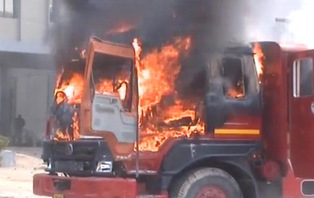
Strike turns violent in UP, vehicles set on fire in Noida

February 20, 2013

Fire_Service

Lucknow, Feb 20: The two-day nationwide strike called by Central trade unions disrupted normal life in many states on Wednesday leaving commuters in the lurch.

Violence erupted in some places on the first day of a two-day strike as workers, angry about high fuel prices in particular, tried to keep vehicles off the roads.

The strike turned violent in Noida in Uttar Pradesh, adjoining Delhi, after angry workers protested in Noida Phase II. They pelted stones at some factories and burnt vehicles, including a fire engine. The police had to resort to lathicharge to disperse the restive crowd.

The two-day nationwide strike called by trade unions in support of their demands evoked a good response in Uttar Pradesh on Wednesday. Roadways buses remained off roads and bank branches were closed in support of the strike call, adversely affecting normal life since morning.

Reports from different parts of the state said employees of various government departments and banks assembled at their respective offices and held protest meetings raising slogans in support of their demands.

Commuters were left stranded, and overcrowding was reported at railway stations. Following this, the state government pressed 200 buses into service at the Kumbh in Allahabad.

The state government had made alternative arrangements like pressing private buses into service, but these were not enough to clear the office rush and people had to depend either on private vehicles or autorickshaws to reach their destinations.

In the state capital, all the major offices have remained shut with employees also taking out protest marches.

The bandh was total in Meerut, Ghaziabad, Noida, Kanpur, Varanasi, Lucknow, Saharanpur, Unnao, Moradabad and Allahabad.

Major markets in Lucknow like Aminabad and Hazratganj were deserted, and operations at post offices and state-run banks were disrupted.

Banking, transport services hit

Normal banking operations were hit today as employees of public sector banks went on a two-day strike in response to a call given by central trade unions to press for wage hike in the backdrop of rising inflation.

The nationwide strike call has been given by United Forum of Bank Unions (UFBU), consisting of nine national level unions, including AIBEA, NCBE, BEFI, INBEF, NOBW and AIBOC.

Apprehending disruption in their normal banking operations, many banks had already informed their customers about the proposed strike.

Meanwhile, sources said, banks have taken steps to ensure that public do not face problems at least on the cash front during the strike period.

Banks have fed additional cash in ATMs to meet the cash needs of their customers.

Bank unions are pressing for early wage revision of employees, which they said is due from November 2012. They are also opposing banking sector reforms and any plan for merger of banks.

There are 26 public sector banks with employees strength of around 10 lakh.

In December 2012 also, four bank unions went on strike opposing amendments carried out in Banking Regulation Act and Banking Companies Act, enabling foreign equity in public sector banks.

The bank strike is part of a general strike call given by 11 central trade unions including Indian National Trade Union Congress (INTUC), All India Trade Union Congress (AITUC), Bharatiya Mazdoor Sangh ( BMS), Centre of Indian Trade Unions (CITU) and All India United Trade Union Centre.

Trade union leader killed in Ambala

A trade union leader, who was squatting along with a group of workers near the local bus depot as part of the two-day nationwide strike call, on Wednesday died when he was hit by a bus in his bid to stop it from plying, a senior Roadways official said here.

"The incident took place around 4 am this morning when Narender Singh, a bus driver by profession, tried to stop the vehicle which was being taken out from the Ambala Depot despite the strike," district president, Haryana Roadways Workers Union's, Inder Singh Bhadana told reporters here.

Bhadana alleged that the district administration tried to forcibly ply the bus, which hit Singh, who was also the treasurer of a AITUC union, killing him on the spot.

After the incident, the other workers resorted to violence damaging vehicles belonging to the Ambala's Deputy Commissioner of Police and SHO of the Baldev police station area, police said.

Meanwhile, Bhadana demanded a case to be lodged against the General Manager of the Roadways, failing which they will not allow the body to be cremated.

In view of the tense situation, heavy police force had been deployed at the bus depot and its surrounding areas.

Earlier, however, AITUC general secretary Gurudas Dasgupta said that the victim was allegedly stabbed to death by some miscreants.

Financial sector crippled as shutdown starts in Mumbai

India's financial sector was crippled on Wednesday after all banks, insurance companies and commercial establishments in this commercial capital remained shut on the first of the two-day nationwide strike, organisers said.

"The banking and financial sector is 100 percent closed, not only in Mumbai and Maharashtra but all over the country," All India Bank Employees Association vice-president V Utagi told IANS.

Utagi said all banks -- nationalised, private, foreign, regional, rural and cooperative -- had "wholeheartedly" participated in the strike.

Trains, road services hit in Bihar

Thousands of people were stranded across Bihar on Wednesday as trains were stopped and key highways blocked by activists affiliated to various trade unions that have called for a nationwide two-day strike.

Workers of trade unions stopped nearly a dozen passenger and long-distance trains at Patna, Gaya, Jehanabad, Hajipur, Bhagalpur and Darbhanga railway stations.

Strike hits normal life in Kerala

The 48-hour nationwide strike called by central trade unions hit normal life across Kerala today with workers from varied sectors, including transport and banking, staying away from work to protest the UPA government's economic and labour policies.

Early reports said buses and taxis were off the roads and shops and restaurants remained closed. Train services were not affected.

The Congress-led UDF government has declared 'dies non' (no work, no pay) as pro-Left service and teachers unions are also striking work.

Security has been tightened and no violence has been reported from anywhere. Police have offered protection to those willing to work and public conveyances ready to ply, police sources said.

West Bengal partially hit by strike

Life was partially affected in West Bengal on the first day today of the two-day countrywide strike called by central trade unions with the situation remaining peaceful.

Shops, markets and business establishments were closed in many parts of the metropolis, while government run buses and trams ran in large numbers in comparison to private buses and taxis, which were less.

Banking operations remained paralysed in the state. Chief Minister Mamata Banerjee said that attendance at the Writers' Buildings was 100 per cent.

Finance Mitra Amit Mitra also said that his department registered 100 per cent attendance.

Many government employees stayed overnight in their offices.

Partial impact to strike call in Tamil Nadu

The strike call given by 11 trade unions country wide had partial impact in Tamil Nadu as a majority of shops remained open and transport services plied normally.

However, banking services were hit hard as most public and private sector banks remained closed.

The United Form of Bank Unions, an association representing the banking community, had said it would join the strike call given by the Trade Unions.

City buses and auto-rickshaws plied as usual. Partial inter-city services were operated from Chennai Mofussil Bus Terminus, sources said.

Members of agitating workers union including CITU and all India Bank Employees Association staged a demonstration in Chennai as part of the strike call.

Comments

Add new comment

  • Coastaldigest.com reserves the right to delete or block any comments.
  • Coastaldigset.com is not responsible for its readers’ comments.
  • Comments that are abusive, incendiary or irrelevant are strictly prohibited.
  • Please use a genuine email ID and provide your name to avoid reject.
News Network
December 6,2025

indigoticket.jpg

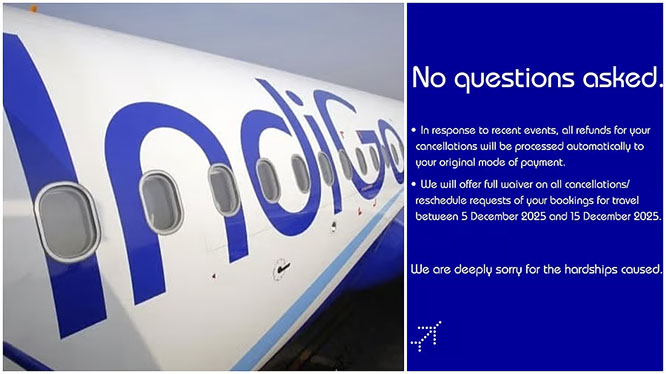
With IndiGo flight disruptions impacting thousands of passengers, the airline on Saturday said that it will offer full waiver on all cancellations/reschedule requests for travel bookings between December 5, 2025 and December 15, 2025.

Earlier in the day, the civil aviation ministry had directed the airline to complete the ticket refund process for the cancelled flights by Sunday evening, as well as ensure baggage separated from the travellers are delivered in the next two days.

In a post on X, titled 'No questions asked', IndiGo wrote, "In response to recent events, all refunds for your cancellations will be processed automatically to your original mode of payment."

"We are deeply sorry for the hardships caused," it further added.

Several passengers, however, complained of not getting full refund as promised by the airline.

Netizens have shared screenchots of getting charged for airline cancellation fee and convenience fee.

"Please tell me why u have did this airline cancellation charges when u say full amount will be refunded (sic)," a user wrote sharing a screenshot of the refund page.

"Well, but you have still debited the convenience charges," wrote another.

Passengers have also raised concerns about the "cancel" option being disabled on the IndiGo app. "First enable the 'Cancel' button on your App & offer full refund on tickets cancelled by customers between the said dates," wrote a user.

A day after the country's largest airline, IndiGo, cancelled more than 1,000 flights and caused disruptions for the fifth day on Saturday, the ministry said that any delay or non-compliance in refund processing will invite immediate regulatory action.

The refund process for all cancelled or disrupted flights must be completed by 8 pm on Sunday, the ministry said in a statement.

"Airlines have also been instructed not to levy any rescheduling charges for passengers whose travel plans were affected by cancellations," it said.

On Saturday, more than 400 flights were cancelled at various airports.

IndiGo has also been instructed to set up dedicated passenger support and refund facilitation cells.

Comments

Add new comment

  • Coastaldigest.com reserves the right to delete or block any comments.
  • Coastaldigset.com is not responsible for its readers’ comments.
  • Comments that are abusive, incendiary or irrelevant are strictly prohibited.
  • Please use a genuine email ID and provide your name to avoid reject.
News Network
December 3,2025

indigo.jpg

IndiGo, India’s largest airline, is battling one of its worst operational disruptions in recent years, with hundreds of delays and cancellations throwing domestic travel into chaos.

Government data on Tuesday showed its on-time performance plunging to 35%, an unusual dip for a carrier long associated with punctuality.

By Wednesday afternoon, airports in Delhi, Mumbai, Bengaluru and Hyderabad had collectively reported close to 200 cancellations, stranding travellers across the country.

Crew Shortage After New Duty Norms

A major trigger behind the meltdown is a severe crew shortage, especially among pilots, following the rollout of revised Flight Duty Time Limitation (FDTL) norms last month.

The rules mandate longer rest hours and more humane rosters — a shift IndiGo has struggled to incorporate across its vast network.

Sources said several flights were grounded due to lack of cabin crew, while some delays stretched upwards of eight hours.

With IndiGo controlling over 60% of India’s domestic aviation market, the ripple effect has impacted airports nationwide.

IndiGo Issues Apology, Lists “Compounding Factors”

In a statement, IndiGo acknowledged the large-scale disruption:

“We sincerely apologise to customers. A series of unforeseen operational challenges — technology glitches, winter schedule changes, adverse weather, system congestion and updated FDTL norms — created a compounding impact that could not have been anticipated.”

To stabilise operations, the airline has begun calibrated schedule adjustments for the next 48 hours, aiming to restore punctuality. Affected passengers are being offered refunds or alternate travel arrangements, IndiGo said.

What the FDTL Rules Require

The FDTL norms, designed to reduce pilot fatigue, cap duty and flying hours as follows:
•    Maximum 8 hours of flying per day
•    35 hours per week
•    125 hours per month
•    1,000 hours per year

Crew must also receive rest equalling twice the flight duration, with a minimum 10-hour rest period in any 24-hour window.

The DGCA introduced these limits to enhance flight safety.

Hyderabad: 33 Flights Cancelled, Long Queues Reported

Hyderabad’s Rajiv Gandhi International Airport saw heavy early-morning crowds as 33 IndiGo flights (arrivals and departures) were cancelled.

The airport clarified on X that operations were normal, advising passengers to contact IndiGo directly for latest flight status.

Cancellations included flights to and from Visakhapatnam, Goa, Ahmedabad, Delhi, Bengaluru, Chennai, Madurai, Hubli, Bhopal and Bhubaneswar.

Bengaluru: 42 Flights Disrupted

Bengaluru’s Kempegowda International Airport recorded 42 cancellations — 22 arrivals and 20 departures — affecting routes to Delhi, Mumbai, Chennai, Hyderabad, Goa, Kolkata and Lucknow.

Passengers Vent on Social Media

Irate travellers took to X to share their experiences. One passenger stranded in Hyderabad wrote: “I have been here since 3 a.m. and missed an important meeting.”

Another said: “My flight was pushed from 1:55 PM to 2:55 PM and now 4:35 PM. I was informed only three minutes before entering the airport.”

Delhi Airport Hit by Tech Glitch

At Delhi Airport, the disruption deepened due to a slowdown in the Amadeus system — used for reservations, check-ins and departure control.

The technical issue led to longer queues and sluggish processing, adding to delays already worsened by staff shortages.

Comments

Add new comment

  • Coastaldigest.com reserves the right to delete or block any comments.
  • Coastaldigset.com is not responsible for its readers’ comments.
  • Comments that are abusive, incendiary or irrelevant are strictly prohibited.
  • Please use a genuine email ID and provide your name to avoid reject.
News Network
December 2,2025

A major upgrade in safety and monitoring is planned for Haj 2026, with every Indian pilgrim set to receive a Haj Suvidha smart wristband linked to the official Haj Suvidha mobile app. The initiative aims to support pilgrims—especially senior citizens—who may struggle with smartphones during the 45-day journey.

What the Smart Wristband Will Do

Officials said the device will come with:
•    Location tracking
•    Pedometer
•    SOS emergency button
•    Qibla compass
•    Prayer timings
•    Basic health monitoring

SP Tiwari, secretary of the UP State Haj Committee, said the goal is to make the pilgrimage safer and more comfortable.

“Most Hajis are elderly and not comfortable with mobile apps,” he said. “The smartwatch will help locate pilgrims who forget their way or cannot communicate their location.”

The wristbands will be monitored by the Consulate General of India in Saudi Arabia, similar to mobile tracking via the Haj Suvidha App.

Free Distribution and Training

•    Smart wristbands will be given free of cost.
•    Training for pilgrims will be conducted between January and February 2026.
•    Sample units will reach state Haj committees soon.
•    Final devices will be distributed as pilgrims begin their journey.

New Rules for Accommodation

Two major decisions have also been finalised for Haj 2026:
1.    Separate rooms for men and women – including married couples. They may stay on the same floor but must occupy different rooms, following stricter Saudi guidelines.
2.    Cooking banned – gas cylinders will not be allowed; all meals will be provided through official catering services arranged by the Haj Committee of India.

These decisions were finalised during a meeting of the Haj Committee of India and state representatives in Mumbai.

Haj Suvidha App Launched Earlier

The government launched the Haj Suvidha App in 2024, offering:

•    Training modules
•    Accommodation and flight details
•    Baggage information
•    SOS and translation tools
•    Grievance redressal

Haj 2026 Quota and Key States

•    India’s total Haj quota for 2026: 1,75,025 pilgrims
•    70% (1,25,000) allotted to the Haj Committee of India
•    30% (around 50,000) reserved for Haj Group Organisers

Uttar Pradesh has the largest allocation (around 30,000 seats), though approximately 18,000 pilgrims are expected to go this year. States with high pilgrim numbers include Kerala, Maharashtra and Gujarat.

Dates of Haj 2026

The pilgrimage is scheduled to take place from 24 May to 29 May, 2026 (tentative).
Haj is one of the five pillars of Islam and is mandatory for Muslims who meet the required conditions.

Comments

Add new comment

  • Coastaldigest.com reserves the right to delete or block any comments.
  • Coastaldigset.com is not responsible for its readers’ comments.
  • Comments that are abusive, incendiary or irrelevant are strictly prohibited.
  • Please use a genuine email ID and provide your name to avoid reject.