RBI new bad loan rules may improve prospects of loan recovery

News Network
February 14, 2018

Mumbai, Feb 14: The Reserve Bank of India’s (RBI) decision to tighten norms for resolution of stressed loans, currently estimated at over Rs10 trillion, will improve recovery prospects from bad loans but keep banks’ provisioning requirement at an elevated level, analysts said.
Late on Monday, the central bank withdrew a host of norms such as strategic debt restructuring (SDR) and scheme for sustainable structuring of stressed assets (S4A) among others, and made the process time-bound. The new rules stipulate that starting 1 March, lenders must implement a resolution plan within 180 days for accounts of at least Rs2,000 crore.

“To begin with, lenders will have to start finalizing and implementing resolution plans for cases where restructuring has been done. The fact that most cases remain in stress despite restructuring under various RBI schemes means that there is a high probability that most of these could be referred for (insolvency) proceedings,” said Udit Kariwala, senior analyst, financial institutions at India Ratings. “To that extent, provisioning cost will increase.”

He added that as per the rating agency’s analysis, at the end of September, large banks—six each from private and public sectors—are sitting on a restructured loan pool (including SDR and another scheme called 5/25) of around Rs1.9 trillion.

Accounts from highly leveraged thermal power and capital goods sectors are at high risk of landing in bankruptcy courts.

However, Krishnan Sitaraman, senior director at Crisil Ratings, said the circular in itself may not lead to materially higher provisioning on an aggregate basis, since banks are already steadily increasing their provisioning levels on bad loans owing to the resolution processes under way.

Public sector banks on an aggregate basis are looking to enhance provision coverage levels from 40-45% to 55-60%, he said.

Banks must kept aside at least 50% in the form of provision for accounts referred to bankruptcy court.

Currently, lenders are finalizing resolution plans for 11 of the 12 accounts in RBI’s first defaulter list referred to bankruptcy court. They are also filing insolvency petitions for some of the 28 accounts which were part of central bank’s second defaulter list.

Analysts said the revised rules - which, for instance, call for credit rating agencies to evaluate resolution plans will make the process of restructuring more transparent, enable lenders to get better market-linked pricing for the underlying asset, and sync bank balance sheets with expected loss from the stressed asset pool.

Still, there are some grey areas, others said.

For instance, it is not clear how lenders would work out a proposal which involves interest rate reductions or other sacrifices without a framework in place, said Manish Aggarwal, partner and head resolutions, special situations group, KPMG.

Crisil’s Sitaram said that in the long term, the new rules will improve recovery rates because the failure in meeting timeline will lead to insolvency proceedings, which has to be completed in a maximum of 270 days.

“In the past, we have the average recovery period in corporate NPA accounts extending to 4-5 years. Reduction in the recovery period will lead to higher certainty of outcome for lenders as well as preserve value better,” he said.

With the revised norms mandating an account must no longer be in default after the implementation of a resolution plan, there will be an improvement in the quality of such plans and both the debtors and lenders will have more skin in the game, according to analysts.

As per new RBI norms, in case the resolution plan involves change in the ownership structure of the defaulting firm, the account should not be in default at any point during the specified period, which is the time between implementation of the plan and the date, where up to 20% of the outstanding principal debt is repaid. If there is a default in the specified period, the account must be referred for IBC proceedings.

“With the new norms in place, there is possibility that the promoters will try to defend their assets by bringing the amount and safeguarding their assets from insolvency and bankruptcy code reference. That probability is increasing is what I feel,” said R. Subramaniakumar managing director and chief executive officer at Indian Overseas Bank.

Comments

Add new comment

  • Coastaldigest.com reserves the right to delete or block any comments.
  • Coastaldigset.com is not responsible for its readers’ comments.
  • Comments that are abusive, incendiary or irrelevant are strictly prohibited.
  • Please use a genuine email ID and provide your name to avoid reject.
News Network
November 27,2025

DKSvokkaliga.jpg

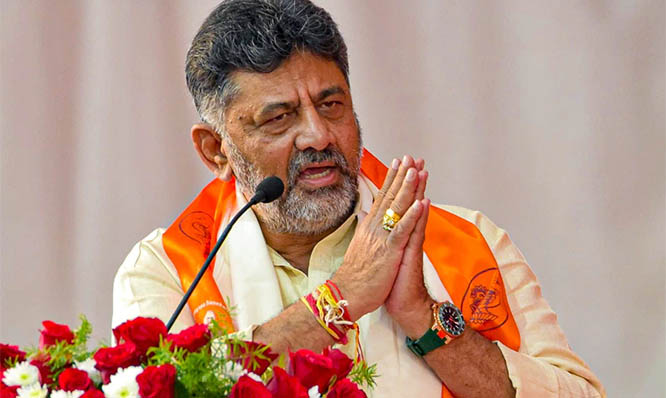
Bengaluru: The Vokkaligara Sangha on Thursday issued a stern warning to the Congress, saying the party could face serious electoral repercussions if Deputy Chief Minister D.K. Shivakumar is not appointed as Chief Minister.

The warning follows the public backing of Shivakumar’s chief ministerial ambition by top Vokkaliga pontiff Nirmalanandanatha Swami, who urged the Congress high command to honor his claim.

“The community supported Congress in the 2023 Assembly elections only because Shivakumar had a real chance to become CM. If he is cheated, we’ll teach the party a big lesson,” said newly elected Sangha president L. Srinivas. He added that Vokkaligas would organize protests under the guidance of community leaders.

General Secretary C.G. Gangadhar pointed out that Congress won more seats in the Vokkaliga-dominated Old Mysuru region due to Shivakumar’s influence, adding, “If Congress wants to retain power, Shivakumar should be made the CM.”

Outgoing president Kenchappa Gowda emphasized Shivakumar’s contribution to Congress’ victory. “Our community voted for Congress thinking he would become CM. Siddaramaiah has also served the party well, but Shivakumar should now be given a chance,” he said.

Former general-secretary Konappa Reddy appealed to Sonia and Rahul Gandhi to recognize Shivakumar’s loyalty and service, saying, “Congress is known to keep its promises. We hope it won’t break the promise made to him.”

Comments

Add new comment

  • Coastaldigest.com reserves the right to delete or block any comments.
  • Coastaldigset.com is not responsible for its readers’ comments.
  • Comments that are abusive, incendiary or irrelevant are strictly prohibited.
  • Please use a genuine email ID and provide your name to avoid reject.
coastaldigest.com news network
November 28,2025

roadshow.jpg

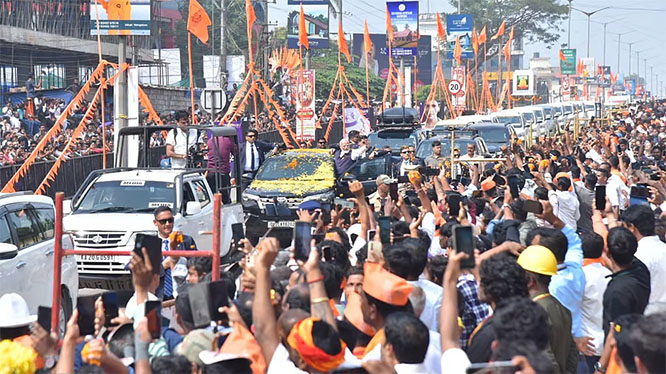
Udupi district transformed into a sea of saffron and celebration on Friday, November 28, as Prime Minister Narendra Modi’s roadshow swept through the coastal temple town. Thousands of residents lined the streets, turning the event into a vibrant public spectacle filled with cheers, flags, and festive energy.

The procession route—from the helipad to the historic Sri Krishna Math—was decked with buntings, saffron flags, and multilayered security barricades. One of the district’s largest-ever security deployments was put in place for the high-profile visit, with over 3,000 police personnel on duty. The arrangement included ten SPs, 27 DSPs, 49 inspectors, 127 sub-inspectors, 232 assistant sub-inspectors, 1,608 constables, and 39 women staff.

Six platoons of the Karnataka State Reserve Police, six Quick Response Teams, bomb detection units, and dog squads were stationed across Udupi. Enhanced surveillance covered Adi Udupi, Bannanje bus stand, and the Sri Krishna Math parking zone, with combing operations carried out along the roadshow corridor.

At the 800-year-old Sri Krishna Math, preparations reached a ceremonial peak. Paryaya Puttige Math seer Sugunendra Teertha Swamiji said the Prime Minister would take part in the Laksha Kantha Geetha Parayana, a mass chanting of the Bhagavad Gita by one lakh devotees, and inaugurate the new Suvarna Teertha Mantapa.

“He will first offer floral tributes to saint-poet Kanakadasa and then unveil the golden covering over the Kanakana Kindi,” the seer said.

The Prime Minister will also receive a Poorna Kumbha welcome and have darshan of Lord Sri Krishna, Mukhyaprana Devaru, and the Suvarna Paduke. Union Minister Pralhad Joshi, Karnataka Governor Thaawarchand Gehlot, Minister Bairathi Suresh, Dharmadhikari D. Veerendra Heggade, and seers from the Ashta Maths are expected to join the ceremony.

Ahead of his arrival, the Prime Minister posted on X that he felt “honoured” to attend the spiritually significant gathering. “This is a special occasion that brings together people from different sections of society for a recital of the Gita. This Matha has a very special significance in our cultural life,” he wrote, noting the institution’s long-standing legacy rooted in the teachings of Sri Madhvacharya.

roadshow2.jpg

Comments

Add new comment

  • Coastaldigest.com reserves the right to delete or block any comments.
  • Coastaldigset.com is not responsible for its readers’ comments.
  • Comments that are abusive, incendiary or irrelevant are strictly prohibited.
  • Please use a genuine email ID and provide your name to avoid reject.
News Network
December 4,2025

Mangaluru: Chaos erupted at Mangaluru International Airport (MIA) after IndiGo flight 6E 5150, bound for Mumbai, was repeatedly delayed and ultimately cancelled, leaving around 100 passengers stranded overnight. The incident highlights the ongoing country-wide operational disruptions affecting the airline, largely due to the implementation of new Flight Duty Time Limitations (FDTL) norms for crew.

The flight was initially scheduled for 9:25 PM on Tuesday but was first postponed to 11:40 PM, then midnight, before being cancelled around 3:00 AM. Passengers expressed frustration over last-minute communication and the lack of clarity, with elderly and ailing travellers particularly affected. “Though the airline arranged food, there was no proper communication, leaving us confused,” said one family member.

An IndiGo executive at MIA cited the FDTL rules, designed to prevent pilot fatigue by limiting crew working hours, as the cause of the cancellation. While alternative arrangements, including hotel stays, were offered, about 100 passengers chose to remain at the airport, creating tension. A replacement flight was arranged but also faced delays due to the same constraints, finally departing for Mumbai around 1:45 PM on Wednesday. Passengers either flew, requested refunds, or postponed their travel.

The Mangaluru delay is part of a broader crisis for IndiGo. The airline has been forced to make “calibrated schedule adjustments”—a euphemism for widespread cancellations and delays—after stricter FDTL norms came into effect on November 1.

While an IndiGo spokesperson acknowledged unavoidable flight disruptions due to technology issues, operational requirements, and the updated crew rostering rules, the DGCA has intervened, summoning senior airline officials to explain the chaos and outline corrective measures.

The ripple effect has been felt across the country, with major hubs like Bengaluru and Mumbai reporting numerous cancellations. The Mangaluru incident underscores the systemic operational strain currently confronting India’s largest carrier, leaving passengers nationwide grappling with uncertainty and delays.

Comments

Add new comment

  • Coastaldigest.com reserves the right to delete or block any comments.
  • Coastaldigset.com is not responsible for its readers’ comments.
  • Comments that are abusive, incendiary or irrelevant are strictly prohibited.
  • Please use a genuine email ID and provide your name to avoid reject.