



US President Donald Trump steps into North Korea, in historic first

Agencies
June 30, 2019

Panmunjom, Jun 30: Donald Trump stepped onto North Korean soil Sunday as he met Pyongyang's leader Kim Jong Un in the Demilitarized Zone dividing the peninsula, in a symbolic diplomatic spectacle and a first for any American president.
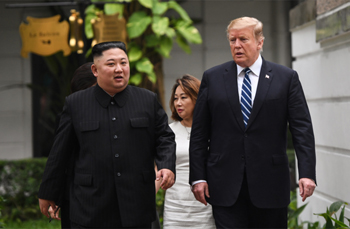
After shaking hands with Kim over the line that marks where their two countries and their allies fought each other to a standstill in the 1950-53 Korean War, Trump walked for several steps into North Korean territory, before another handshake.

The two men then walked into Seoul's territory together -- pausing on the line for photographers -- where they were joined by South Korean President Moon Jae-in.

"It's a great day for the world and it's an honour for me to be here," Trump said. "A lot of great things are happening."

The impromptu meeting in the DMZ -- which came after Trump issued an invitation on Twitter on Saturday -- comes with negotiations between Pyongyang and Washington over the North's nuclear arsenal at a deadlock.

The two would "just shake hands quickly and say hello because we haven't seen each other since Vietnam", Trump said earlier.

Their first summit took place in a blaze of publicity in Singapore last year but produced a vaguely-worded pledge about denuclearisation, and a second meeting in Vietnam in February intended to put flesh on those bones broke up without agreement.

Contact between the two sides has since been minimal -- with Pyongyang issuing frequent criticisms of the US position -- but the two leaders have exchanged a series of letters and Trump turned to Twitter on Saturday to issue his offer.

"If Chairman Kim of North Korea sees this, I would meet him at the Border/DMZ just to shake his hand and say Hello(?)!," he wrote from from Osaka in Japan, where he was attending a G20 summit before flying to Seoul.

In an unusually fast and public response, within hours of Trump's tweet the North's official KCNA news agency quoted Vice Foreign Minister Choe Son Hui as saying the offer was "a very interesting suggestion".

Trump's entry onto North Korean soil is a dramatic re-enactment of the extraordinary scene last year when the young leader invited South Korean President Moon Jae-in to walk over the Military Demarcation Line that divides the Koreas.

Moon -- who seized on last year's Winter Olympics to broker the process between Pyongyang and Washington, after tensions soared in 2017 amid missile and nuclear tests and mutual insults -- will be going to the DMZ with Trump.

"The leaders of the US and the North will have a handshake for peace at Panmunjom, the symbol of division, for the first time," Moon said, referring to the "truce village" in the DMZ.

But analysts were divided over the headline-grabbing meeting's potential impact on the underlying issues.

The four-kilometre-wide (2.5 miles) DMZ, running for 250 kilometres, is where the front line lay when the Korean War ended with a ceasefire rather than a peace treaty, and is described as the world's last Cold War frontier.

John Delury of Yonsei University in Seoul said an encounter in the "barren no man's land that embodies the unhealed wound of post-WWII division, the Korean War, and 70 years of animosity" would help improve ties.

"It's not just about denuclearisation and it's not all about a deal -- important as those are," he said. "If Trump and Kim meet & can announce some kind of interim agreement, that's great. If they meet and don't, that's ok too. If in the end they don't meet, it's good that Trump offered to."

But Joshua Pollack of the Middlebury Institute of International Studies cast doubt on what it could achieve.

The Hanoi meeting foundered amid disagreements on what the North -- which has carried out six nuclear tests and developed missiles capable of reaching the entire US mainland -- would be willing to give up in exchange for relief from sanctions that have crippled its economy.

"An agenda-free, made-for-TV encounter won't undo a year of inflated expectations and disappointment," said Pollack.

What was needed, he added, was "something more than a one-page letter and another handshake".

The DMZ has been a regular stop for US presidents visiting the South, a security ally -- although Trump's helicopter was forced to turn back by fog in 2017 -- while Panmunjom saw the first two summits between Moon and Kim last year.

Comments

Add new comment

  • Coastaldigest.com reserves the right to delete or block any comments.
  • Coastaldigset.com is not responsible for its readers’ comments.
  • Comments that are abusive, incendiary or irrelevant are strictly prohibited.
  • Please use a genuine email ID and provide your name to avoid reject.
News Network
November 24,2025

israelsyra.jpg

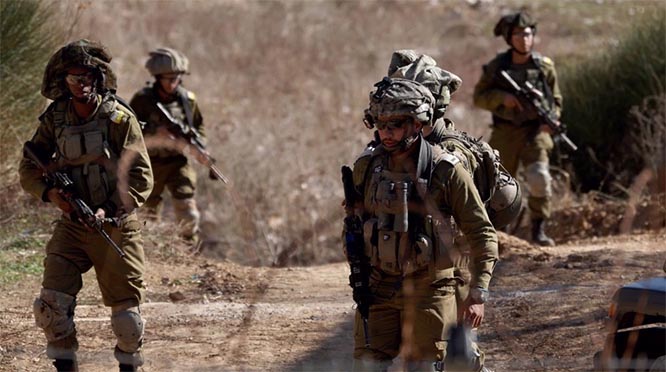
Israeli forces have pushed over the Syrian frontier, erecting a checkpoint and stopping vehicles in the southwestern city of Quneitra, in yet another breach of the Arab country’s sovereignty.

The violation took place on Sunday, when the troops made their way across the border, setting up the outpost near the Ain al-Bayda junction in northern Quneitra, Syrian outlets reported.

According to the al-Ikhbariya paper, an Israeli detachment positioned itself at the junction, halting cars and conducting searches.

The Syrian Arab News Agency (SANA) reported that three Israeli military vehicles then moved further into the northern countryside, deploying between the town of Jubata al-Khashab and the villages of Ofaniya and Ain al-Bayda. The agency added that a separate Israeli unit mounted a new incursion in the central region, approaching the villages of Umm Batina and al-Ajraf.

Residents said such activities have surged in recent months, pointing to Israeli advances onto farmland, leveling of extensive forested areas, arrests, and spread of mobile checkpoints.

The Israeli regime began markedly increasing its military aggression against Syria last year.

The escalation coincided with increasingly ferocious onslaughts throughout the country by the so-called Hay'at Tahrir al-Sham (HTS) Takfiri terrorist group, which the government of President Bashar al-Assad had confined to northwestern Syria. The HTS, however, managed to overthrow the government as the Israeli attacks would pummel the country’s civilian and defensive infrastructure.

Various reports have shown that, during the escalation, the regime conducted more than 1,000 airstrikes on the Syrian territory and over 400 ground raids into the south.

Following the collapse of the Assad government, Tel Aviv also widened its grip over the occupied Golan Heights by taking control of a demilitarized buffer zone, in defiance of a 1974 Disengagement Agreement. Earlier this month, senior Israeli officials, including Prime Minister Benjamin Netanyahu, visited the buffer zone, prompting expressions of alarm on the part of the United Nations.

The United States, the regime’s biggest ally, has, meanwhile, been fraternizing the HTS head Abu Mohammed al-Jolani amid the widely reported prospect of rapprochement with Tel Aviv.

Comments

Add new comment

  • Coastaldigest.com reserves the right to delete or block any comments.
  • Coastaldigset.com is not responsible for its readers’ comments.
  • Comments that are abusive, incendiary or irrelevant are strictly prohibited.
  • Please use a genuine email ID and provide your name to avoid reject.
News Network
December 6,2025

pilot.jpg

New Delhi: IndiGo, India’s largest airline, faced major operational turbulence this week after failing to prepare for new pilot-fatigue regulations issued by the Directorate General of Civil Aviation (DGCA). The stricter rules—designed to improve flight safety—took effect in phases through 2024, with the latest implementation on November 1. IndiGo has acknowledged that inadequate roster planning led to widespread cancellations and delays.

Below are the key DGCA rules that affected IndiGo’s operations:

1. Longer Mandatory Weekly Rest

Weekly rest for pilots has been increased from 36 hours to 48 hours.

The government says the extended break is essential to curb cumulative fatigue. This rule remains in force despite the current crisis.

2. Cap on Night Landings

Pilots can now perform only two night landings per week—a steep reduction from the earlier limit of six.

Night hours, defined as midnight to early morning, are considered the least alert period for pilots.

Given the disruptions, this rule has been temporarily relaxed for IndiGo until February 10.

3. Reduced Maximum Night Flight Duty

Flight duty that stretches into the night is now capped at 10 hours.

This measure has also been kept on hold for IndiGo until February 10 to stabilize operations.

4. Weekly Rest Cannot Be Replaced With Personal Leave

Airlines can no longer count a pilot’s personal leave as part of the mandatory 48-hour rest.

Pilots say this closes a loophole that previously reduced actual rest time.

Currently, all airlines are exempt from this rule to normalise travel.

5. Mandatory Fatigue Monitoring

Airlines must submit quarterly fatigue reports along with corrective actions to DGCA.

This system aims to create a transparent fatigue-tracking framework across the industry.

The DGCA has stressed that these rules were crafted to strengthen flight safety and align India with global fatigue-management standards. The temporary relaxations are expected to remain until February 2025, giving IndiGo time to stabilise its schedules and restore normal air travel.

Comments

Add new comment

  • Coastaldigest.com reserves the right to delete or block any comments.
  • Coastaldigset.com is not responsible for its readers’ comments.
  • Comments that are abusive, incendiary or irrelevant are strictly prohibited.
  • Please use a genuine email ID and provide your name to avoid reject.
News Network
November 26,2025

Mangaluru, Nov 26: Mangaluru East police have registered a case following a sophisticated online fraud where a 57-year-old local resident was allegedly cheated out of ₹13.4 lakh after being targeted on Facebook.

The scam began in February when the complainant, while browsing Facebook reels, was contacted by a woman identifying herself as "Lillian Mary George" from London. After establishing a chat relationship, the woman claimed she would visit India in November and bring a significant sum of money.

The trap was sprung on November 15, when the victim received a call from a woman named "Sonali Gupta," who claimed Lillian had arrived at Mumbai International Airport but was detained by customs. The fraudsters convinced the man that Lillian was carrying £25,000 (about ₹26 lakh) in traveller’s cheques and 1 kg of gold (valued at around ₹30 lakh).

Under the pretense of clearing these items, the victim was asked to make numerous online transfers between November 15 and 18 for various bogus charges, including:

•    "Pounds exchange registration"
•    "Customs declaration issues"
•    "Discount charges"
•    "Money-laundering charges"

Believing the fictitious story, the complainant transferred the cumulative sum of ₹13.4 lakh to various bank accounts provided by the fraudsters. He realised he was cheated when the culprits later promised a refund within two days but stopped answering his calls. The Mangaluru East police are now investigating the case, which highlights the continuing threat of transnational cyber fraud using social engineering and promises of fictitious wealth.

Comments

Add new comment

  • Coastaldigest.com reserves the right to delete or block any comments.
  • Coastaldigset.com is not responsible for its readers’ comments.
  • Comments that are abusive, incendiary or irrelevant are strictly prohibited.
  • Please use a genuine email ID and provide your name to avoid reject.
