



Air India plane overshoots runway in Jammu; airport closed

June 9, 2017

New Delhi, Jun 9: Almost 140 people on Air India's Delhi-Jammu flight on Friday afternoon had a narrow escape when the plane could not stop in time on the runway and went into the kutcha area at the end of the small airstrip in Jammu.
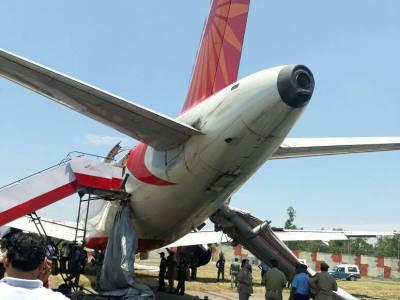
hit

According to sources, AI 821 had 134 passengers on board when the 23-year-old old Airbus A-320 (VT-ESL) touched down in Jammu. "The preliminary information is that pilots applied emergency braking too but the plane did not stop on the runway and overshot it. Four tyres got deflated. Passengers were evacuated using emergency chutes," said an official.

All passengers are learnt to be safe. However, it could not be ascertained by the time of filing this report if some people on board AI 821 sustained injuries during evacuation.

AI was going to very soon retire the classic A-320 which was among the first batch of planes erstwhile Indian Airlines had received in December 1994.

The critical for defence purposes Jammu runway is closed for other flights till the stuck aircraft is removed. All flights have reportedly been cancelled till the plane is removed. This includes the return flight VT-ESL had to operate to Delhi. Aircraft operations in Jammu take place only till sunset and unless the old Airbus is removed quickly, flight resumption may take a long time.

In fact, the Indian Air Force (IAF) had earlier this year asked airlines to station aircraft removal kits and trained personnel to operate them at its airports during meetings for deciding this summer schedule as sensitive defence airstrips are often blocked by schedule carriers' planes that get stuck there due to technical reasons for several hours, the. And IAF had warned that if airlines fail to do so their permission to operate flights to IAF airports like Jammu, Srinagar, Pune and Chandigarh could be cancelled this summer.

The minutes of a meeting aviation authorities had with airlines to finalise this summer schedule of domestic flights quote the the IAF representative saying: "Removal of disabled aircraft from runway: Operators are requested (to) provision equipment and trained manpower for removal of disabled aircraft from runway as this has serious aerospace safety ramifications. The approval of summer schedule is provisional and subject to operators fulfilling these conditions meticulously. Default, on this account, would render the clearances granted automatically invalid for operations of flights under summer schedule to IAF bases."

Schedule Indian carriers operate regular flights to about 20 defence airfields that have a civil enclave or passenger terminal. These include IAF bases like Gorakhpur, Allahabad and Bikaner and Naval bases like Goa's Dabolim and Vishakhapatnam. All these airports have only one runway. If a plane gets stuck there, the forces are unable to operate their fighter jets - something that has security implications.

Comments

Add new comment

  • Coastaldigest.com reserves the right to delete or block any comments.
  • Coastaldigset.com is not responsible for its readers’ comments.
  • Comments that are abusive, incendiary or irrelevant are strictly prohibited.
  • Please use a genuine email ID and provide your name to avoid reject.
News Network
December 13,2025

New Delhi: School-going children are picking up drug and smoking habits and engaging in consumption of alcohol, with the average age of introduction to such harmful substances found to be around 13 years, suggesting a need for earlier interventions as early as primary school, a multi-city survey by AIIMS-Delhi said.

The findings also showed substance use increased in higher grades, with grade XI/XII students two times more likely to report use of substances when compared with grade VIII students. This emphasised the importance of continued prevention and intervention through middle and high school.

The study led by Dr Anju Dhawan of AIIMS's National Drug Dependence Treatment Centre, published in the National Medical Journal of India this month, looks at adolescent substance use across diverse regions.

The survey included 5,920 students from classes 8, 9, 11 and 12 in urban government, private and rural schools across 10 cities -- Bengaluru, Chandigarh, Delhi, Dibrugarh, Hyderabad, Imphal, Jammu, Lucknow, Mumbai, and Ranchi. The data were collected between May 2018 and June 2019.

The average age of initiation for any substance was 12.9 (2.8) years. It was lowest for inhalants (11.3 years) followed by heroin (12.3 years) and opioid pharmaceuticals (without prescription; 12.5 years).

Overall, 15.1 per cent of participants reported lifetime use, 10.3 per cent reported past year use, and 7.2 per cent reported use in the past month of any substance, the study found.

The most common substances used in the past year, after tobacco (4 per cent) and alcohol (3.8 per cent), were opioids (2.8 per cent), followed by cannabis (2 per cent) and inhalants (1.9 per cent). Use of non-prescribed pharmaceutical opioids was most common among opioid users (90.2 per cent).

On being asked, 'Do you think this substance is easily available for a person of your age' separately for each substance category, nearly half the students (46.3 per cent) endorsed that tobacco products and more than one-third of the students (36.5 per cent) agreed that a person of their age can easily procure alcohol products.

Similarly, for Bhang (21.9 per cent), ganja/charas (16.1 per cent), inhalants (15.2 per cent), sedatives (13.7 per cent), opium and heroin (10 per cent each), the students endorsed that these can be easily procured.

About 95 per cent of the children, irrespective of their grade, agreed with the statement that 'drug use is harmful'.

The rates of substance use (any) among boys were significantly higher than those of girls for substance use (ever), use in the past year and use in the past 30 days. Compared to grade VIII students, grade IX students were more likely, and grade XI/XII students were twice as likely to have used any substance (ever).

The likelihood of past-year use of any substance was also higher for grade IX students and for grade XI/XII students as compared to grade VIII students.

About 40 per cent of students mentioned that they had a family member who used tobacco or alcohol each. The use of cannabis (any product) and opioid (any product) by a family member was reported by 8.2 per cent and 3.9 per cent of students, respectively, while the use of other substances, such as inhalants/sedatives by family was 2-3 per cent, the study found.

A relatively smaller percentage of students reported use of tobacco or alcohol among peers as compared to among family members, while a higher percentage reported inhalants, sedatives, cannabis or opioid use among peers.

Children using substances (past year) compared to non-users reported significantly higher any substance use by their family members and peers.

There were 25.7 per cent students who replied 'yes' to the question 'conflicts/fights often occur in your family'. Most students also replied affirmatively to 'family members are aware of how their time is being spent' and 'damily members are aware of with whom they spend their time'.

Comments

Add new comment

  • Coastaldigest.com reserves the right to delete or block any comments.
  • Coastaldigset.com is not responsible for its readers’ comments.
  • Comments that are abusive, incendiary or irrelevant are strictly prohibited.
  • Please use a genuine email ID and provide your name to avoid reject.