



Alok Verma ouster: Kharge dissents, questions CVC findings

Agencies
January 11, 2019

New Delhi, Jan 11: Congress leader Mallikarjun Kharge submitted a dissent note before the High Powered Committee, which decided the ouster of Alok Verma as the CBI Director, questioning the Central Vigilance Commission (CVC) findings against Verma.

Kharge, the lone dissenting voice in the high-powered selection committee in his note argued, why Verma should be restored with "full extent and authority of powers" under his office.

Verma was removed as the CBI Director on account of the extremely serious nature of observations made by the CVC against him. The CVC was of the view that being the head of a very sensitive organisation, Verma was not functioning with the integrity expected of him.

"CVC (Central Vigilance Commission) report submitted to the Supreme Court doesn't arrive at any conclusive finding with respect to allegations against him," Kharge's note accessed by ANI stated.

Kharge also demanded that Verma be allowed to continue as CBI Director for an additional period of 77 days to make up for the days lost when he was sent on leave.

"Having examined the contents of the CVC report, it is my considered opinion that Alok Verma be allowed to explain himself before this Committee, along with the charges made against him, prior to any decision being taken," the note further read.

A high-powered committee comprising Justice Sikri, Prime Minister Narendra Modi and Kharge met for over two hours on Thursday to decide the fate of Verma, who was reinstated by the Supreme Court earlier this week after he was sent on forced leave by the government.

Echoing similar sentiments, another senior Congress leader Kapil Sibal took to Twitter on Friday and wrote, "Alok Verma's removal. The Committee ensured the caged parrot did not fly away fearing the parrot might spill the beans by parroting the goings on in the corridors of power. The caged parrot will remain caged."

According to sources, the CVC found evidence of influencing of investigation in the Moin Qureshi case. There was also evidence of Verma taking bribe of Rs. 2 crore, the sources claimed.

The CVC was of the view that Verma's conduct in the case was "suspicious," and there was a "prima facie case" against him. The CVC also felt that the "entire truth will come out if a criminal investigation is ordered."

In the IRCTC case, the CVC felt that it can be reasonably concluded that Verma allegedly "deliberately excluded" a name from the FIR, for reasons "best known to him," the sources said.

The CVC found evidence against Verma in several other cases as well, the sources said, including instances of wilful non-production and fabrication of record. The Committee also took note of Verma's alleged attempts to induct officers of doubtful integrity in the CBI.

In response to the "insinuation" that he was not given a chance to be heard, the sources said that Verma was given an opportunity to present his case before the CVC in the presence of Retd. Justice Patnaik.

The Supreme Court also provided a copy of the CVC report to Verma's advocate, the sources claimed.

The Committee felt that as a detailed investigation, including criminal investigation, was necessary in some cases, Verma's continuation as CBI Director was not desirable, and he should be transferred, the sources mentioned.

Verma, a 1979-batch IPS officer, was posted as DG, Fire Services, Civil Defence, and Home Guards, two days after he was reinstated as the CBI Director by the Supreme Court. His reinstatement had come about two-and-a-half months after being divested of his powers and sent on leave by the government.

In his place, 1986-batch IPS officer M. Nageshwar Rao, who is Additional Director of CBI, will look after the duties of the Director, till the appointment of a new Director or until further orders, whichever is earlier, according to an order issued by the Department of Personnel and Training.

Comments

Add new comment

  • Coastaldigest.com reserves the right to delete or block any comments.
  • Coastaldigset.com is not responsible for its readers’ comments.
  • Comments that are abusive, incendiary or irrelevant are strictly prohibited.
  • Please use a genuine email ID and provide your name to avoid reject.
News Network
December 13,2025

New Delhi: School-going children are picking up drug and smoking habits and engaging in consumption of alcohol, with the average age of introduction to such harmful substances found to be around 13 years, suggesting a need for earlier interventions as early as primary school, a multi-city survey by AIIMS-Delhi said.

The findings also showed substance use increased in higher grades, with grade XI/XII students two times more likely to report use of substances when compared with grade VIII students. This emphasised the importance of continued prevention and intervention through middle and high school.

The study led by Dr Anju Dhawan of AIIMS's National Drug Dependence Treatment Centre, published in the National Medical Journal of India this month, looks at adolescent substance use across diverse regions.

The survey included 5,920 students from classes 8, 9, 11 and 12 in urban government, private and rural schools across 10 cities -- Bengaluru, Chandigarh, Delhi, Dibrugarh, Hyderabad, Imphal, Jammu, Lucknow, Mumbai, and Ranchi. The data were collected between May 2018 and June 2019.

The average age of initiation for any substance was 12.9 (2.8) years. It was lowest for inhalants (11.3 years) followed by heroin (12.3 years) and opioid pharmaceuticals (without prescription; 12.5 years).

Overall, 15.1 per cent of participants reported lifetime use, 10.3 per cent reported past year use, and 7.2 per cent reported use in the past month of any substance, the study found.

The most common substances used in the past year, after tobacco (4 per cent) and alcohol (3.8 per cent), were opioids (2.8 per cent), followed by cannabis (2 per cent) and inhalants (1.9 per cent). Use of non-prescribed pharmaceutical opioids was most common among opioid users (90.2 per cent).

On being asked, 'Do you think this substance is easily available for a person of your age' separately for each substance category, nearly half the students (46.3 per cent) endorsed that tobacco products and more than one-third of the students (36.5 per cent) agreed that a person of their age can easily procure alcohol products.

Similarly, for Bhang (21.9 per cent), ganja/charas (16.1 per cent), inhalants (15.2 per cent), sedatives (13.7 per cent), opium and heroin (10 per cent each), the students endorsed that these can be easily procured.

About 95 per cent of the children, irrespective of their grade, agreed with the statement that 'drug use is harmful'.

The rates of substance use (any) among boys were significantly higher than those of girls for substance use (ever), use in the past year and use in the past 30 days. Compared to grade VIII students, grade IX students were more likely, and grade XI/XII students were twice as likely to have used any substance (ever).

The likelihood of past-year use of any substance was also higher for grade IX students and for grade XI/XII students as compared to grade VIII students.

About 40 per cent of students mentioned that they had a family member who used tobacco or alcohol each. The use of cannabis (any product) and opioid (any product) by a family member was reported by 8.2 per cent and 3.9 per cent of students, respectively, while the use of other substances, such as inhalants/sedatives by family was 2-3 per cent, the study found.

A relatively smaller percentage of students reported use of tobacco or alcohol among peers as compared to among family members, while a higher percentage reported inhalants, sedatives, cannabis or opioid use among peers.

Children using substances (past year) compared to non-users reported significantly higher any substance use by their family members and peers.

There were 25.7 per cent students who replied 'yes' to the question 'conflicts/fights often occur in your family'. Most students also replied affirmatively to 'family members are aware of how their time is being spent' and 'damily members are aware of with whom they spend their time'.

Comments

Add new comment

  • Coastaldigest.com reserves the right to delete or block any comments.
  • Coastaldigset.com is not responsible for its readers’ comments.
  • Comments that are abusive, incendiary or irrelevant are strictly prohibited.
  • Please use a genuine email ID and provide your name to avoid reject.
News Network
December 22,2025

bhagavat.jpg

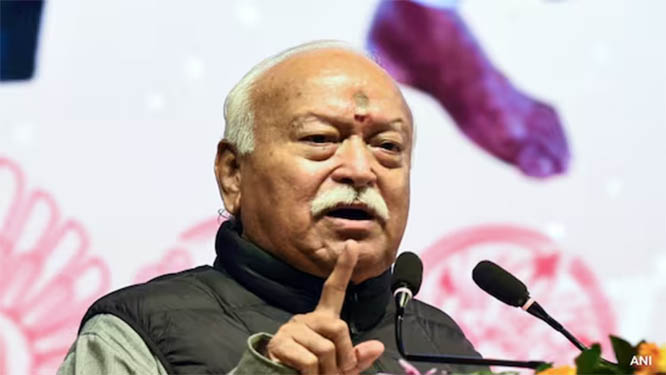
Kolkata: Stressing that India is a "Hindu nation," Rashtriya Swayamsevak Sangh (RSS) Chief Mohan Bhagwat on Sunday said that no constitutional approval is needed as it is the "truth".

Addressing an event marking 100 years of the RSS, Bhagwat said that India is, and will remain, a Hindu nation until Indian culture is appreciated in the country.

"The Sun rises in the east; we don't know since when this has been happening. So, do we need constitutional approval for that, too? Hindustan is a Hindu nation. Whoever considers India their motherland appreciates Indian culture, as long as there is even one person alive on the land of Hindustan who believes in and cherishes the glory of Indian ancestors, India is a Hindu nation. This is the ideology of the Sangh," he said at the '100 Vyakhyan Mala' program of RSS in Kolkata.

"If Parliament ever decides to amend the Constitution and add that word, whether they do it or not, it's fine. We don't care about that word because we are Hindus, and our nation is a Hindu nation. That is the truth. The caste system based on birth is not the hallmark of Hindutva," he added.

RSS has always argued that India is a "Hindu Nation," given the culture and majority's affiliations to Hinduism. However, 'secular' was not originally part of the Preamble of the Constitution, but it was added along with the word 'socialist' by the Constitution (42nd Amendment) Act, 1976, during the Emergency imposed by then Prime Minister Indira Gandhi.

Bhagwat also urged people to visit the organisation's offices and 'shakhas' to understand its work, so that what he dubbed as the “false perception” of the organisation as anti-Muslim can be dispelled!

Bhagwat said that people have understood that the organisation advocates for the protection of Hindus, and are "staunch nationalists," but not anti-muslim.

"If there is a perception that we are anti-Muslim, then, as I said, the RSS work is transparent. You can come anytime and see for yourself, and if you see anything like that happening, then you keep your views, and if you don't see it, then you change your views. There is a lot to understand (about RSS), but if you don't want to understand, then no one can change your mind," Bhagwat said.

He said, but anyone unwilling to learn cannot be helped.

"After seeing, people have said that you are staunch nationalists. You organise Hindus, and you advocate for the protection of Hindus. But you are not anti-Muslim. Many people have accepted this, and those who want to know more should come and see the RSS for themselves," he said.

Comments

Add new comment

  • Coastaldigest.com reserves the right to delete or block any comments.
  • Coastaldigset.com is not responsible for its readers’ comments.
  • Comments that are abusive, incendiary or irrelevant are strictly prohibited.
  • Please use a genuine email ID and provide your name to avoid reject.
News Network
December 16,2025

jordan.jpg

Prime Minister Narendra Modi on Monday held talks with Jordan’s King Abdullah II in Amman, during which the two leaders discussed ways to further strengthen bilateral relations, with the Prime Minister outlining an eight-point vision covering key areas of cooperation.

Describing the meeting as “productive”, PM Modi said he shared a roadmap focused on trade and economy, fertilisers and agriculture, information technology, healthcare, infrastructure, critical and strategic minerals, civil nuclear cooperation, and people-to-people ties.

In a post on social media platform X, the Prime Minister praised King Abdullah II’s personal commitment to advancing India–Jordan relations, particularly as both countries mark the 75th anniversary of the establishment of diplomatic ties this year.

“Held productive discussions with His Majesty King Abdullah II in Amman. His personal commitment towards vibrant India-Jordan relations is noteworthy. This year, we are celebrating the 75th anniversary of our bilateral diplomatic relations,” PM Modi said.

The meeting took place at the Al Husseiniya Palace, where the two leaders also exchanged views on regional and global issues of mutual interest. According to the Ministry of External Affairs (MEA), both sides agreed to further deepen cooperation in areas including trade and investment, defence and security, counter-terrorism and de-radicalisation, fertilisers and agriculture, infrastructure, renewable energy, tourism, and heritage.

The MEA said both leaders reaffirmed their united stand against terrorism.

PM Modi arrived in Amman earlier on Monday and was received by Jordanian Prime Minister Jafar Hassan, who accorded him a formal welcome. Following the talks, King Abdullah II hosted a banquet dinner in honour of the Prime Minister, reflecting the warmth of bilateral ties.

Jordan is the first leg of PM Modi’s three-nation tour. From Amman, the Prime Minister will travel to Ethiopia at the invitation of Prime Minister Abiy Ahmed Ali, marking his first official visit to the African nation. The tour will conclude with a visit to Oman.

Comments

Add new comment

  • Coastaldigest.com reserves the right to delete or block any comments.
  • Coastaldigset.com is not responsible for its readers’ comments.
  • Comments that are abusive, incendiary or irrelevant are strictly prohibited.
  • Please use a genuine email ID and provide your name to avoid reject.
