



Amit Shah: BJP's 'Chanakya' who delivered Modi Wave 2.0

Agencies
May 24, 2019

New Delhi, May 24: He combined BJP's core Hindutva plank with a hardcore nationalism agenda and set up a huge ground-level organisational setup to execute it the BJP's 'Chanakya' Amit Shah blazed such a trail that the 'Modi Wave 2.0' surpassed its own original avatar with a much bigger saffron surge.
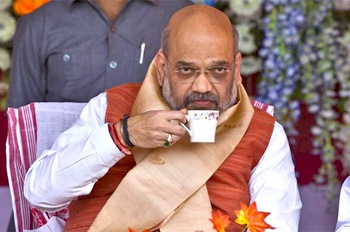
Known as an astute strategist whose non-political interests range from playing chess and watching cricket to stage performances and listening to classical music, 54-year-old Shah is often hailed as the BJP's most successful president for crafting its way to power states after states.

The record tally that he has now delivered for the BJP in the Lok Sabha 2019 elections is already being seen by many as something that would be difficult to repeat, though there are others who believe there is more to come as they point towards further inroads to be made in West Bengal, Odisha and in down South.

A man with avowed aim of having the BJP rule from "panchayat to Parliament", Shah has built his party into a formidable army that has been forever marching on since he took charge as its president in July 2014, turning India more saffron than it has ever been.

Political pundits say Shah has used a skilful mix of ideological firmness, unlimited political imagination and realpolitik flexibility to keep the BJP ahead of the game.

He ceded space in states like Bihar and Maharashtra to put allies at ease, worked on rival politicians with captive local vote banks to get them into the BJP fold, and sewed up new alliances as in Tamil Nadu and in the North East to boost his party's winning prospects.

And, unlike in the 90s when the BJP first came to power at the Centre, Shah ensured that his party made new friends without inviting the charge from its core voter base of diluting its core principles, ranging from Ram temple to cow, nationalism and Kashmir, for political gains.

If under Atal Bihari Vajpayee and L K Advani, the saffron party was seen as being inhibited in going all-out with its Hindutva plank for fear of antagonising allies and due to its perceived limited electoral appeal, the BJP has worn its Hindutva ideology on sleeve like a badge of honour under Prime Minister Narendra Modi and Shah.

Shah has been of a firm view that Hindutva combined with the BJP's hardcore nationalism agenda, though panned as shrill and divisive by its critics, render the party a distinct identity, and is a winning electoral strategy.

He has always believed that the allies would keep coming as long as the party is delivering in the polls.

Shah is also known to always match his limitless political ambition with thorough spadework, and then takes charge at the ground to put it into work.

When it emerged in 2015 that the BJP with its small allies was no match to the joint forces of Lalu Prasad and Nitish Kumar in Bihar, the party worked at winning over the JD(U) president, who finally broke his short alliance with Prasad in 2017 and joined hands with the former ally.

And when reports of disquiet within the JD(U) emerged with the alliance, Shah met Kumar and announced that both parties will contest an equal number of Lok Sabha seats in Bihar, virtually conceding the senior status to the regional party within the state.

In Maharashtra, where Shah had let ally Shiv Sena walk out of the alliance in the 2015 assembly polls so that the BJP can consolidate its position there, he offered a generous seat-sharing deal to the Hindutva ally for the all-important Lok Sabha polls.

In Uttar Pradesh with Yogi Adityanath at the helm as chief minister, Shah combined the Hindutva agenda with the Modi government's development plank to woo backward castes and bolster its traditional base of upper castes to take on a formidable SP-BSP combine.

Having risen through the ranks since starting at the booth level for the party in Gujarat at the age of 14 years, Shah is a firm believer in the prerequisite of a strong ground-level organisational machinery for poll successes.

In state after state, he has put in place robust organisational machinery for publicising the government schemes, carrying out political programmes and making full use of social media to reach out to voters.

For the 2019 elections, he deployed over 7,000 leaders for nearly 500 poll committee across the country, with special focus on 120 seats that the BJP had lost in 2014, and brought in 3,000 "full-timers" across parliamentary seats.

Seen as a Modi confidant, Shah also brought about cohesion between the government and the party, with the party leaders promoting the government's work and the ministers being used for the party work.

Leading from the front, Shah held over 161 rallies and visited over 312 Lok Sabha seats, clocking over 1.58 lakh km, more than any other leader.

After being given charge of the party, he was seen as Modi's hand-picked man to usher in changes to make it more attuned to the prime minister's vision. He did so, including by easing out veterans like L K Advani and Murli Manohar Joshi, cultivating a new band of younger leaders and by keeping the party firmly under his grip.

By all accounts, Shah has become to Modi what Advani was to Vajpayee, and may have crafted a success much bigger than that of the original Hindutva mascot.

Just a few months back, Shah said the BJP will remain in power for 50 years if it wins the 2019 elections. With 2019 done and dusted, he can be trusted to work at the "50-year" saffron rule in India.


Comments

Add new comment

  • Coastaldigest.com reserves the right to delete or block any comments.
  • Coastaldigset.com is not responsible for its readers’ comments.
  • Comments that are abusive, incendiary or irrelevant are strictly prohibited.
  • Please use a genuine email ID and provide your name to avoid reject.
News Network
December 15,2025

Udupi, Dec 15: What was meant to be a post-pilgrimage gathering turned tragic in Padukere village of Brahmavar taluk, Udupi district, late Sunday night, when a clash among youths escalated into a fatal assault, leaving one man dead.

The victim has been identified as 30-year-old Santosh Mogaveera, a resident of Padukere.

According to preliminary information, the incident took place during a late-night drinking party involving a group of local youths who had recently returned after completing their pilgrimage to the Sabarimala shrine. An argument reportedly broke out among the group and soon escalated into a violent confrontation.

During the ensuing brawl, Santosh Mogaveera was allegedly assaulted and collapsed at the spot after sustaining serious injuries. He was rushed by local residents to a private hospital in Brahmavar, where doctors declared him dead.

On receiving information, senior police officials, including Brahmavar Circle Inspector Gopikrishna, Kota Police Sub-Inspector Praveen Kumar T, Station ASI Manthesh Jabagoudar, and head constables Pradeep and Ashok, visited the spot and conducted an inspection.

Police have taken four youths into custody in connection with the incident. A case has been registered at the Kota police station, and further investigation is underway to ascertain the exact sequence of events leading to the death.

Comments

Add new comment

  • Coastaldigest.com reserves the right to delete or block any comments.
  • Coastaldigset.com is not responsible for its readers’ comments.
  • Comments that are abusive, incendiary or irrelevant are strictly prohibited.
  • Please use a genuine email ID and provide your name to avoid reject.
News Network
December 6,2025

pilot.jpg

New Delhi: IndiGo, India’s largest airline, faced major operational turbulence this week after failing to prepare for new pilot-fatigue regulations issued by the Directorate General of Civil Aviation (DGCA). The stricter rules—designed to improve flight safety—took effect in phases through 2024, with the latest implementation on November 1. IndiGo has acknowledged that inadequate roster planning led to widespread cancellations and delays.

Below are the key DGCA rules that affected IndiGo’s operations:

1. Longer Mandatory Weekly Rest

Weekly rest for pilots has been increased from 36 hours to 48 hours.

The government says the extended break is essential to curb cumulative fatigue. This rule remains in force despite the current crisis.

2. Cap on Night Landings

Pilots can now perform only two night landings per week—a steep reduction from the earlier limit of six.

Night hours, defined as midnight to early morning, are considered the least alert period for pilots.

Given the disruptions, this rule has been temporarily relaxed for IndiGo until February 10.

3. Reduced Maximum Night Flight Duty

Flight duty that stretches into the night is now capped at 10 hours.

This measure has also been kept on hold for IndiGo until February 10 to stabilize operations.

4. Weekly Rest Cannot Be Replaced With Personal Leave

Airlines can no longer count a pilot’s personal leave as part of the mandatory 48-hour rest.

Pilots say this closes a loophole that previously reduced actual rest time.

Currently, all airlines are exempt from this rule to normalise travel.

5. Mandatory Fatigue Monitoring

Airlines must submit quarterly fatigue reports along with corrective actions to DGCA.

This system aims to create a transparent fatigue-tracking framework across the industry.

The DGCA has stressed that these rules were crafted to strengthen flight safety and align India with global fatigue-management standards. The temporary relaxations are expected to remain until February 2025, giving IndiGo time to stabilise its schedules and restore normal air travel.

Comments

Add new comment

  • Coastaldigest.com reserves the right to delete or block any comments.
  • Coastaldigset.com is not responsible for its readers’ comments.
  • Comments that are abusive, incendiary or irrelevant are strictly prohibited.
  • Please use a genuine email ID and provide your name to avoid reject.
News Network
December 16,2025

Mangaluru, Dec 16: The Mangaluru City police have significantly escalated their campaign against drug trafficking, arresting 25 individuals and booking 12 cases under the Narcotic Drugs and Psychotropic Substances (NDPS) Act between November 30 and December 13. The crackdown resulted in the seizure of a substantial quantity of illicit substances, including 685.6 grams of MDMA and 1.5 kg of ganja.

The success of this recent drive has been significantly boosted by the city’s innovative, QR code-based anonymous reporting system.

"The anonymous reporting system has received an encouraging response. Several recent arrests were made based on inputs received through this system, helping police tighten the noose around drug peddlers," said the City Police Commissioner.

The latest arrests contribute to a robust year-to-date record, underscoring the police's relentless commitment to combating the drug menace.

Up to December 14 this year, the police have registered a total of 107 cases of drug peddling, leading to the arrest of 219 peddlers. Furthermore, they have booked 562 cases of drug consumption, resulting in the arrest of 671 individuals.

The scale of the seizure for the year reflects the magnitude of the problem being tackled: police have seized 320.6 kg of ganja worth ₹88.7 lakh and 1.4 kg of MDMA valued at ₹1.2 crore. Other significant seizures include hydro-weed ganja worth ₹94.7 lakh and cocaine worth ₹1.9 lakh, among others.

The Commissioner emphasized a policy of rigorous enforcement: "We ensure that peddlers are caught red-handed so that they cannot later dispute the case or claim innocence."

To counter the rising trend of substance abuse among youth, the Mangaluru City police have rolled out uniform guidelines for random drug testing across educational institutions.

As part of the drive, tests were conducted in approximately 100 institutions, screening an estimated 5,500 to 6,000 students in the first phase. 20 students tested positive for drug consumption during the initial screening.

Students who tested positive have been provided counselling and are scheduled for re-testing in the second quarter. The testing will also be expanded to students not covered in the first phase. In a move to ensure strict implementation, police personnel were deployed in mufti in some institutions. Reiterating a zero-tolerance stance, the Commissioner confirmed that random testing will continue, and colleges have also been instructed to conduct drug tests at the time of admission to deter substance abuse from an early stage.

Comments

Add new comment

  • Coastaldigest.com reserves the right to delete or block any comments.
  • Coastaldigset.com is not responsible for its readers’ comments.
  • Comments that are abusive, incendiary or irrelevant are strictly prohibited.
  • Please use a genuine email ID and provide your name to avoid reject.