Another setback for Mallya as UK court rejects permission to appeal

Agencies
July 26, 2018

London/New Delhi, Jul 26: The UK's Court of Appeal has refused Vijay Mallya the permission to appeal against a High Court order in favour of 13 Indian banks to recover funds amounting to nearly 1.145 billion pounds, in another setback to the embattled liquor tycoon.

The 62-year-old businessman, who is separately undergoing an extradition trial in a UK court over fraud and money laundering charges by the Indian authorities, had sought permission to appeal against the High Court order dated May 8.

In the ruling, Judge Andrew Henshaw had refused to overturn a worldwide order freezing Mallya's assets and also denied permission to appeal, which left Mallya with the only option of turning to the Court of Appeal.

Judge Henshaw's order marked the first recorded case of a judgement of the Debt Recovery Tribunal (DRT) in India being registered by the English High Court, setting a legal precedent.

The Court of Appeal judges looked into Mallya's application seeking permission to appeal and decided against it on Tuesday.

As a result of the High Court order, the Indian banks - State Bank of India, Bank of Baroda, Corporation Bank, Federal Bank Ltd, IDBI Bank, Indian Overseas Bank, Jammu & Kashmir Bank, Punjab & Sind Bank, Punjab National Bank, State Bank of Mysore, UCO Bank, United Bank of India and JM Financial Asset Reconstruction Co Pvt Ltd - have the right to enforce the Indian judgment against Mallya's assets in England and Wales.

"In the event, permission has been refused, then the decision of the judge is final and Mallya does not have any further recourse of appeal against his decision," said Kartik Mittal, Senior Solicitor at London-based Zaiwalla & Co LLP.

"The English judicial system does not give parties an unfettered right to appeal. The right to appeal is restricted. A party can only appeal a decision of the first instance Court if the first instance Court or the Appellate Court gives the party permission to appeal," he explained.

"A party is granted permission to appeal only in cases where the appeal appears to have a real prospect of success or there is some other compelling reason why the appeal should be heard. Therefore, in a majority of the cases permission is refused," he added.

In a related High Court ruling on June 26, Justice Bryan had issued an enforcement order in favour of the banks, granting permission to the UK High Court Enforcement Officer to enter Mallya's properties in Hertfordshire, near London, where he is based. While it is not an instruction to enter and that particular order can be appealed against, the banks have the option to use the order as one of the means to recover funds owed to them.

"The High Court Enforcement Officer, including any Enforcement Agent acting under his authority, may use reasonable force to enter the Property if necessary," it states. Mallya has since said that he has handed over a full statement of his UK assets to the court and there was no question of the use of force to enter his home Ladywalk in the village of Tewin in England.

The former Kingfisher Airlines boss had also issued a lengthy media statement last month, condemning the charges against him as politically motivated. He then took to social media to clarify that he made the statement "after a long period of silence" because he had filed an application before the Karnataka High Court on June 22, setting out available assets of approximately Rs 13,900 crores.

"Media reports quote an ED [Enforcement Directorate] official stating that I am attempting a plea bargain. Would respectfully suggest that the official read the ED charge sheet first," Mallya had said in his last Twitter message on the issue on June 30.

"I would invite the ED to advance the same plea bargain theory in Court in front of whom I have placed my assets," he said.

Meanwhile, Mallya remains on bail since his arrest on an extradition warrant in April last year. He will return for his extradition hearing at Westminster Magistrates' Court in London on July 31, when closing arguments are expected from the Crown Prosecution Service (CPS), acting on behalf of the Indian government, and Mallya's defence team.

A judgment is expected in the case at a later date, which will be arranged by Judge Emma Arbuthnot.

While the CPS claims it has successfully established a prima facie case of fraud against the businessman, Mallya's lawyers have sought to establish that the criminal charges against him are "without substance".

They have also challenged the case on human rights grounds, questioning the conditions at Arthur Road Jail in Mumbai, where the businessman is to be held post-extradition.


Comments

Add new comment

  • Coastaldigest.com reserves the right to delete or block any comments.
  • Coastaldigset.com is not responsible for its readers’ comments.
  • Comments that are abusive, incendiary or irrelevant are strictly prohibited.
  • Please use a genuine email ID and provide your name to avoid reject.
News Network
December 6,2025

pilot.jpg

New Delhi: IndiGo, India’s largest airline, faced major operational turbulence this week after failing to prepare for new pilot-fatigue regulations issued by the Directorate General of Civil Aviation (DGCA). The stricter rules—designed to improve flight safety—took effect in phases through 2024, with the latest implementation on November 1. IndiGo has acknowledged that inadequate roster planning led to widespread cancellations and delays.

Below are the key DGCA rules that affected IndiGo’s operations:

1. Longer Mandatory Weekly Rest

Weekly rest for pilots has been increased from 36 hours to 48 hours.

The government says the extended break is essential to curb cumulative fatigue. This rule remains in force despite the current crisis.

2. Cap on Night Landings

Pilots can now perform only two night landings per week—a steep reduction from the earlier limit of six.

Night hours, defined as midnight to early morning, are considered the least alert period for pilots.

Given the disruptions, this rule has been temporarily relaxed for IndiGo until February 10.

3. Reduced Maximum Night Flight Duty

Flight duty that stretches into the night is now capped at 10 hours.

This measure has also been kept on hold for IndiGo until February 10 to stabilize operations.

4. Weekly Rest Cannot Be Replaced With Personal Leave

Airlines can no longer count a pilot’s personal leave as part of the mandatory 48-hour rest.

Pilots say this closes a loophole that previously reduced actual rest time.

Currently, all airlines are exempt from this rule to normalise travel.

5. Mandatory Fatigue Monitoring

Airlines must submit quarterly fatigue reports along with corrective actions to DGCA.

This system aims to create a transparent fatigue-tracking framework across the industry.

The DGCA has stressed that these rules were crafted to strengthen flight safety and align India with global fatigue-management standards. The temporary relaxations are expected to remain until February 2025, giving IndiGo time to stabilise its schedules and restore normal air travel.

Comments

Add new comment

  • Coastaldigest.com reserves the right to delete or block any comments.
  • Coastaldigset.com is not responsible for its readers’ comments.
  • Comments that are abusive, incendiary or irrelevant are strictly prohibited.
  • Please use a genuine email ID and provide your name to avoid reject.
News Network
December 6,2025

pilot.jpg

New Delhi: IndiGo, India’s largest airline, faced major operational turbulence this week after failing to prepare for new pilot-fatigue regulations issued by the Directorate General of Civil Aviation (DGCA). The stricter rules—designed to improve flight safety—took effect in phases through 2024, with the latest implementation on November 1. IndiGo has acknowledged that inadequate roster planning led to widespread cancellations and delays.

Below are the key DGCA rules that affected IndiGo’s operations:

1. Longer Mandatory Weekly Rest

Weekly rest for pilots has been increased from 36 hours to 48 hours.

The government says the extended break is essential to curb cumulative fatigue. This rule remains in force despite the current crisis.

2. Cap on Night Landings

Pilots can now perform only two night landings per week—a steep reduction from the earlier limit of six.

Night hours, defined as midnight to early morning, are considered the least alert period for pilots.

Given the disruptions, this rule has been temporarily relaxed for IndiGo until February 10.

3. Reduced Maximum Night Flight Duty

Flight duty that stretches into the night is now capped at 10 hours.

This measure has also been kept on hold for IndiGo until February 10 to stabilize operations.

4. Weekly Rest Cannot Be Replaced With Personal Leave

Airlines can no longer count a pilot’s personal leave as part of the mandatory 48-hour rest.

Pilots say this closes a loophole that previously reduced actual rest time.

Currently, all airlines are exempt from this rule to normalise travel.

5. Mandatory Fatigue Monitoring

Airlines must submit quarterly fatigue reports along with corrective actions to DGCA.

This system aims to create a transparent fatigue-tracking framework across the industry.

The DGCA has stressed that these rules were crafted to strengthen flight safety and align India with global fatigue-management standards. The temporary relaxations are expected to remain until February 2025, giving IndiGo time to stabilise its schedules and restore normal air travel.

Comments

Add new comment

  • Coastaldigest.com reserves the right to delete or block any comments.
  • Coastaldigset.com is not responsible for its readers’ comments.
  • Comments that are abusive, incendiary or irrelevant are strictly prohibited.
  • Please use a genuine email ID and provide your name to avoid reject.
News Network
December 2,2025

DKSsiddu.jpg

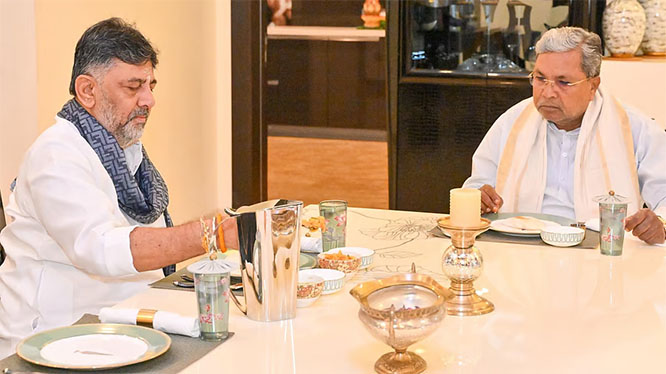
Bengaluru: 'Nati koli saaru' (country chicken curry) considered one of Chief Minister Siddaramaiah’s favourites along with steaming hot idlis was on the breakfast menu at Deputy CM D K Shivakumar’s residence on Tuesday, according to official sources.

The spread also included 'nati koli' fry, vada and pongal, among other items, they said.

In an apparent show of unity, Siddaramaiah visited Shivakumar’s residence for breakfast, just days after the two leaders shared a meal amid a simmering power tussle in the state Congress.

Siddaramaiah drove to the Deputy CM’s residence in Sadashivanagar, where he was received by Shivakumar and his brother D K Suresh, who is a former Congress MP.

Suresh and Kunigal MLA H D Ranganath, a relative of Shivakumar, joined them for breakfast, which featured a mix of vegetarian and non-vegetarian dishes.

Speaking to reporters later, Siddaramaiah said Shivakumar had invited him during his visit to the CM’s residence for breakfast on Saturday.

Asked about the difference between the two meals, the chief minister said, "At his (Shivakumar’s) house it was non-veg, while at my house it was veg. He is a vegetarian, I am a non-vegetarian. I had not prepared non-veg. I told DK to get chicken from the village as you won’t get the original in Bengaluru."

Shivakumar said he had initially invited Siddaramaiah to his residence, but the CM had suggested visiting his place first and reciprocating later. "It was a vegetarian breakfast at the CM’s house on Saturday," he noted.

"Today, I invited him (the CM) to my house. He enjoyed the breakfast, which had his Mysuru taste," Shivakumar added. At this point, Siddaramaiah remarked that Shivakumar’s wife is also from Mysuru.

Saturday’s breakfast at Siddaramaiah’s official residence, held as part of efforts by the Congress high command to ease tensions in the leadership dispute between the two, reportedly included idlis and sambar, according to official sources.

Comments

Add new comment

  • Coastaldigest.com reserves the right to delete or block any comments.
  • Coastaldigset.com is not responsible for its readers’ comments.
  • Comments that are abusive, incendiary or irrelevant are strictly prohibited.
  • Please use a genuine email ID and provide your name to avoid reject.