



Assam floods: 6 dead, over 8 lakh affected as situation worsens

Agencies
July 13, 2019

Guwahati, Jul 13: The Army was called for assistance in Assam as the flood situation in the state worsened on Friday with the toll rising to six and affecting nearly 8.7 lakh people across 21 districts.
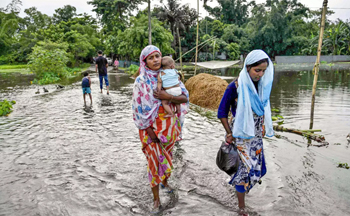
Officials said the Army's assistance was sought in Baksa district to aid the personnel of National Disaster Response Force and State Disaster Response Force in rescuing marooned people.

Assam State Disaster Management Authority (ASDMA) officials said three more persons died in rain and flood-related incidents in Golaghat and Dima Hasao districts Friday. While two persons died in the flood at Bokakhat revenue circle in Golaghat, one died in landslide in Haflong in Dima Hasao district.

It said about 8.7 lakh persons have been hit by the deluge in Dhemaji, Lakhimpur, Biswanath, Sonitpur, Darrang, Baksa, Barpeta, Nalbari, Chirang, Bongaigaon, Kokrajhar, Goalpara, Morigaon, Hojai, Nagaon, Golaghat, Majuli, Jorhat, Sivasagar, Dibrugarh and Tinsukia districts.

The state has a total of 33 districts and till yesterday three persons had died in floods and around 4.23 lakh people were affected in 17 districts.

Barpeta is the worst hit with 3.5 lakh people affected, followed by Dhemaji where 1.2 lakh people are hit. They are followed by Bongaigaon where the number of affected is 62,500, ASDMA said.

Massive erosions have taken place at various places in Chirang, Barpeta and Baksa due to the floods, which has submerged a total 1,556 villages and damaged 27,864.16 hectares of crop area, embankments, roads, bridges, culverts and other infrastructure in the affected districts.

The authorities are running 68 relief camps and distribution centres in 11 districts, where 7,643 people are taking shelter currently, ASDMA said.

The Army, NDRF and SDRF have rescued 1,160 persons in the state since Thursday and have distributed 1,281.35 quintals of rice, dal, salt and 1,493.46 litres of mustard oil, besides tarpaulin, water pouch, sanitary napkins, baby food and other essential items.

Currently, Brahmaputra is flowing above its danger-mark at Guwahati, at Nimatighat in Jorhat, Tezpur in Sonitpur and at Goalpara and Dhubri towns, it said.

Burhidehing river is flowing above its danger mark at Khowang in Dibrugarh, Desang river at Nanglamuraghat in Sivasagar, Dhansiri river at Numaligarh in Golaghat and Jia Bharali at NT Road Crossing in Sonitpur district. Kopili river is above the red at Kampur in Nagaon, Puthimari river at NH Road Crossing in Kamrup, Beki river at Road Bridge in Barpeta, Katakhal river at Matizuri in Hailakandi and Kushiyara river at Karimganj town, the ASDMA added.

With the Brahmaputra flowing 2.27 meters above the danger level at Neematighat, ferry services to and from Majuli island, which is Asia's largest river island, remained suspended for the fifth day Friday, Central Water Commission officials said here.

The Inland Water Transport Authority of the state government has kept two of its vessels ready loaded with anti-erosion materials to meet any situation in the erosion prone areas of the island.

The swirling floodwaters have forced the railway authority to control train services due to "settlement of tracks" in Lumding-Badarpur hill section, Northeast Frontier Railway Chief Public Relations Officer Pranav Jyoti Sharma said.

Heavy rains have affected the train tracks between Jatinga Lumpur to New Harangajao station in Lumding-Badarpur hill section of the NF Railway, he added.

As a result, some trains have either been cancelled or short terminated, Sharma said.

Kaziranga National Park, the famed habitat of the Great Indian Rhino and a World Heritage site, has been affected too forcing the authorities to set up road barricades on the National Highway passing through it to limit the speed of vehicles, said Kaziranga Divisional Forest Officer Ruhini Saikia.

The Golaghat administration has also imposed prohibitory orders under Section 144 CrPC in the areas near the park as the animals are coming out of it to go to the Karbi Anglong hills in search of safety in its high grounds.


Comments

Add new comment

  • Coastaldigest.com reserves the right to delete or block any comments.
  • Coastaldigset.com is not responsible for its readers’ comments.
  • Comments that are abusive, incendiary or irrelevant are strictly prohibited.
  • Please use a genuine email ID and provide your name to avoid reject.
News Network
December 13,2025

New Delhi: School-going children are picking up drug and smoking habits and engaging in consumption of alcohol, with the average age of introduction to such harmful substances found to be around 13 years, suggesting a need for earlier interventions as early as primary school, a multi-city survey by AIIMS-Delhi said.

The findings also showed substance use increased in higher grades, with grade XI/XII students two times more likely to report use of substances when compared with grade VIII students. This emphasised the importance of continued prevention and intervention through middle and high school.

The study led by Dr Anju Dhawan of AIIMS's National Drug Dependence Treatment Centre, published in the National Medical Journal of India this month, looks at adolescent substance use across diverse regions.

The survey included 5,920 students from classes 8, 9, 11 and 12 in urban government, private and rural schools across 10 cities -- Bengaluru, Chandigarh, Delhi, Dibrugarh, Hyderabad, Imphal, Jammu, Lucknow, Mumbai, and Ranchi. The data were collected between May 2018 and June 2019.

The average age of initiation for any substance was 12.9 (2.8) years. It was lowest for inhalants (11.3 years) followed by heroin (12.3 years) and opioid pharmaceuticals (without prescription; 12.5 years).

Overall, 15.1 per cent of participants reported lifetime use, 10.3 per cent reported past year use, and 7.2 per cent reported use in the past month of any substance, the study found.

The most common substances used in the past year, after tobacco (4 per cent) and alcohol (3.8 per cent), were opioids (2.8 per cent), followed by cannabis (2 per cent) and inhalants (1.9 per cent). Use of non-prescribed pharmaceutical opioids was most common among opioid users (90.2 per cent).

On being asked, 'Do you think this substance is easily available for a person of your age' separately for each substance category, nearly half the students (46.3 per cent) endorsed that tobacco products and more than one-third of the students (36.5 per cent) agreed that a person of their age can easily procure alcohol products.

Similarly, for Bhang (21.9 per cent), ganja/charas (16.1 per cent), inhalants (15.2 per cent), sedatives (13.7 per cent), opium and heroin (10 per cent each), the students endorsed that these can be easily procured.

About 95 per cent of the children, irrespective of their grade, agreed with the statement that 'drug use is harmful'.

The rates of substance use (any) among boys were significantly higher than those of girls for substance use (ever), use in the past year and use in the past 30 days. Compared to grade VIII students, grade IX students were more likely, and grade XI/XII students were twice as likely to have used any substance (ever).

The likelihood of past-year use of any substance was also higher for grade IX students and for grade XI/XII students as compared to grade VIII students.

About 40 per cent of students mentioned that they had a family member who used tobacco or alcohol each. The use of cannabis (any product) and opioid (any product) by a family member was reported by 8.2 per cent and 3.9 per cent of students, respectively, while the use of other substances, such as inhalants/sedatives by family was 2-3 per cent, the study found.

A relatively smaller percentage of students reported use of tobacco or alcohol among peers as compared to among family members, while a higher percentage reported inhalants, sedatives, cannabis or opioid use among peers.

Children using substances (past year) compared to non-users reported significantly higher any substance use by their family members and peers.

There were 25.7 per cent students who replied 'yes' to the question 'conflicts/fights often occur in your family'. Most students also replied affirmatively to 'family members are aware of how their time is being spent' and 'damily members are aware of with whom they spend their time'.

Comments

Add new comment

  • Coastaldigest.com reserves the right to delete or block any comments.
  • Coastaldigset.com is not responsible for its readers’ comments.
  • Comments that are abusive, incendiary or irrelevant are strictly prohibited.
  • Please use a genuine email ID and provide your name to avoid reject.
coastaldigest.com news network
December 20,2025

Mangaluru, Dec 20: City Police Commissioner Sudheer Kumar Reddy has issued a high-alert warning to vehicle owners regarding a surge in cyber fraud targeting those looking to pay traffic violation fines. Fraudsters are reportedly exploiting recent government discount schemes on traffic penalties to deceive citizens.

The Scam: How Fraudsters Strike

Criminals are using SMS, WhatsApp, and social media to circulate suspicious links and APK files (Android application packages). They claim these apps allow users to pay e-challans at a discount.

•    Device Hacking: Downloading these unauthorized apps gives hackers full access to the victim's smartphone.

•    Financial Theft: Once the phone is compromised, fraudsters intercept OTPs and personal data to drain bank accounts.

•    Phishing Sites: Fake websites mimicking official portals are also being used to harvest banking credentials.

Already, two residents within Mangaluru city limits have reported significant financial losses after falling victim to these fraudulent apps.

Comments

Add new comment

  • Coastaldigest.com reserves the right to delete or block any comments.
  • Coastaldigset.com is not responsible for its readers’ comments.
  • Comments that are abusive, incendiary or irrelevant are strictly prohibited.
  • Please use a genuine email ID and provide your name to avoid reject.
News Network
December 16,2025

bengal.jpg

The deletion of over 58 lakh names from West Bengal’s draft electoral rolls following a Special Intensive Revision (SIR) has sparked widespread concern and is likely to deepen political tensions in the poll-bound state.

According to the Election Commission, the revision exercise has identified 24 lakh voters as deceased, 19 lakh as relocated, 12 lakh as missing, and 1.3 lakh as duplicate entries. The draft list, published after the completion of the first phase of SIR, aims to remove errors and duplication from the electoral rolls.

However, the scale of deletions has raised fears that a large number of eligible voters may have been wrongly excluded. The Election Commission has said that individuals whose names are missing can file objections and seek corrections. The final voter list is scheduled to be published in February next year, after which the Assembly election announcement is expected. Notably, the last Special Intensive Revision in Bengal was conducted in 2002.

The development has intensified the political row over the SIR process. Chief Minister Mamata Banerjee and her Trinamool Congress have strongly opposed the exercise, accusing the Centre and the Election Commission of attempting to disenfranchise lakhs of voters ahead of the elections.

Addressing a rally in Krishnanagar earlier this month, Banerjee urged people to protest if their names were removed from the voter list, alleging intimidation during elections and warning of serious consequences if voting rights were taken away.

The BJP, meanwhile, has defended the revision and accused the Trinamool Congress of politicising the issue to protect what it claims is an illegal voter base. Leader of the Opposition Suvendu Adhikari alleged that the ruling party fears losing power due to the removal of deceased, fake, and illegal voters.

The controversy comes amid earlier allegations by the Trinamool Congress that excessive work pressure during the SIR led to the deaths by suicide of some Booth Level Officers (BLOs), for which the party blamed the Election Commission. With the draft list now out, another round of political confrontation appears imminent.

As objections begin to be filed, the focus will be on whether the correction mechanism is accessible, transparent, and timely—critical factors in ensuring that no eligible voter is denied their democratic right ahead of a crucial election.

Comments

Add new comment

  • Coastaldigest.com reserves the right to delete or block any comments.
  • Coastaldigset.com is not responsible for its readers’ comments.
  • Comments that are abusive, incendiary or irrelevant are strictly prohibited.
  • Please use a genuine email ID and provide your name to avoid reject.