



BJP's rise to prominence riding on Ram Janmabhoomi issue

News Network
November 9, 2019

New Delhi, Nov 9: The Supreme Court verdict paving the way for the construction of Ram temple in Ayodhya has brought to the fore the decades-old Ram Janmabhoomi movement which propelled the BJP from the fringes of national politics to becoming a dominant political force as it used the deeply emotive issue to mobilise Hindus.
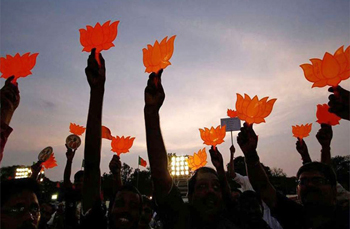
Struggling to find a space in the country's politics dominated by secular parties, the BJP under L K Advani hitched its bandwagon to the temple cause in its Palampur resolution in 1989, giving a defining Hindutva edge to its politics which until then had lacked a popular cause celebre.

The issue combined with its alliance with anti-Congress parties in 1989 won the BJP 85 seats in Lok Sabha elections against a mere two in 1984.

It came to the party's rescue again in 1990 when caste politics, fuelled by the then VP Singh government's decision to adopt the Mandal Commission report on the reservation, began to dominate Indian politics.

Advani launched his famous 'Rath Yatra' from Somnath temple in Gujarat, drawing people in their thousands as his chariot rolled through the country's heartland, at times triggering communal riots as well, while the movement gained momentum.

The demolition of Babri Masjid at the disputed site on December 6, 1992, made the party a pariah in politics for a while but could not stop its rise to power.

Speaking of the movement's role in the BJP's rise, Manindra Nath Thakur, an associate professor at the Centre for Political Studies of JNU, told PTI, "It played a very important role. It gave a symbol to the BJP to fight elections as it did not have a proper symbol earlier, as the Congress had in the legacy of freedom struggle. Mahatma Gandhi was also a great symbol for Congress."

The issue gave the BJP "the symbol of Lord Ram" which it converted "into an aggressive plank in organising the Hindu majoritarian politics", he said.

Incidentally, it was the decision to put the issue of temple construction and other core contentious matters like the Uniform Civil Code on the back burner in the late 1990s in its quest to win allies to form government at the Centre that halted the BJP's political rise before the Congress ousted it from power in 2004.

It took the BJP a full decade to capture the power again after Narendra Modi, then the Gujarat chief minister, combined his aggressive Hindutva image with development plank and catapulted the party to its maiden majority in Lok Sabha in 2014 and then bettering the show in 2019.

With the apex court verdict likely to put a closure to decades-old dispute, Arun Anand, a prolific commentator and author of two books on the RSS, said the demand of a Ram temple in Ayodhya is "unarguably the longest movement in the history of any civilization".

"The mass movement that started in 1983 not only brought greater awareness about the identity of the nation but also made a huge impact in all spheres of national life. It has created a consensus on the legitimacy of the demand to construct a Ram Temple at Lord Rama's birthplace," he said.

Hindus had begun agitating to reclaim the land from 1528 before a mass movement restarted in 1983-84, he said, adding that the community fought many battles and sacrificed lives.

It will be curious to see as to what turn the BJP's Hindutva politics takes following the verdict, according to political watchers.

Thakur cautioned that if the party now takes up the issues of other disputed holy sites like the ones in Mathura and Varanasi, then it will be "dangerous" for politics.

However, if the judgement leads to the issue's resolution for good and the party moving on to matters like the economy, then things may settle.

Comments

Add new comment

  • Coastaldigest.com reserves the right to delete or block any comments.
  • Coastaldigset.com is not responsible for its readers’ comments.
  • Comments that are abusive, incendiary or irrelevant are strictly prohibited.
  • Please use a genuine email ID and provide your name to avoid reject.
News Network
December 15,2025

Mangaluru, Dec 15: Air India Express has announced that it will resume direct flight services between Mangaluru and Muscat from March 2026, restoring an important international air link for passengers from the coastal region.

Airport authorities said the service will operate twice a week—on Sundays and Tuesdays—from March 1. The initial flights are scheduled on March 3, 8 and 10, followed by March 15 and 17, with the same operating pattern to continue thereafter. The flight duration is approximately three hours and 25 minutes.

The Mangaluru–Muscat route was earlier operated under the 2025 summer schedule, with services beginning on July 14. At that time, Air India Express had operated four flights a week before suspending the service.

Officials said the summer schedule will come into effect from March 29, after which changes in flight timings and departure schedules from Mangaluru are expected. Passengers have been advised to check the latest schedules while planning their travel.

The resumption of direct flights to Muscat is expected to significantly benefit expatriates, business travellers and others, further strengthening Mangaluru’s air connectivity with the Gulf region.

Comments

Add new comment

  • Coastaldigest.com reserves the right to delete or block any comments.
  • Coastaldigset.com is not responsible for its readers’ comments.
  • Comments that are abusive, incendiary or irrelevant are strictly prohibited.
  • Please use a genuine email ID and provide your name to avoid reject.
coastaldigest.com news network
December 20,2025

Mangaluru, Dec 20: City Police Commissioner Sudheer Kumar Reddy has issued a high-alert warning to vehicle owners regarding a surge in cyber fraud targeting those looking to pay traffic violation fines. Fraudsters are reportedly exploiting recent government discount schemes on traffic penalties to deceive citizens.

The Scam: How Fraudsters Strike

Criminals are using SMS, WhatsApp, and social media to circulate suspicious links and APK files (Android application packages). They claim these apps allow users to pay e-challans at a discount.

•    Device Hacking: Downloading these unauthorized apps gives hackers full access to the victim's smartphone.

•    Financial Theft: Once the phone is compromised, fraudsters intercept OTPs and personal data to drain bank accounts.

•    Phishing Sites: Fake websites mimicking official portals are also being used to harvest banking credentials.

Already, two residents within Mangaluru city limits have reported significant financial losses after falling victim to these fraudulent apps.

Comments

Add new comment

  • Coastaldigest.com reserves the right to delete or block any comments.
  • Coastaldigset.com is not responsible for its readers’ comments.
  • Comments that are abusive, incendiary or irrelevant are strictly prohibited.
  • Please use a genuine email ID and provide your name to avoid reject.
News Network
December 13,2025

New Delhi: School-going children are picking up drug and smoking habits and engaging in consumption of alcohol, with the average age of introduction to such harmful substances found to be around 13 years, suggesting a need for earlier interventions as early as primary school, a multi-city survey by AIIMS-Delhi said.

The findings also showed substance use increased in higher grades, with grade XI/XII students two times more likely to report use of substances when compared with grade VIII students. This emphasised the importance of continued prevention and intervention through middle and high school.

The study led by Dr Anju Dhawan of AIIMS's National Drug Dependence Treatment Centre, published in the National Medical Journal of India this month, looks at adolescent substance use across diverse regions.

The survey included 5,920 students from classes 8, 9, 11 and 12 in urban government, private and rural schools across 10 cities -- Bengaluru, Chandigarh, Delhi, Dibrugarh, Hyderabad, Imphal, Jammu, Lucknow, Mumbai, and Ranchi. The data were collected between May 2018 and June 2019.

The average age of initiation for any substance was 12.9 (2.8) years. It was lowest for inhalants (11.3 years) followed by heroin (12.3 years) and opioid pharmaceuticals (without prescription; 12.5 years).

Overall, 15.1 per cent of participants reported lifetime use, 10.3 per cent reported past year use, and 7.2 per cent reported use in the past month of any substance, the study found.

The most common substances used in the past year, after tobacco (4 per cent) and alcohol (3.8 per cent), were opioids (2.8 per cent), followed by cannabis (2 per cent) and inhalants (1.9 per cent). Use of non-prescribed pharmaceutical opioids was most common among opioid users (90.2 per cent).

On being asked, 'Do you think this substance is easily available for a person of your age' separately for each substance category, nearly half the students (46.3 per cent) endorsed that tobacco products and more than one-third of the students (36.5 per cent) agreed that a person of their age can easily procure alcohol products.

Similarly, for Bhang (21.9 per cent), ganja/charas (16.1 per cent), inhalants (15.2 per cent), sedatives (13.7 per cent), opium and heroin (10 per cent each), the students endorsed that these can be easily procured.

About 95 per cent of the children, irrespective of their grade, agreed with the statement that 'drug use is harmful'.

The rates of substance use (any) among boys were significantly higher than those of girls for substance use (ever), use in the past year and use in the past 30 days. Compared to grade VIII students, grade IX students were more likely, and grade XI/XII students were twice as likely to have used any substance (ever).

The likelihood of past-year use of any substance was also higher for grade IX students and for grade XI/XII students as compared to grade VIII students.

About 40 per cent of students mentioned that they had a family member who used tobacco or alcohol each. The use of cannabis (any product) and opioid (any product) by a family member was reported by 8.2 per cent and 3.9 per cent of students, respectively, while the use of other substances, such as inhalants/sedatives by family was 2-3 per cent, the study found.

A relatively smaller percentage of students reported use of tobacco or alcohol among peers as compared to among family members, while a higher percentage reported inhalants, sedatives, cannabis or opioid use among peers.

Children using substances (past year) compared to non-users reported significantly higher any substance use by their family members and peers.

There were 25.7 per cent students who replied 'yes' to the question 'conflicts/fights often occur in your family'. Most students also replied affirmatively to 'family members are aware of how their time is being spent' and 'damily members are aware of with whom they spend their time'.

Comments

Add new comment

  • Coastaldigest.com reserves the right to delete or block any comments.
  • Coastaldigset.com is not responsible for its readers’ comments.
  • Comments that are abusive, incendiary or irrelevant are strictly prohibited.
  • Please use a genuine email ID and provide your name to avoid reject.