



Book traces evolution of campaigning in India elections

Agencies
September 22, 2019

New Delhi, Sept 22: A new book traces the evolution of election campaigns in India by focusing on key players, rise and fall of political parties, role of digital and technology platforms, and emergence of fake news impacting poll outcome in the country and across the world.

In “The Game of Votes: Visual Media Politics and Elections in the Digital Era”, author Farhat Basir Khan argues that traditional ways of poll campaigns are no longer effective or enough to gain the attention of voters.

“Political branding, image management, crisis communication, data analytics, microblogging, and most importantly, short crisp videos hold the key for today’s elections,” he says.

In the early general elections, political parties used newspapers, public meetings and door-to-door canvassing to convey their messages, policies, manifesto and information about the party.

With rapid advancement and industrialisation, the traditional methodologies of electoral campaigning also changed dramatically and gave rise to an even higher proliferation of modern media technologies, he says.

The book traces the changing political and media landscape beginning with the tepid elections of the 1950s to the feverish social media-driven elections of the 21st century, from the heady post-Independence Nehruvian era to the frenzied victory of Narendra Modi in 2019.

Former President Pranab Mukherjee has written the foreword to the book, published by SAGE, terms it as a reflection on the mood swings of the "unpredictable but very intelligent" Indian voter.

“The book looks at the role of technology platforms, micro-profiling voters, clash of personalities and the rise of the ‘national champion’ - all of which have been dealt with in detail," he writes.

The book discusses the art of forging political alliances, the overwhelming influence of social media companies in global politics, the menace of fake news and the worldwide rise of right-wing politics.

“The unpredictable rise of brand Modi, his inexplicable persona, style of politics and vote-conversion abilities are contrasted with the losing sheen of the Nehru-Gandhi dynasty, loss of confidence in the Congress and electoral reverses for the party,” it says.

The book also looks back at former US president Barack Obama’s and incumbent Donald Trump’s elections where social media, particularly Facebook, played a major role in the campaigns.

“What the pundits had not reckoned with was the impact the newer kid on the block - WhatsApp will have, considering its mega role in making viral news elements that are volatile, insidious and fake,” Khan, a faculty member at AJK Mass Communication Research Centre, Jamia Millia Islamia, says.

He critically looks at how new media companies and platforms have been used to the hilt by election campaign managers.

The book highlights the fact that social media has not just become a daily battleground for fake news but has spread its tentacles around the core of Indian democracy - its free and fair elections.

According to Khan, social media helps to overcome the barrier of means in communication that in turn enables strengthened relationships between voters or advocates and politicians. And when it comes to election campaigns, social media becomes the digital version of the election rallies held on the ground.

There are, however, repercussions - trolls, shaming, morphing and social bullying are the other side of the story. Yet, it allows the politician to focus on the target voter group more earnestly than on-field where they are an inseparable part of the crowd, he says.

He argues that the BJP’s way of using social media is different.

“It pushed as much information as possible to saturate and overwhelm the mind of an average Indian with information, not really allowing too much space for further consideration, and driving him to opt for a hurried, if not impetuous, decision on who he chooses to govern the nation for next five years.”

In one of the chapters, Khan tries to decipher the visual imagery in the newspapers during the 2014 Indian elections.

“The patterns that emerged from the analysis are a clear indication of a robust and well-thought photographic communication strategy in place; it does not seem to be just happenstance or coincidence.

“The BJP was the only party with visible and consistent patterns in their use of photographs. They maintained a constant flow of photographic communication in both the newspapers depicting their focus on the use of newspapers for the dissemination of messages,” he writes.

Comments

Add new comment

  • Coastaldigest.com reserves the right to delete or block any comments.
  • Coastaldigset.com is not responsible for its readers’ comments.
  • Comments that are abusive, incendiary or irrelevant are strictly prohibited.
  • Please use a genuine email ID and provide your name to avoid reject.
coastaldigest.com news network
December 20,2025

Mangaluru, Dec 20: City Police Commissioner Sudheer Kumar Reddy has issued a high-alert warning to vehicle owners regarding a surge in cyber fraud targeting those looking to pay traffic violation fines. Fraudsters are reportedly exploiting recent government discount schemes on traffic penalties to deceive citizens.

The Scam: How Fraudsters Strike

Criminals are using SMS, WhatsApp, and social media to circulate suspicious links and APK files (Android application packages). They claim these apps allow users to pay e-challans at a discount.

•    Device Hacking: Downloading these unauthorized apps gives hackers full access to the victim's smartphone.

•    Financial Theft: Once the phone is compromised, fraudsters intercept OTPs and personal data to drain bank accounts.

•    Phishing Sites: Fake websites mimicking official portals are also being used to harvest banking credentials.

Already, two residents within Mangaluru city limits have reported significant financial losses after falling victim to these fraudulent apps.

Comments

Add new comment

  • Coastaldigest.com reserves the right to delete or block any comments.
  • Coastaldigset.com is not responsible for its readers’ comments.
  • Comments that are abusive, incendiary or irrelevant are strictly prohibited.
  • Please use a genuine email ID and provide your name to avoid reject.
News Network
December 6,2025

indigoticket.jpg

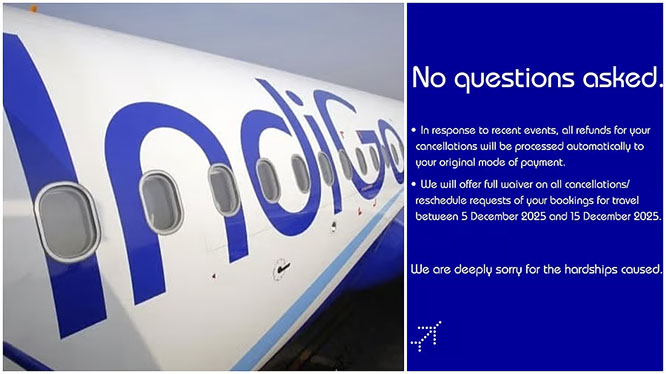
With IndiGo flight disruptions impacting thousands of passengers, the airline on Saturday said that it will offer full waiver on all cancellations/reschedule requests for travel bookings between December 5, 2025 and December 15, 2025.

Earlier in the day, the civil aviation ministry had directed the airline to complete the ticket refund process for the cancelled flights by Sunday evening, as well as ensure baggage separated from the travellers are delivered in the next two days.

In a post on X, titled 'No questions asked', IndiGo wrote, "In response to recent events, all refunds for your cancellations will be processed automatically to your original mode of payment."

"We are deeply sorry for the hardships caused," it further added.

Several passengers, however, complained of not getting full refund as promised by the airline.

Netizens have shared screenchots of getting charged for airline cancellation fee and convenience fee.

"Please tell me why u have did this airline cancellation charges when u say full amount will be refunded (sic)," a user wrote sharing a screenshot of the refund page.

"Well, but you have still debited the convenience charges," wrote another.

Passengers have also raised concerns about the "cancel" option being disabled on the IndiGo app. "First enable the 'Cancel' button on your App & offer full refund on tickets cancelled by customers between the said dates," wrote a user.

A day after the country's largest airline, IndiGo, cancelled more than 1,000 flights and caused disruptions for the fifth day on Saturday, the ministry said that any delay or non-compliance in refund processing will invite immediate regulatory action.

The refund process for all cancelled or disrupted flights must be completed by 8 pm on Sunday, the ministry said in a statement.

"Airlines have also been instructed not to levy any rescheduling charges for passengers whose travel plans were affected by cancellations," it said.

On Saturday, more than 400 flights were cancelled at various airports.

IndiGo has also been instructed to set up dedicated passenger support and refund facilitation cells.

Comments

Add new comment

  • Coastaldigest.com reserves the right to delete or block any comments.
  • Coastaldigset.com is not responsible for its readers’ comments.
  • Comments that are abusive, incendiary or irrelevant are strictly prohibited.
  • Please use a genuine email ID and provide your name to avoid reject.
News Network
December 6,2025

pilot.jpg

New Delhi: IndiGo, India’s largest airline, faced major operational turbulence this week after failing to prepare for new pilot-fatigue regulations issued by the Directorate General of Civil Aviation (DGCA). The stricter rules—designed to improve flight safety—took effect in phases through 2024, with the latest implementation on November 1. IndiGo has acknowledged that inadequate roster planning led to widespread cancellations and delays.

Below are the key DGCA rules that affected IndiGo’s operations:

1. Longer Mandatory Weekly Rest

Weekly rest for pilots has been increased from 36 hours to 48 hours.

The government says the extended break is essential to curb cumulative fatigue. This rule remains in force despite the current crisis.

2. Cap on Night Landings

Pilots can now perform only two night landings per week—a steep reduction from the earlier limit of six.

Night hours, defined as midnight to early morning, are considered the least alert period for pilots.

Given the disruptions, this rule has been temporarily relaxed for IndiGo until February 10.

3. Reduced Maximum Night Flight Duty

Flight duty that stretches into the night is now capped at 10 hours.

This measure has also been kept on hold for IndiGo until February 10 to stabilize operations.

4. Weekly Rest Cannot Be Replaced With Personal Leave

Airlines can no longer count a pilot’s personal leave as part of the mandatory 48-hour rest.

Pilots say this closes a loophole that previously reduced actual rest time.

Currently, all airlines are exempt from this rule to normalise travel.

5. Mandatory Fatigue Monitoring

Airlines must submit quarterly fatigue reports along with corrective actions to DGCA.

This system aims to create a transparent fatigue-tracking framework across the industry.

The DGCA has stressed that these rules were crafted to strengthen flight safety and align India with global fatigue-management standards. The temporary relaxations are expected to remain until February 2025, giving IndiGo time to stabilise its schedules and restore normal air travel.

Comments

Add new comment

  • Coastaldigest.com reserves the right to delete or block any comments.
  • Coastaldigset.com is not responsible for its readers’ comments.
  • Comments that are abusive, incendiary or irrelevant are strictly prohibited.
  • Please use a genuine email ID and provide your name to avoid reject.
