


CAA Debate: Falsehoods to the Fore

Ram Puniyani
December 28, 2019

Citizenship Amendment Bill, while passed in both houses of Parliament has elicited diverse and negative responses all over India. On one hand we see massive protests in North East leading to death of four people. On the other there is a sever discomfort among those upholding Indian Constitution and among the Muslim community all over the country. This Bill in its present form gives the rights of citizenship to Hindus, Sikhs, Buddhists, Jains and Christians persecuted in Afghanistan, Pakistan and Bangle Desh. What is glaring is that Muslims are missing from the list. What is glaring and dangerous is that while those persecuted in these countries have been offered citizenship, the Countries like Myanmar, where worst persecution against Muslims has been seen in recent years, don’t fins any place in the list. Also even in the countries which are mentioned in the bill, there are sects of Muslims which are persecuted, but have been left out.

A lots has been written against the bill and its intention of converting our plural India into Hindu rashtra, what is also disturbing is that the defense of this Bill has been done by blaming Congress and by stating that partition was done on the basis of faith! Both these formulation are a total lie. Mr. Amit Shah while speaking in Rajya Sabha in an aggressive manner retorted that “Is desh ka vibhajan agar dharma ke aadhar par Congress na kari hoti to is Bill ka kaam nahin hota (Had the Congress not partitioned this country on the basis of religion, there would have been no need for this Bill).” In response Shahshi Tharoor of Congress said that Amit Shah was not paying attention to History class. The facts lie somewhere else.

Mr. Shah was a RSS worker who later joined RSS student wing ABVP. Contrary to what Shashi Tharoor is saying Shah has imbibed the history taught by RSS combine and seriously internalized it. We recall that even Nathuram Godse the murderer of Father of Nation, also held Gandhi, the patriarch of Congress, as being responsible for partition.  This is believed by most of the Hindu nationalists. Religion as the basis of Nationhood is by and large attributed to begin with Savarkar and then Jinnah. As such the story is much older. Before coming to roots of genesis of the idea of religion as the root of Nationhood, we also need to remember that, the British, the colonial masters, were the prime force in encouraging Muslim League on one side and Hindu Mahasabha-RSS on the other.

The British, to begin with, saw these organizations as helpful in the pursuing their ‘divide and rule’ policy. Later close to the peaking of National movement in 1942, they started keeping yet another angle in their mind. This was the geo-political realities of those times. Russia had emerged as the major other pole in the power politics of the World. It was posing the challenge to British-American hegemony of the World. Russia was also inspiring the anti colonial movements. Many of the leaders of freedom movement were influenced by socialist ideology. Keeping this in mind, division of India was one of the steps in the mind of British. The idea behind this was that they can retain their hold in the region through yet to be formed Pakistan.

Coming to the genesis of nationalism in the name of religion, it was the reaction of declining classes’, landlords and Kings, to the changing scenario, where through Industrialization, communication and modern education, India was emerging as a secular democratic nation. Different groups, Madras Mahajan Sabha, Pune Sarvjakik Sabha, Bombay Association, representing the emerging classes and newer social changes started coming up and as they formed the political organization Indian National Congress in 1885. In response to this declining classes became very uncomfortable with the changes which were the root of equality. The feudal classes, Landlords-Kings of both religions were deeply shaken as the system of birth based hierarchy, on which they were presiding, started crumbling.

At this point of time the Muslim section started saying that Islam is in danger and Hindu sections presented as if Hindu religion is in danger. As Indian National organizations and parallel activities of education for dalits and women started picking up, the feudal classes saw it as an assault on the religiously ordained inequality. While these organizations initially had the participation of landlord-kings, later they succeeded in winning over other elite and still later sections of average people. This is the foundation of religious nationalism-Muslim and Hindu. So on one hand we had Indian nationalism, which can broadly be identified with Gandhi, Ambedkar and Bhagat Singh, on the other Muslim League formed in 1906, Hindu Mahasabha in 1915 and RSS in 1925. The latter group harped on ancient glorious past while the India nationalist stream saw the need for struggle against the prevalent inequality.

The articulation of religious nationalism comes with Savarkar, who saw Hindus and Muslims as two opponents, and Muslim League which saw that Hindu majority will not let them have equal rights. Hindu nationalists spread hatred against Muslims and Muslim nationalists, forming the base of intense communal violence in times to come.

It was the gravity of communal violence which forced Congress to gradually accept the Mountbatten’s (March 1947) proposal of partitioning the country. Congress in its resolution accepting the partition stated that though it opposes the ‘Two Nation theory’ (of Savrakar, Jinnah, Golwalkar-Muslim League, Hindu Mahasabha and RSS), in the given circumstances it seems to be lesser evil than the communal venom which is engulfing the nation. Here again VP Menon, the architect of the Partition Plan, points out that Patel 'accepted the division of India in December 1946, while Nehru would only acquiesce six months later'."

Maulana Azad and Gandhi, did not accept the idea at all, but in the face of the rising communal tide, they had to keep quiet about it. In Amit Shah-RSS narrative Congress is blamed as Congress, leading the freedom movement, never accepted the idea of religion as the basis of nation.

Comments

Add new comment

  • Coastaldigest.com reserves the right to delete or block any comments.
  • Coastaldigset.com is not responsible for its readers’ comments.
  • Comments that are abusive, incendiary or irrelevant are strictly prohibited.
  • Please use a genuine email ID and provide your name to avoid reject.
coastaldigest.com news network
January 19,2026

rizwanzameer.jpg

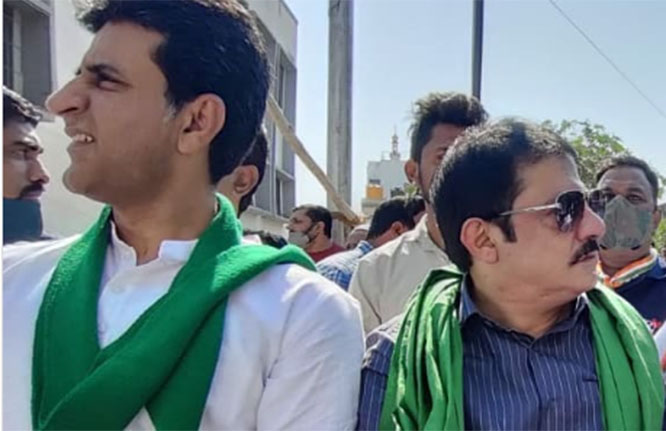
Bengaluru: As the dust settles on the recent legislative session, the corridors of Vidhana Soudha are buzzing with more than just policy talk. A high-stakes game of political musical chairs has begun, exposing a deepening rift within the Congress party’s Muslim leadership as a major Cabinet reshuffle looms.

With the party hierarchy signaling a "50% refresh" to gear up for the 2028 Assembly elections, the race to fill three projected Muslim ministerial berths has transformed from a strategic discussion into an all-out turf war.

The "Star Son" Spark

The internal friction turned public this week following provocative remarks by Zaid Khan, actor and son of Wakf Minister Zameer Ahmed Khan. Zaid’s claim—that his father "helped" secure a ticket for Shivajinagar MLA Rizwan Arshad in 2023—has acted as a lightning rod for resentment.

Rizwan’s camp was quick to fire back, dismissing the comment as a desperate attempt by Zameer to manufacture seniority. "Rizwan’s political pedigree was forged in the NSUI and Youth Congress long before Zameer even stepped into the party," a supporter noted, highlighting Rizwan’s tenure as an AICC secretary and his two-term presidency of the State Youth Congress.

A Tale of Two Loyalists

While both Zameer Ahmed Khan and Rizwan Arshad are staunch allies of Chief Minister Siddaramaiah and represent Bengaluru strongholds, their political DNA could not be more different:

•    Zameer Ahmed Khan: A four-time MLA who crossed over from JD(S) in 2018. Known for his "overzealous" and often polarizing outreach during communal flashpoints—from the DJ Halli riots to the recent Wakf land notice controversy—his style has frequently left the Congress high command in a state of "discomfort."

•    Rizwan Arshad: A homegrown organizational man. Seen as a "quiet performer," Arshad represents the sophisticated, moderate face of the party, preferred by those who find Zameer’s brand of politics too volatile.

The Outsiders Looking In

The bickering isn't limited to a duo. The "Beary" community, represented by leaders like N A Haris and Saleem Ahmed, is demanding its pound of flesh. Saleem Ahmed, the Chief Whip in the Legislative Council, has dropped the veil of diplomacy, openly declaring his ministerial aspirations.

"I was the only working president not included in the Cabinet last time," Saleem noted pointedly, signaling that the "loyalty quota" is no longer enough to keep the peace.

As Chief Minister Siddaramaiah prepares to finalize the list, he faces a delicate balancing act: rewarding the aggressive grassroots mobilization of Zameer’s camp without alienating the organizational stalwarts and minority sub-sects who feel increasingly sidelined by the "Chamarajpet-Shivajinagar" binary.

Comments

Add new comment

  • Coastaldigest.com reserves the right to delete or block any comments.
  • Coastaldigset.com is not responsible for its readers’ comments.
  • Comments that are abusive, incendiary or irrelevant are strictly prohibited.
  • Please use a genuine email ID and provide your name to avoid reject.
News Network
January 23,2026

Mangaluru: The Karnataka Government Polytechnic (KPT), Mangaluru, has achieved autonomous status from the All India Council for Technical Education (AICTE), becoming the first government polytechnic in the country to receive such recognition in its 78-year history. The status was granted by AICTE, New Delhi, and subsequently approved by the Karnataka Board of Technical Education in October last year.

Officials said the autonomy was conferred a few months ago. Until recently, AICTE extended autonomous status only to engineering colleges, excluding diploma institutions. However, with a renewed national focus on skill development, several government polytechnics across India have now been granted autonomy.

KPT, the second-largest polytechnic in Karnataka, was established in 1946 with four branches and has since expanded to offer eight diploma programmes, including computer science and polymer technology. The institution is spread across a 19-acre campus.

Ravindra M Keni, the first dean of the institution, told The Times of India that AICTE had proposed autonomous status for polytechnic institutions that are over 25 years old. “Many colleges applied. In the first round, 100 institutions were shortlisted, which was further narrowed down to 15 in the second round. We have already completed one semester after becoming an autonomous institution,” he said. He added that nearly 500 students are admitted annually across eight three-year diploma courses.

Explaining the factors that helped KPT secure autonomy, Keni said the institution has consistently recorded 100 per cent admissions and placements for its graduates. He also noted its strong performance in sports, with the college emerging champions for 12 consecutive years, along with active student participation in NCC and NSS activities.

Autonomous status allows KPT to design industry-oriented curricula, conduct examinations, prepare question papers, and manage academic documentation independently. The institution can also directly collaborate with industries and receive priority funding from AICTE or the Ministry of Education. While academic autonomy has been granted, financial control will continue to rest with the state government.

“There will be separate committees for examinations, question paper setting, boards of studies, and boards of examiners. The institution will now have the freedom to conduct admissions without government notifications and issue its own marks cards,” Keni said, adding that new academic initiatives would be planned after a year of functioning under the autonomous framework.

Comments

Add new comment

  • Coastaldigest.com reserves the right to delete or block any comments.
  • Coastaldigset.com is not responsible for its readers’ comments.
  • Comments that are abusive, incendiary or irrelevant are strictly prohibited.
  • Please use a genuine email ID and provide your name to avoid reject.
News Network
January 31,2026

Roy.jpg

Bengaluru: The shooting incident involving CJ Roy, founder of the Confident Group, has once again put the spotlight on a businessman whose life has swung between flamboyant global success and persistent controversy at home.

Though Roy’s business interests extended across continents, his roots lay firmly in Karnataka. An alumnus of Christ School in Bengaluru, he later moved to Tumakuru to pursue an engineering degree. Those familiar with his early years describe him as intensely ambitious, beginning his career as a salesman at a small electronics firm dealing in computers.

Roy’s entry into large-scale real estate came through the Crystal Group, where he worked closely with Latha Namboothiri and rose from manager to director. However, the launch of the Confident Group in 2005 was clouded by industry speculation. Insiders speak of a fallout involving alleged “benami” properties and claims of deception that ultimately led to his independent venture—an episode Roy spent years trying to distance himself from, according to associates.

A tale of two cities

Roy’s professional trajectory diverged sharply across geographies.

In Dubai, he built a reputation as a bold and efficient developer, completing massive luxury residential projects in record time—some reportedly within 11 months. His rapid project delivery and lavish lifestyle in the Emirates earned him admiration and visibility in the real estate sector.

In Bengaluru, however, his image remained far more fractured. Sources say Roy stayed away from the city for several years amid disputes over unpaid dues to vendors and suppliers. Several projects were allegedly stalled, with accusations of unfulfilled commitments to cement and steel suppliers continuing to follow him.

Roy’s return to Bengaluru’s business and social circles began around 2018, marked by a conscious attempt at rebranding. His appointment as Honorary Consul of the Slovak Republic added diplomatic legitimacy, which he complemented with visible CSR initiatives, including ambulance donations and high-profile charity events.

Heavy police presence in Langford Town

Following the incident, police personnel from the Central division were deployed outside the Confident Group building in Langford Town, which also houses the Slovak Honorary Consulate in Bengaluru.

The otherwise busy premises near Hosur Road wore a deserted look on Friday, reflecting the shock and uncertainty that followed the tragedy.

Comments

Add new comment

  • Coastaldigest.com reserves the right to delete or block any comments.
  • Coastaldigset.com is not responsible for its readers’ comments.
  • Comments that are abusive, incendiary or irrelevant are strictly prohibited.
  • Please use a genuine email ID and provide your name to avoid reject.
