Can Hindi be the ‘Uniting Language’ of India?

Ram Puniyani
September 19, 2019

Modi 2.0 has emerged as a very powerful Government. It has not only the numerical majority; it is also facing a weak and divided opposition. That is one of the reasons for it stream rolling over people’s opinions and imposing the agenda of RSS-BJP of Hindu nationalism in a blatant way. On one side it has brought in a law banning triple talaq, on the other it has revoked article 370. Encouraged by these easy successes, now it seems to be unfolding it’s other agendas one by one.

Speaking on occasion of Hindi day, the BJP President and Union Home minister Amit Shah went on to speak his party mind on the subject Hindi as the national language. Mr. Shah said, it was necessary to have one language which could represent India in the world…and that Hindi was widely spoken and could be the language to keep India 'united'…"To preserve our ancient philosophy, our culture and the memory of our freedom struggle,…there is at least one language, Hindi, that the nation knows. If Hindi is taken out of our freedom struggle, the entire soul of the struggle is lost." He tweeted this to emphasize his point: "I want to appeal to people to promote their native languages but also use Hindi to make the dream of Bapu and Sardar Patel of one language come true."

The intentions behind this statement were not so hidden though the language is very clever. The idea is to relegate English and regional languages to the margins and to give more prominence to Hindi all through. Sensing the intentions of Mr. Shah, many a leaders from South India, M K Stalin, Shashi Tharoor, Pinrayi Vijayan and Kamal Haasan have openly come against his statement. All of them see this as an attempt to impose Hindi on these states. Vijayan put it bluntly through his tweet, “That language (Hindi) is not the mother tongue of majority of Indians. The move to inflict Hindi upon them amounts to enslaving them.” While Kamal Haasasn, in a video uploaded with him standing next to the Ashoka pillar and the Preamble, says India became a republic in 1950 with a promise to the people that their language and culture will be protected. "No Shah, Sultan or Samrat can suddenly break that promise. We respect all languages but our mother language will always be Tamil… The battle for our language will be exponentially bigger…"

As such our country has been very diverse in all the matters related to language, culture, religion and ethnicity. The freedom movement was the real reflector of this diversity. People cutting across all these considerations stood as a single fraternity, respecting the diversity and the rich heritage coming from different religions and languages in particular. In all the languages, India’s aspirations of becoming a single nation got expressed. Hindi along with other regional languages have inherited rich lineage of becoming the mirror of Indian society. Though English was introduced primarily as administrative language, it soon became part of Indian culture, and all these also became a mirror of Indian society and aspirations.

In contrast to national movement for freedom from British slavery, which stood to reflect all the languages, the communal forces had different ideas. Muslim communalism came up with the slogan, ‘Urdu, Muslim, Pakistan’, and on parallel lines Hindu nationalism threw up the slogan, ‘Hindi, Hindu, Hindustan’. When Pakistan was formed in the Muslim majority areas (East Pakistan and West Pakistan) their languages were very diverse. Muslim League’s insistence that Urdu should become the national language of Pakistan did precipitate the feeling of separation of East Pakistan from West Pakistan leading to formation Bangla Desh with Bengali as the major language.

Interestingly the Constitution makers concluded that "Hindustani, written either in Devanagari or the Persian script at the option of the citizen, shall, as the national language, be the first official language of the Union. English shall be the second official language for such period as the Union may, by law, determine."  The three language formula envisaged English, Hindi and regional language as the fulcrum of education. During sixties there was an attempt to introduce Hindi in Southern states, and this led to massive protests all over, with the result the policy was put on hold. Again with new Education Policy under consideration wanted to make Hindi as mandatory. The argument continues that Hindi is language of the majority of Indians. The latest data shows that it is mother tongue of 25% of Indians and 44% people say they know Hindi. The massive opposition to this language part of New Education Policy yet again led to holding back of Hindi as mandatory. One recalls that even during 1940s when Congress Government came to power in Tamilnadu (Madras at that time.), attempt was made to introduce Hindi there. The resistance to this was articulated by Periyar Ramasamy Naicker, who raised the slogan 'Tamil Nadu for Tamilians' and accused Hindi of being a tool of the Aryans for infiltrating Dravidian culture.

How does one deal with the complex language issue. Country has been running well with English, Hindi and regional languages being used in different proportions at different levels. While there have been conscious efforts to spread Hindi to Southern states, there are no parallel steps to popularize regional languages in Hindi speaking states. One must say Hindi has definitely made long strides in spreading into southern and other states all over the country but this task has been achieved not by impositions from top but by the spread of Hindi films, and popular Hindi serials apart from the efforts of organizations promoting Hindi.

Issue of Urdu as national language contributed to split of Pakistan. In contrast India has done a remarkable balancing act in matters of languages so far. The reorganization of states on linguistic lines has given a unique strength to us. With Amit Shah unfolding their agenda of imposing homogeneity all over, including in matters of language, one hopes this present sanity will prevail and sentiments and aspirations of all non Hindi speaking states will be given due weight age in deciding the national language policy.


Comments

Add new comment

  • Coastaldigest.com reserves the right to delete or block any comments.
  • Coastaldigset.com is not responsible for its readers’ comments.
  • Comments that are abusive, incendiary or irrelevant are strictly prohibited.
  • Please use a genuine email ID and provide your name to avoid reject.
News Network
January 31,2026

Roy.jpg

Bengaluru: The shooting incident involving CJ Roy, founder of the Confident Group, has once again put the spotlight on a businessman whose life has swung between flamboyant global success and persistent controversy at home.

Though Roy’s business interests extended across continents, his roots lay firmly in Karnataka. An alumnus of Christ School in Bengaluru, he later moved to Tumakuru to pursue an engineering degree. Those familiar with his early years describe him as intensely ambitious, beginning his career as a salesman at a small electronics firm dealing in computers.

Roy’s entry into large-scale real estate came through the Crystal Group, where he worked closely with Latha Namboothiri and rose from manager to director. However, the launch of the Confident Group in 2005 was clouded by industry speculation. Insiders speak of a fallout involving alleged “benami” properties and claims of deception that ultimately led to his independent venture—an episode Roy spent years trying to distance himself from, according to associates.

A tale of two cities

Roy’s professional trajectory diverged sharply across geographies.

In Dubai, he built a reputation as a bold and efficient developer, completing massive luxury residential projects in record time—some reportedly within 11 months. His rapid project delivery and lavish lifestyle in the Emirates earned him admiration and visibility in the real estate sector.

In Bengaluru, however, his image remained far more fractured. Sources say Roy stayed away from the city for several years amid disputes over unpaid dues to vendors and suppliers. Several projects were allegedly stalled, with accusations of unfulfilled commitments to cement and steel suppliers continuing to follow him.

Roy’s return to Bengaluru’s business and social circles began around 2018, marked by a conscious attempt at rebranding. His appointment as Honorary Consul of the Slovak Republic added diplomatic legitimacy, which he complemented with visible CSR initiatives, including ambulance donations and high-profile charity events.

Heavy police presence in Langford Town

Following the incident, police personnel from the Central division were deployed outside the Confident Group building in Langford Town, which also houses the Slovak Honorary Consulate in Bengaluru.

The otherwise busy premises near Hosur Road wore a deserted look on Friday, reflecting the shock and uncertainty that followed the tragedy.

Comments

Add new comment

  • Coastaldigest.com reserves the right to delete or block any comments.
  • Coastaldigset.com is not responsible for its readers’ comments.
  • Comments that are abusive, incendiary or irrelevant are strictly prohibited.
  • Please use a genuine email ID and provide your name to avoid reject.
coastaldigest.com news network
January 19,2026

badriya.jpg

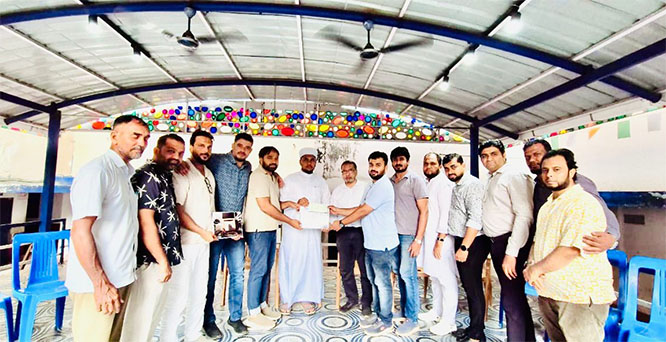
Mangaluru: The Phase I project of Badria Vision 2028 was formally launched at a ceremony held at the Badria Campus on January 17, marking an important step in the institution’s long-term development roadmap.

The programme was attended by P.B. Abdul Hameed, Secretary of the MEA, and P.C. Hasir, Correspondent of the MEA, who presided over the event and underscored the institution’s commitment to growth and academic excellence.

Office-bearers of the Badria Alumni Association were present in large numbers, including A.K. Sajid (President), Shamsuddin and S.M. Farooq (Vice-Presidents), Shaheed (General Secretary), and Khaleel (Treasurer), reflecting strong alumni engagement in the initiative.

The gathering was blessed by Sayyid Shamsuddeen Basith Thangal Kukkaje, Qateeb of Zeenat Yatheem Bakshi, who led a special dua seeking divine guidance and success for the project.

The ceremony also witnessed the participation of prominent alumnus and local corporate professional Abdul Latheef, along with alumni members Naushad, Kalandar, Safwan, members of the core committee, and several other former students.

A key moment of the event was the formal handover of a cheque to Ameen Woodland Architect, signalling the immediate commencement of construction work under Phase I of the project.

Organisers said the launch of Phase I reflects a shared vision, institutional unity, and collective resolve to realise the objectives of Badria Vision 2028.

Comments

Add new comment

  • Coastaldigest.com reserves the right to delete or block any comments.
  • Coastaldigset.com is not responsible for its readers’ comments.
  • Comments that are abusive, incendiary or irrelevant are strictly prohibited.
  • Please use a genuine email ID and provide your name to avoid reject.
News Network
January 23,2026

Karnataka Governor Thaawarchand Gehlot read only three lines from the 122-paragraph address prepared by the Congress-led state government while addressing the joint session of the Legislature on Thursday, effectively bypassing large sections critical of the BJP-led Union government.

The omitted portions of the customary Governor’s address outlined what the state government described as a “suppressive situation in economic and policy matters” under India’s federal framework. The speech also sharply criticised the Centre’s move to replace the Mahatma Gandhi National Rural Employment Guarantee Act (MGNREGA) with the Viksit Bharat–Guarantee for Rozgar and Ajeevika Mission (Gramin) Act, commonly referred to as the VB-GRAM (G) Act.

Governor Gehlot had earlier conveyed his objection to several paragraphs that were explicitly critical of the Union government. On Thursday, he confined himself to the opening lines — “I extend a warm welcome to all of you to the joint session of the State legislature. I am extremely pleased to address this august House” — before jumping directly to the concluding sentence of the final paragraph.

He ended the address by reading the last line of paragraph 122: “Overall, my government is firmly committed to doubling the pace of the State’s economic, social and physical development. Jai Hind — Jai Karnataka.”

According to the prepared speech, the Karnataka government demanded the scrapping of the VB-GRAM (G) Act, describing it as “contractor-centric” and detrimental to rural livelihoods, and called for the full restoration of MGNREGA. The state government argued that the new law undermines decentralisation, weakens labour protections, and centralises decision-making in violation of constitutional norms.

Key points from the unread sections of the speech:

•    Karnataka facing a “suppressive” economic and policy environment within the federal system

•    Repeal of MGNREGA described as a blow to rural livelihoods

•    VB-GRAM (G) Act accused of protecting corporate and contractor interests

•    New law alleged to weaken decentralised governance

•    Decision-making said to be imposed by the Centre without consulting states

•    Rights of Adivasis, women, backward classes and agrarian communities curtailed

•    Labourers allegedly placed under contractor control

•    States facing mounting fiscal stress due to central policies

•    VB-GRAM (G) Act accused of enabling large-scale corruption

Comments

Add new comment

  • Coastaldigest.com reserves the right to delete or block any comments.
  • Coastaldigset.com is not responsible for its readers’ comments.
  • Comments that are abusive, incendiary or irrelevant are strictly prohibited.
  • Please use a genuine email ID and provide your name to avoid reject.