



Debate on Hindutva element in Tulu Nadu’s ‘Bhootharadhane’ ritual

News Network
October 29, 2022

kanthaara.jpg

A debate is going on in the social and cultural circles of Karnataka over Bhootharadhane, a ritual of spirit worship practised by people of coastal Karnataka, as to whether it is part of Hindu culture. The discussion was opened up with the stupendous success of Rishab Shetty’s Kannada film Kantara, a story based on the traditions and beliefs, including worship of Bhootha Kola, in the Dakshina Kannada region.

The controversy was kicked off by Kannada actor-activist Chetan Kumar who questioned Rishab Shetty’s claim in an interview that the Bhootha Kola ritual is part of Hindu culture. During the interview, Shetty was asked whether Panjurli, a spirit in the form of a wild boar, was depicted in the movie as a Hindu deity. Shetty, in his reply said those gods are ‘all part of our tradition’ and of Hindu culture and rituals. “Because I am a Hindu, I have belief and respect for my religion. But I will not say others are wrong. What we have said (in the movie) is through the element that is present in Hindu dharma,” he said.

Contesting this, Kumar told a press conference that it is important how we use the word ‘Hindu’. “It is wrong to say that Bhootha Kola is part of the Hindu religion. Adivasis practised the ritual and there is no ‘Brahminism’ in Bhootha Kola, he pointed out. Cautioning against bracketing ancient ‘Moolvasi’ culture with Hinduism, he said it is the culture of the Adivasis. Do not put Adivasi culture in the column of Hindu religion,” he said, inviting strong protests from right wing Hindu outfits.

Bhootha Kola is a ritual performance where local spirits or deities are worshipped. It is believed that the person performing the ritual turns himself in as God at the moment and listens to people’s grievances and provides answers. Several Bhoothas are being worshipped in the Tulu-speaking belt of Dakshina Kannada and Udupi districts. The rituals are mostly confined to small local communities and rural areas where the Daivas are believed to protect the villagers from all evils.

North Kerala’s Theyyam performed in local temples and houses has strong resemblance to the Bhootha Kola. 

Chetan Kumar, an activist who had earlier taken up the cause of Adivasis, said Bhootha Kola, a non-Vedic ritual, was not part of Hindu tradition but of indigenous people who are Moolvasis, which was later ‘hijacked’ by Aryans. In a tweet, Kumar said, “Glad our Kannada film Kantara is making national waves. Director Rishab Shetty claims Bhootha Kola is ‘Hindu culture’. False. Our Pambada/Nalike/Parawa’s Bahujan traditions pre-date Vedic-Brahminical Hinduism. We ask that Moolnivasi cultures be shown w/ truth on & off screen.”

Karnataka’s land has its own culture, tradition and history even before the Hindu religion began. Bhootha Kola and other practices are part of the Adivasi culture which has been existing for several thousand years, he later said, clarifying his argument.

Rishab Shetty, who sought to distance himself from the controversy, said he has no comment on the issue. “When I was making this movie, those people who practised this culture were with me and I have been very cautious. I come from the same part, still I do not want to comment about it as only people who perform it have the right to speak,” he told media. Many others joined issue criticising Chetan Kumar for his remarks.

Noting that Bhootha Kola represents Hindu culture and tradition, Sri Rama Sene chief Pramod Muthalik in a statement said the actor, who is an atheist, does not know the culture of the land. Identifying Panjurli, a spirit worshiped in Bhootha Kola, with the Hindu God Vishnu has led to the controversy, with some pointing out the ‘appropriation’ of Adivasi culture in films that depict Hinduism.

Reacting to the row, Dharmasthala dharmadhikari (hereditary administrator) and Rajya Sabha MP Veerendra Heggade said several such practices have evolved over the years and people have strong belief in them. The people in Dakshina Kannada and Udupi districts believe in Daivaradhane and Bhootharadhane. There is no need to link it with dharma, he told media after watching the movie in Mangaluru recently.

Karnataka Tulu Sahitya academy president Dayanand G Kathalsar affirmed that Bhootharadhane and worship of Bhoothas are part and parcel of Hindu religion. Attempts are being made to separate those practising the worship from the mainstream of Hindu religion, he told reporters here.

Kathalsar, who is also former president of Pampadara Yane Daivaradkara Seva Samaja, said there are 16 different classes who are involved in Daivaradhane in the coastal region. All the people from different classes are involved in the process, he said, adding it is unfair to try to distance it from Hinduism. He said all Tuluvas believed in Daivradhane, including the scheduled caste people who belong to the Hindu religion. The right-wing outfits are up in arms against Chetan Kumar for his comments on Bhootha Kola.

Recently, an FIR was registered in Bengaluru against the actor for his comments on Bhootha Kola, based on a complaint from a Bajrang Dal activist. The Hindu Jagarana Vedike (HJV), which has also taken up the issue, also lodged a complaint at Karkala police station in Udupi stating that Chetan Kumar’s statement has hurt the sentiments of Hindus. The Vedike has urged the police to take suitable action against the actor.

Comments

Add new comment

  • Coastaldigest.com reserves the right to delete or block any comments.
  • Coastaldigset.com is not responsible for its readers’ comments.
  • Comments that are abusive, incendiary or irrelevant are strictly prohibited.
  • Please use a genuine email ID and provide your name to avoid reject.
News Network
January 16,2026

gaurimurder.jpg

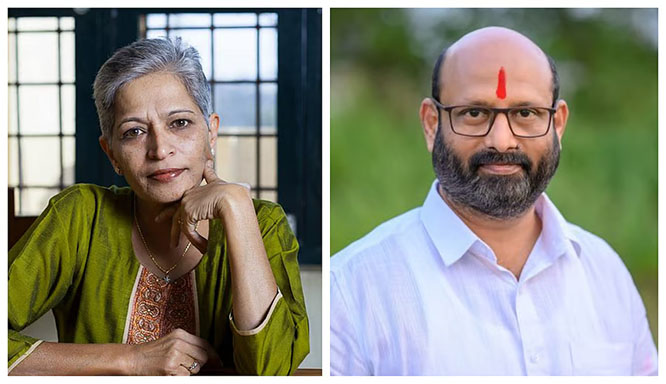
Mumbai: In a shocking development, Shrikant Pangarkar, an accused in the murder of journalist-activist Gauri Lankesh and the Nalasopara arms and ammunition haul case, has won the Jalna Municipal Corporation (JMC) elections as an independent candidate.

Pangarkar emerged victorious from Ward 13 of the JMC, where he was pitted against the BJP. Notably, the Shiv Sena led by Deputy Chief Minister Eknath Shinde, which contested the Jalna civic polls independently, did not field a candidate in the ward.

Gauri Lankesh was shot dead outside her residence in Bengaluru on September 5, 2017. A prominent journalist and activist, she edited Lankesh Patrike, a Kannada weekly founded by her father P Lankesh, and later ran her own publication, Gauri Lankesh Patrike.

Pangarkar was granted bail by the Karnataka High Court on September 4, 2024, in the Lankesh murder case. Ahead of the October 2024 Assembly elections, he was inducted into the Shiv Sena and appointed chief of the party’s Jalna campaign. However, following intense criticism, then Chief Minister Eknath Shinde revoked the appointment.

A former municipal councillor in Jalna between 2001 and 2006 from the undivided Shiv Sena under late Balasaheb Thackeray, Pangarkar later became associated with right-wing organisations.

In August 2018, he was arrested by the Maharashtra Anti-Terrorism Squad (ATS) in connection with the seizure of crude bombs and weapons in Nalasopara and booked under the Explosives Act, Explosive Substances Act, and the Unlawful Activities (Prevention) Act (UAPA). He is currently out on bail in both cases.

Soon after the election results were declared, Pangarkar’s supporters celebrated his victory.

After filing his nomination, Pangarkar had said he was returning to politics after a gap and had received an encouraging response from voters. “I have worked for the people earlier and have returned again,” he said, asserting that the cases against him had no bearing on the elections. “The matter is before the court. I stand before the nyay devta. There may be misunderstandings by agencies, but the court will decide. I am 100 per cent innocent,” he maintained, adding that the Lankesh murder case was unrelated to the civic polls and pertained to Karnataka.

Comments

Add new comment

  • Coastaldigest.com reserves the right to delete or block any comments.
  • Coastaldigset.com is not responsible for its readers’ comments.
  • Comments that are abusive, incendiary or irrelevant are strictly prohibited.
  • Please use a genuine email ID and provide your name to avoid reject.
News Network
January 20,2026

Mangaluru: In a major step towards strengthening rural innovation, the Office of the Principal Scientific Adviser (PSA) to the Government of India is supporting the establishment of RuTAGe Smart Village Centres (RSVCs) across the country through collaborations with academic institutions, civil society organisations and philanthropic partners.

As part of this national initiative, Nitte (Deemed to be University) will set up the first RSVCs in the region at Nitte GP in Udupi district and at the Nitte Health Centre, Sevanjali Trust, Farangipete, in Dakshina Kannada district. The centres will be inaugurated on January 21. In South India, the programme is being implemented by the Section Infin-8 Foundation (SI-8).

Speaking to reporters on Monday, SI-8 founder-director Vishwas US said experts from Nitte University and SI-8 would work closely with farmers, students, youth and local entrepreneurs to adapt and deploy technologies tailored to local needs.

Project head Prof Iddya Karunasagar, representing Nitte DU, said the RSVCs at Nitte and Farangipete would serve as demonstration hubs for a wide range of agriculture, energy, skill-development and assistive technologies. These include solar dryers for fruits, vegetables and crops; soil-testing solutions; power weeders and women-friendly farm tools; wind-powered devices for rural artisans; grain storage systems; grass-cutting and tree-climbing equipment; and liquid fertiliser production using cowshed waste.

SI-8 CEO Aravind C Kumar said the centres would also provide access to digital and knowledge-based platforms such as ISRO applications, government scheme portals, market linkage tools and gamified learning resources, along with assistive technologies for persons with visual impairments.

Highlighting the broader impact of the initiative, Principal Scientific Adviser Prof Ajay Kumar Sood said it demonstrated how applied research could bridge the rural–urban divide and help create self-reliant, technology-enabled villages.

The initiative has been made possible through philanthropic support from Dr NC Murthy of ACM Business Solutions, LLC, USA. Dr Sapna Poti, Director (Strategic Alliances) at the Office of the Principal Scientific Adviser, said the long-term objective is to build self-sufficient, technology-driven communities capable of generating sustainable livelihoods on their own.

Comments

Add new comment

  • Coastaldigest.com reserves the right to delete or block any comments.
  • Coastaldigset.com is not responsible for its readers’ comments.
  • Comments that are abusive, incendiary or irrelevant are strictly prohibited.
  • Please use a genuine email ID and provide your name to avoid reject.
News Network
January 23,2026

Karnataka Governor Thaawarchand Gehlot read only three lines from the 122-paragraph address prepared by the Congress-led state government while addressing the joint session of the Legislature on Thursday, effectively bypassing large sections critical of the BJP-led Union government.

The omitted portions of the customary Governor’s address outlined what the state government described as a “suppressive situation in economic and policy matters” under India’s federal framework. The speech also sharply criticised the Centre’s move to replace the Mahatma Gandhi National Rural Employment Guarantee Act (MGNREGA) with the Viksit Bharat–Guarantee for Rozgar and Ajeevika Mission (Gramin) Act, commonly referred to as the VB-GRAM (G) Act.

Governor Gehlot had earlier conveyed his objection to several paragraphs that were explicitly critical of the Union government. On Thursday, he confined himself to the opening lines — “I extend a warm welcome to all of you to the joint session of the State legislature. I am extremely pleased to address this august House” — before jumping directly to the concluding sentence of the final paragraph.

He ended the address by reading the last line of paragraph 122: “Overall, my government is firmly committed to doubling the pace of the State’s economic, social and physical development. Jai Hind — Jai Karnataka.”

According to the prepared speech, the Karnataka government demanded the scrapping of the VB-GRAM (G) Act, describing it as “contractor-centric” and detrimental to rural livelihoods, and called for the full restoration of MGNREGA. The state government argued that the new law undermines decentralisation, weakens labour protections, and centralises decision-making in violation of constitutional norms.

Key points from the unread sections of the speech:

•    Karnataka facing a “suppressive” economic and policy environment within the federal system

•    Repeal of MGNREGA described as a blow to rural livelihoods

•    VB-GRAM (G) Act accused of protecting corporate and contractor interests

•    New law alleged to weaken decentralised governance

•    Decision-making said to be imposed by the Centre without consulting states

•    Rights of Adivasis, women, backward classes and agrarian communities curtailed

•    Labourers allegedly placed under contractor control

•    States facing mounting fiscal stress due to central policies

•    VB-GRAM (G) Act accused of enabling large-scale corruption

Comments

Add new comment

  • Coastaldigest.com reserves the right to delete or block any comments.
  • Coastaldigset.com is not responsible for its readers’ comments.
  • Comments that are abusive, incendiary or irrelevant are strictly prohibited.
  • Please use a genuine email ID and provide your name to avoid reject.