



Recurring floods: A direct consequence of deforestation in the Western Ghats

Shivani
September 17, 2020

The Western Ghats have been exposed to excessive human interference for past few years. Though a certain amount of forest was lent for agroforestry in this hot-spot of biological diversity, people have crossed the margin which resulted in irregular rains and floods in the region. In the past few years, south-west of India was prone to floods and landslides though the amount of rain received by these parts is relatively less.

According to environmental activist Dinesh Holla, “the shola grassland that grows in the hills of Western Ghats play a major role in holding the rainwater that flows down the hill. The roots of the grass hold the rainwater and this water is stored in the catchment area. Hence only a limited amount of rainwater joins the river. Since the shola forest is being cut down for different purposes like setting up the power plant, resorts, commercial crop plantation etc the water flows down the hill causing soil erosion and flooding as well. In 2018, Kerala and Madikeri faced major floods due to this.”

“Last year, several parts of Western Ghats suffered forest fire. This became an opportunity for estate owners to extend their land of agroforest. There are even instances where the estate owner sprayed chemicals on the grassland so that they catch fire during summer and they could occupy the reserved forest land. Also, the forest fire burns the seed that would germinate into another tree. Hence the reserved forest area is somehow devastated by the people. Though only certain parts of Western Ghats are allotted for development purpose, a large area of forest has been encroached.”

Shivananda Kalave, a water conversationalist, says, “There are   several endemic plants grown in Western Ghats. In order to make deforestation look convincing to the public, the industrialists claim it as compensatory deforestation. The suitable climate necessary for the growth of the endemic plants is only found in Western Ghats. Hence deforestation is still a damage with or without compensation.” 

“There are several plants in Western Ghats that boost our immunity but people decide to destroy forests under the pretext of development, employment and what not. What kind of unhealthy society are we building by destroying this forest which is beyond price?” he laments. 

In concern with floods, Karve says that the absorption rate of the forest in Western Ghats is 10- 12% rest of water flows down and joins the river. Since the highway has been constructed in between the forest, the water does not have a proper path to flow. Also, after immense clear cutting of the forest, the rate of absorption has declined to 4% which means the amount of rainwater that would be flowing to the river will be unendurable, resulting in floods.

The section 2 of the Forest (Conservation) Act of 1980 states that a prior approval is necessary from the central government before de-reserving the reserved forest. Several parts of Western Ghats also belong to the reserved forest. Also, according to the National Forest Policy 2016, climate change should be given importance in forest management and community management plans. The Ministry of Environment and Forest appointed the Western Ghats ecological expert panel under the chairmanship of Madhav Gadgil. The committee divided the area into three based on their ecological sensitivity. But the report faced great criticism as the people assumed it to be against farmers. Later the Kasturirangan committee was formed to examine the report of the Gadgil committee. However, this report favoured the corporates. As only 37% Western Ghats was considered an ecological sensitive zone and rest of the land is available for development projects. 

Nature has the power to generate as well as destroy. Even after facing the destruction caused by floods, humans have not learnt any lessons from the past. Clear cutting still takes place in Western Ghats, people still go there for road trips and throw plastic. This is just the beginning of karma to human society for the destruction we have caused. Destruction of nature will be nothing but us digging our own grave.



Comments

Add new comment

  • Coastaldigest.com reserves the right to delete or block any comments.
  • Coastaldigset.com is not responsible for its readers’ comments.
  • Comments that are abusive, incendiary or irrelevant are strictly prohibited.
  • Please use a genuine email ID and provide your name to avoid reject.
coastaldigest.com news network
January 19,2026

badriya.jpg

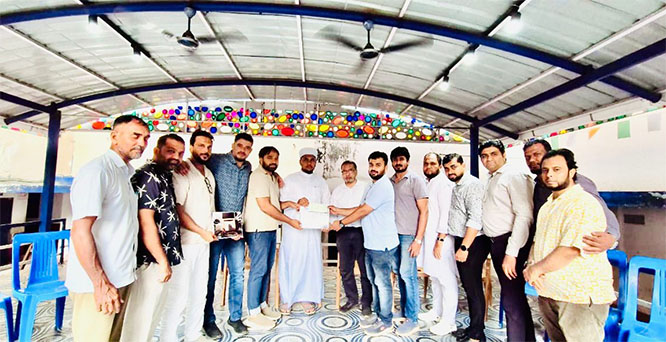
Mangaluru: The Phase I project of Badria Vision 2028 was formally launched at a ceremony held at the Badria Campus on January 17, marking an important step in the institution’s long-term development roadmap.

The programme was attended by P.B. Abdul Hameed, Secretary of the MEA, and P.C. Hasir, Correspondent of the MEA, who presided over the event and underscored the institution’s commitment to growth and academic excellence.

Office-bearers of the Badria Alumni Association were present in large numbers, including A.K. Sajid (President), Shamsuddin and S.M. Farooq (Vice-Presidents), Shaheed (General Secretary), and Khaleel (Treasurer), reflecting strong alumni engagement in the initiative.

The gathering was blessed by Sayyid Shamsuddeen Basith Thangal Kukkaje, Qateeb of Zeenat Yatheem Bakshi, who led a special dua seeking divine guidance and success for the project.

The ceremony also witnessed the participation of prominent alumnus and local corporate professional Abdul Latheef, along with alumni members Naushad, Kalandar, Safwan, members of the core committee, and several other former students.

A key moment of the event was the formal handover of a cheque to Ameen Woodland Architect, signalling the immediate commencement of construction work under Phase I of the project.

Organisers said the launch of Phase I reflects a shared vision, institutional unity, and collective resolve to realise the objectives of Badria Vision 2028.

Comments

Add new comment

  • Coastaldigest.com reserves the right to delete or block any comments.
  • Coastaldigset.com is not responsible for its readers’ comments.
  • Comments that are abusive, incendiary or irrelevant are strictly prohibited.
  • Please use a genuine email ID and provide your name to avoid reject.
News Network
January 19,2026

New Delhi: Setting speculation to the rest, the CPI(M) has made it clear that it is open to have an electoral understanding with the Congress “to defeat” the Trinamool Congress and the BJP in West Bengal Assembly election even as it is all set to take on the grand old party in Kerala accusing it of “found wanting” in fighting the Hindutva forces.

The CPI(M) also said that it will contest the Tamil Nadu election “with DMK and its allies to defeat the BJP and its allies”, amid a section in the Congress triggering confusion about its participation in the M K Stalin-led coalition over demand over power-sharing and more seats. It is also willing to join hands with Congress and others in Assam and Puducherry to defeat the BJP.

The decisions came at a three-day meeting of the CPI(M) Central Committee in Thiruvananthapuram, which ended on Sunday after reviewing the poll preparations in the poll-bound states.

The CPI(M)'s decision came even as a section led by West Bengal Congress president Subhankar Sarkar is averse to tying up with the Left Front, claiming that their party is not benefitted by the electoral understanding. Both Congress and CPI(M)-led Left Front had electoral understanding in 2016 and 2021 Assembly elections and 2024 Lok Sabha polls.

Congress and the Left Front fought together for the first time in 2016 when Congress won 44 seats and the CPI(M) got 26. In 2021, the Left Front and the Congress drew a blank. In the 2024 Lok Sabha polls, Congress managed to win one seat while the Left did not win any. In the 2019 Lok Sabha polls, both fought against each other with Congress winning two and the Left none.

“In Bengal, the party will work for the defeat of both the TMC and the BJP, which are trying to polarise the society. We will try to rally all the forces that are ready to work against them,” the CPI(M) said in a statement without naming Congress by name. Senior leaders said there is no change in its strategy of pooling all non-BJP, non-TMC votes.

However, the party was critical of the Congress in Kerala where both will fight against each other.

The CPI(M) said it would "expose the BJP-led Union government’s denial of rightful dues to Kerala, the fiscal constraints imposed and the overall attack on federalism" as also "expose the failure of the Congress to effectively counter this attack on federalism, as the largest opposition party in the Parliament".

"The Congress, especially in Kerala, was found wanting in the fight against communal RSS-BJP, ideologically and this will also be exposed before the people," it added.

In Assam, it said, the CPI(M) will work for the mobilisation of all the anti-BJP parties and forces and defeat the rabidly communal and divisive BJP government. The Left parties are cooperating with Congress in the north-eastern state. In Puducherry, it said it will work for the defeat of the BJP alliance government.

Comments

Add new comment

  • Coastaldigest.com reserves the right to delete or block any comments.
  • Coastaldigset.com is not responsible for its readers’ comments.
  • Comments that are abusive, incendiary or irrelevant are strictly prohibited.
  • Please use a genuine email ID and provide your name to avoid reject.
News Network
January 23,2026

Karnataka Governor Thaawarchand Gehlot read only three lines from the 122-paragraph address prepared by the Congress-led state government while addressing the joint session of the Legislature on Thursday, effectively bypassing large sections critical of the BJP-led Union government.

The omitted portions of the customary Governor’s address outlined what the state government described as a “suppressive situation in economic and policy matters” under India’s federal framework. The speech also sharply criticised the Centre’s move to replace the Mahatma Gandhi National Rural Employment Guarantee Act (MGNREGA) with the Viksit Bharat–Guarantee for Rozgar and Ajeevika Mission (Gramin) Act, commonly referred to as the VB-GRAM (G) Act.

Governor Gehlot had earlier conveyed his objection to several paragraphs that were explicitly critical of the Union government. On Thursday, he confined himself to the opening lines — “I extend a warm welcome to all of you to the joint session of the State legislature. I am extremely pleased to address this august House” — before jumping directly to the concluding sentence of the final paragraph.

He ended the address by reading the last line of paragraph 122: “Overall, my government is firmly committed to doubling the pace of the State’s economic, social and physical development. Jai Hind — Jai Karnataka.”

According to the prepared speech, the Karnataka government demanded the scrapping of the VB-GRAM (G) Act, describing it as “contractor-centric” and detrimental to rural livelihoods, and called for the full restoration of MGNREGA. The state government argued that the new law undermines decentralisation, weakens labour protections, and centralises decision-making in violation of constitutional norms.

Key points from the unread sections of the speech:

•    Karnataka facing a “suppressive” economic and policy environment within the federal system

•    Repeal of MGNREGA described as a blow to rural livelihoods

•    VB-GRAM (G) Act accused of protecting corporate and contractor interests

•    New law alleged to weaken decentralised governance

•    Decision-making said to be imposed by the Centre without consulting states

•    Rights of Adivasis, women, backward classes and agrarian communities curtailed

•    Labourers allegedly placed under contractor control

•    States facing mounting fiscal stress due to central policies

•    VB-GRAM (G) Act accused of enabling large-scale corruption

Comments

Add new comment

  • Coastaldigest.com reserves the right to delete or block any comments.
  • Coastaldigset.com is not responsible for its readers’ comments.
  • Comments that are abusive, incendiary or irrelevant are strictly prohibited.
  • Please use a genuine email ID and provide your name to avoid reject.