



Recurring floods: A direct consequence of deforestation in the Western Ghats

Shivani
September 17, 2020

The Western Ghats have been exposed to excessive human interference for past few years. Though a certain amount of forest was lent for agroforestry in this hot-spot of biological diversity, people have crossed the margin which resulted in irregular rains and floods in the region. In the past few years, south-west of India was prone to floods and landslides though the amount of rain received by these parts is relatively less.

According to environmental activist Dinesh Holla, “the shola grassland that grows in the hills of Western Ghats play a major role in holding the rainwater that flows down the hill. The roots of the grass hold the rainwater and this water is stored in the catchment area. Hence only a limited amount of rainwater joins the river. Since the shola forest is being cut down for different purposes like setting up the power plant, resorts, commercial crop plantation etc the water flows down the hill causing soil erosion and flooding as well. In 2018, Kerala and Madikeri faced major floods due to this.”

“Last year, several parts of Western Ghats suffered forest fire. This became an opportunity for estate owners to extend their land of agroforest. There are even instances where the estate owner sprayed chemicals on the grassland so that they catch fire during summer and they could occupy the reserved forest land. Also, the forest fire burns the seed that would germinate into another tree. Hence the reserved forest area is somehow devastated by the people. Though only certain parts of Western Ghats are allotted for development purpose, a large area of forest has been encroached.”

Shivananda Kalave, a water conversationalist, says, “There are   several endemic plants grown in Western Ghats. In order to make deforestation look convincing to the public, the industrialists claim it as compensatory deforestation. The suitable climate necessary for the growth of the endemic plants is only found in Western Ghats. Hence deforestation is still a damage with or without compensation.” 

“There are several plants in Western Ghats that boost our immunity but people decide to destroy forests under the pretext of development, employment and what not. What kind of unhealthy society are we building by destroying this forest which is beyond price?” he laments. 

In concern with floods, Karve says that the absorption rate of the forest in Western Ghats is 10- 12% rest of water flows down and joins the river. Since the highway has been constructed in between the forest, the water does not have a proper path to flow. Also, after immense clear cutting of the forest, the rate of absorption has declined to 4% which means the amount of rainwater that would be flowing to the river will be unendurable, resulting in floods.

The section 2 of the Forest (Conservation) Act of 1980 states that a prior approval is necessary from the central government before de-reserving the reserved forest. Several parts of Western Ghats also belong to the reserved forest. Also, according to the National Forest Policy 2016, climate change should be given importance in forest management and community management plans. The Ministry of Environment and Forest appointed the Western Ghats ecological expert panel under the chairmanship of Madhav Gadgil. The committee divided the area into three based on their ecological sensitivity. But the report faced great criticism as the people assumed it to be against farmers. Later the Kasturirangan committee was formed to examine the report of the Gadgil committee. However, this report favoured the corporates. As only 37% Western Ghats was considered an ecological sensitive zone and rest of the land is available for development projects. 

Nature has the power to generate as well as destroy. Even after facing the destruction caused by floods, humans have not learnt any lessons from the past. Clear cutting still takes place in Western Ghats, people still go there for road trips and throw plastic. This is just the beginning of karma to human society for the destruction we have caused. Destruction of nature will be nothing but us digging our own grave.



Comments

Add new comment

  • Coastaldigest.com reserves the right to delete or block any comments.
  • Coastaldigset.com is not responsible for its readers’ comments.
  • Comments that are abusive, incendiary or irrelevant are strictly prohibited.
  • Please use a genuine email ID and provide your name to avoid reject.
News Network
January 23,2026

Karnataka Governor Thaawarchand Gehlot read only three lines from the 122-paragraph address prepared by the Congress-led state government while addressing the joint session of the Legislature on Thursday, effectively bypassing large sections critical of the BJP-led Union government.

The omitted portions of the customary Governor’s address outlined what the state government described as a “suppressive situation in economic and policy matters” under India’s federal framework. The speech also sharply criticised the Centre’s move to replace the Mahatma Gandhi National Rural Employment Guarantee Act (MGNREGA) with the Viksit Bharat–Guarantee for Rozgar and Ajeevika Mission (Gramin) Act, commonly referred to as the VB-GRAM (G) Act.

Governor Gehlot had earlier conveyed his objection to several paragraphs that were explicitly critical of the Union government. On Thursday, he confined himself to the opening lines — “I extend a warm welcome to all of you to the joint session of the State legislature. I am extremely pleased to address this august House” — before jumping directly to the concluding sentence of the final paragraph.

He ended the address by reading the last line of paragraph 122: “Overall, my government is firmly committed to doubling the pace of the State’s economic, social and physical development. Jai Hind — Jai Karnataka.”

According to the prepared speech, the Karnataka government demanded the scrapping of the VB-GRAM (G) Act, describing it as “contractor-centric” and detrimental to rural livelihoods, and called for the full restoration of MGNREGA. The state government argued that the new law undermines decentralisation, weakens labour protections, and centralises decision-making in violation of constitutional norms.

Key points from the unread sections of the speech:

•    Karnataka facing a “suppressive” economic and policy environment within the federal system

•    Repeal of MGNREGA described as a blow to rural livelihoods

•    VB-GRAM (G) Act accused of protecting corporate and contractor interests

•    New law alleged to weaken decentralised governance

•    Decision-making said to be imposed by the Centre without consulting states

•    Rights of Adivasis, women, backward classes and agrarian communities curtailed

•    Labourers allegedly placed under contractor control

•    States facing mounting fiscal stress due to central policies

•    VB-GRAM (G) Act accused of enabling large-scale corruption

Comments

Add new comment

  • Coastaldigest.com reserves the right to delete or block any comments.
  • Coastaldigset.com is not responsible for its readers’ comments.
  • Comments that are abusive, incendiary or irrelevant are strictly prohibited.
  • Please use a genuine email ID and provide your name to avoid reject.
News Network
January 23,2026

modIKERALA.jpg

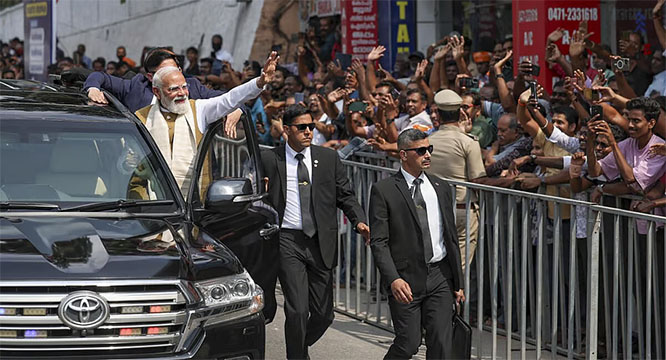
Prime Minister Narendra Modi, during his visit to Thiruvananthapuram on Friday, January 23, indicated that the Bharatiya Janata Party (BJP) is aiming to expand its political footprint in Kerala ahead of the Assembly elections scheduled in the coming months.

Speaking at a BJP-organised public meeting, Modi drew parallels between the party’s early electoral gains in Gujarat and its recent victory in the Thiruvananthapuram Municipal Corporation. The civic body win, which ended decades of Left control, was cited by the Prime Minister as a possible starting point for the party’s broader ambitions in the state.

Recalling BJP’s political trajectory in Gujarat, Modi said the party was largely insignificant before 1987 and received little media attention. He pointed out that the BJP’s first major breakthrough came with its victory in the Ahmedabad Municipal Corporation that year.

“Just as our journey in Gujarat began with one city, Kerala’s journey has also started with a single city,” Modi said, suggesting that the party’s municipal-level success could translate into wider electoral acceptance.

The Prime Minister alleged that successive governments led by the Left Democratic Front (LDF) and the United Democratic Front (UDF) had failed to adequately develop Thiruvananthapuram. He accused both fronts of corruption and neglect, claiming that basic infrastructure and facilities were denied to the capital city for decades.

According to Modi, the BJP’s control of the civic body represents a shift driven by public dissatisfaction with the existing political alternatives. He asserted that the BJP administration in Thiruvananthapuram had begun working towards development, though no specific details or timelines were outlined.

Addressing the gathering at Putharikandam Maidan, Modi said the BJP intended to project Thiruvananthapuram as a “model city,” reiterating his party’s commitment to governance-led change.

The Prime Minister’s visit to Kerala also included the inauguration of several development projects and the flagging off of new train services, as the BJP intensifies its political outreach in the poll-bound state.

Comments

Add new comment

  • Coastaldigest.com reserves the right to delete or block any comments.
  • Coastaldigset.com is not responsible for its readers’ comments.
  • Comments that are abusive, incendiary or irrelevant are strictly prohibited.
  • Please use a genuine email ID and provide your name to avoid reject.