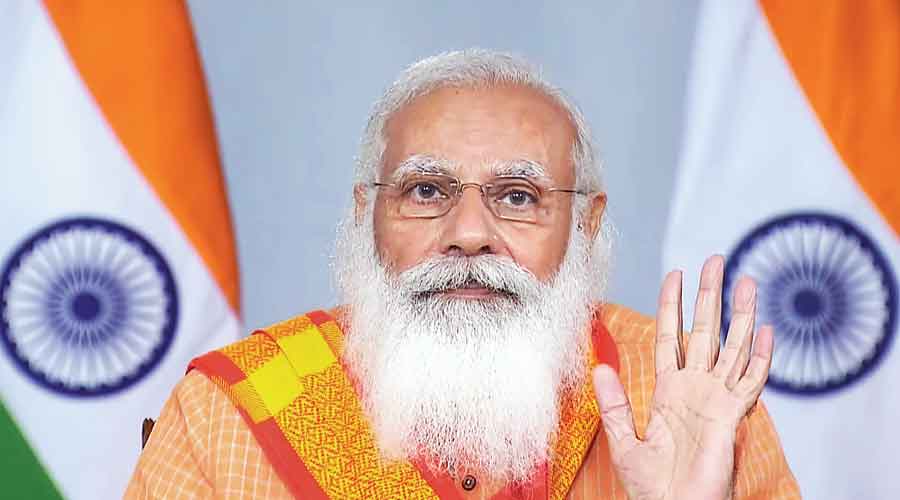
PM Modi in tears makes people question motives

Mafazah Sharafuddin
May 26, 2021

modis.jpg

Prime Minister Narendra Modi choking up at the plight of healthcare workers in Varanasi had brewed up a storm. It has been met with both sympathy and disbelief. The Indian public is divided on what to make of the spectacle.

It is no secret that politics is most often elaborately planned and executed. The speeches are written, the leaders are told what to say, what questions to answer, what questions to evade. That is not to say that there is no truth to what they say, but simply that they choose what truth, and how much of it, to speak.

The question then arises, how much of it is an act?

The video of the Prime Minister in tears has, predictably, gone viral. By his supporters, it has been described as an outpouring of grief. He is commented for empathizing with the terrible situation the healthcare workers are in. It is perceived as him truly caring about the Indian public.

The more skeptical of the Indian public, on the other hand, have called it a spectacle of ‘crocodile tears’. It’s been referred to as drama. Rising to the occasion as always, trolls on the internet have begun to refer to it as PMCries, an allusion to the ‘relief fund’ PMCares.

Pathos has always been the preferred tool in BJP’s arsenal. Indians are sentimental folk, and swaying the public’s emotions is a good way to gain their support. Strategically speaking, it is undoubtedly a smart move. In terms of credibility, however, it leaves much to be desired.

Some other instances of PM Modi being ‘moved to tears in the history of Indian politics may help shed some more light on the current situation. A few notable moments are after he was chosen as the leader of the parliamentary party in 2014 and during the demonetization debacle in 2016. 

The two instances are great examples of the two different kinds of scenarios that brings PM Modi to tears in public. 

When he was chosen as the leader in 2014, he was made emotional saying that he was grateful for the BJP for giving a ‘poor boy’ such an opportunity. It is an act of humanizing politicians. One of removing the professional distance maintained to give the public enough of a glance into their personal lives to make them see them as individuals rather than an amorphous blob of party ideology.  Although the PM’s current lifestyle is far from one of a ‘poor boy’, it creates a relatable figure to look up to. He goes from simply being a man in power, to an underdog who fought against circumstance to get there.  

During the time of demonetization, the public was up in arms, outraged. It was a policy that hit the middle class and poorer sections of society hard. The speech that had him in tears did not speak of how the crisis would be solved, or why it was considered appropriate to plunge the country into crisis without warning. Instead, he tearfully spoke of his sacrifices to reach that position. He said he wasn’t in it for the ‘kursi’ and requested that the public endure the hardships brought about by demonetization. .

Rahul Gandhi tweeted “No Vaccines. Lowest GDP. Highest Covid deaths...GOI’s response? PMCries.”

Amidst the struggle to find beds, oxygen and medicine, along with the mismanagement of the vaccine and social distancing measures, the pressure on the government is high. There has been some questionable decision making, like conducting the Kumbh Mela amidst the pandemic that further exacerbates the public’s skepticism towards how well the government is handling the situation. 

It is important to remember that trying to earn an emotional response happens when logic and competence have both failed. 

Comments

Ramesh Mishra
 - 
Wednesday, 2 Jun 2021

PM MODI IN TEARS: INDIA
The article authored by Mafazah Sharafuddin about the Honourable Modi's tears is to hoodwink the people that he is a genuine person who cares for the people. I welcome the scholarly article and congratulate the writer. I am a UP NRI, have studied, worked and travelled the world for over 50 years. My comment is made in good faith based on my learning, experience and my personal dealings with the UP and the Central Government. Both levels of the governments are governed by irresponsible politicians, IAS, IPS, PCS, terrorists, who are mostly unskilled, uneducated, uncivilised with a Godly attitude. People of India are the victims of the religious faith at the hands of our politicians and their executive's
mafia and their culture are fundamentally barbaric, irrational, violent and horrifying. I provide a simple example that Modi, PM and Yogi CM of UP are untrustworthy and unfit to Govern and they have no moral, as an example for the progress of civilised society. I made a parental property partition application before the civil Courts. My younger brother, his wife and children, other co-shareholders consulted advocates related to my co-shareholders, the advocates advised them that since I married a Japanese Buddhist women I was not entitled to get my shares in the parental properties. I am 75 years old with three children residing in Canada since 1975. My co-shareholders are related to an IAS in Assam, who conspired with 3, IAS, 4, PCS of UP, police, politicians and bhumafia and recruited one relative of co-shareholders late Vikas Dubey of Kanpur to murder me with a motive to steal my properties which is possessed in gun violence by my brother. I prayed to Modi and Yogi for the protection of my life and property they ignored me in a similar way as they ignored the victims of Covid-19, pandemic causing a massive death all over India. The Indian politicians and their executives were willfully negligent which negligence has ruined India. It is up to the Courts of India to judge the conduct of Modi. In my opinion India is a lawless Nation governed by Gundas and no one and no one's property is safe.
Ramesh Mishra
Victoria BC CANADA

Add new comment

  • Coastaldigest.com reserves the right to delete or block any comments.
  • Coastaldigset.com is not responsible for its readers’ comments.
  • Comments that are abusive, incendiary or irrelevant are strictly prohibited.
  • Please use a genuine email ID and provide your name to avoid reject.
News Network
January 23,2026

Mangaluru: The Karnataka Government Polytechnic (KPT), Mangaluru, has achieved autonomous status from the All India Council for Technical Education (AICTE), becoming the first government polytechnic in the country to receive such recognition in its 78-year history. The status was granted by AICTE, New Delhi, and subsequently approved by the Karnataka Board of Technical Education in October last year.

Officials said the autonomy was conferred a few months ago. Until recently, AICTE extended autonomous status only to engineering colleges, excluding diploma institutions. However, with a renewed national focus on skill development, several government polytechnics across India have now been granted autonomy.

KPT, the second-largest polytechnic in Karnataka, was established in 1946 with four branches and has since expanded to offer eight diploma programmes, including computer science and polymer technology. The institution is spread across a 19-acre campus.

Ravindra M Keni, the first dean of the institution, told The Times of India that AICTE had proposed autonomous status for polytechnic institutions that are over 25 years old. “Many colleges applied. In the first round, 100 institutions were shortlisted, which was further narrowed down to 15 in the second round. We have already completed one semester after becoming an autonomous institution,” he said. He added that nearly 500 students are admitted annually across eight three-year diploma courses.

Explaining the factors that helped KPT secure autonomy, Keni said the institution has consistently recorded 100 per cent admissions and placements for its graduates. He also noted its strong performance in sports, with the college emerging champions for 12 consecutive years, along with active student participation in NCC and NSS activities.

Autonomous status allows KPT to design industry-oriented curricula, conduct examinations, prepare question papers, and manage academic documentation independently. The institution can also directly collaborate with industries and receive priority funding from AICTE or the Ministry of Education. While academic autonomy has been granted, financial control will continue to rest with the state government.

“There will be separate committees for examinations, question paper setting, boards of studies, and boards of examiners. The institution will now have the freedom to conduct admissions without government notifications and issue its own marks cards,” Keni said, adding that new academic initiatives would be planned after a year of functioning under the autonomous framework.

Comments

Add new comment

  • Coastaldigest.com reserves the right to delete or block any comments.
  • Coastaldigset.com is not responsible for its readers’ comments.
  • Comments that are abusive, incendiary or irrelevant are strictly prohibited.
  • Please use a genuine email ID and provide your name to avoid reject.
News Network
January 20,2026

Mangaluru: In a major step towards strengthening rural innovation, the Office of the Principal Scientific Adviser (PSA) to the Government of India is supporting the establishment of RuTAGe Smart Village Centres (RSVCs) across the country through collaborations with academic institutions, civil society organisations and philanthropic partners.

As part of this national initiative, Nitte (Deemed to be University) will set up the first RSVCs in the region at Nitte GP in Udupi district and at the Nitte Health Centre, Sevanjali Trust, Farangipete, in Dakshina Kannada district. The centres will be inaugurated on January 21. In South India, the programme is being implemented by the Section Infin-8 Foundation (SI-8).

Speaking to reporters on Monday, SI-8 founder-director Vishwas US said experts from Nitte University and SI-8 would work closely with farmers, students, youth and local entrepreneurs to adapt and deploy technologies tailored to local needs.

Project head Prof Iddya Karunasagar, representing Nitte DU, said the RSVCs at Nitte and Farangipete would serve as demonstration hubs for a wide range of agriculture, energy, skill-development and assistive technologies. These include solar dryers for fruits, vegetables and crops; soil-testing solutions; power weeders and women-friendly farm tools; wind-powered devices for rural artisans; grain storage systems; grass-cutting and tree-climbing equipment; and liquid fertiliser production using cowshed waste.

SI-8 CEO Aravind C Kumar said the centres would also provide access to digital and knowledge-based platforms such as ISRO applications, government scheme portals, market linkage tools and gamified learning resources, along with assistive technologies for persons with visual impairments.

Highlighting the broader impact of the initiative, Principal Scientific Adviser Prof Ajay Kumar Sood said it demonstrated how applied research could bridge the rural–urban divide and help create self-reliant, technology-enabled villages.

The initiative has been made possible through philanthropic support from Dr NC Murthy of ACM Business Solutions, LLC, USA. Dr Sapna Poti, Director (Strategic Alliances) at the Office of the Principal Scientific Adviser, said the long-term objective is to build self-sufficient, technology-driven communities capable of generating sustainable livelihoods on their own.

Comments

Add new comment

  • Coastaldigest.com reserves the right to delete or block any comments.
  • Coastaldigset.com is not responsible for its readers’ comments.
  • Comments that are abusive, incendiary or irrelevant are strictly prohibited.
  • Please use a genuine email ID and provide your name to avoid reject.
News Network
January 23,2026

oscar.jpg

The Voice of Hind Rajab, inspired by the tragic final moments of a young Palestinian girl killed by Israeli fire in Gaza, has been nominated for an Academy Award in the Best International Feature Film category.

Directed by Tunisian filmmaker Kaouther Ben Hania, the film recounts the true story of five-year-old Hind Rajab, who lost her life in January 2024 while fleeing Israeli bombardment with her family.

The film features the real audio of Hind’s desperate call to the Palestinian Red Crescent Society, where she pleaded for help moments before the vehicle she was in was struck by 355 bullets.

The haunting narrative begins with a brief call made from the besieged Tel al-Hawa neighborhood of Gaza, where gunfire and armored vehicles drowned out every sound.

After witnessing the brutal killing of her family, she made a trembling call, her voice reduced to a whisper as she spoke of the massacre and her unbearable loneliness as the sole survivor.

Premiering at the Venice International Film Festival in September 2025, The Voice of Hind Rajab garnered widespread acclaim, receiving a record-setting 23-minute standing ovation and the Silver Lion Grand Jury Prize, the festival’s second-highest honor.

In her acceptance speech, Ben Hania dedicated the film to humanitarian workers and first responders in Gaza, emphasizing that Hind's voice symbolizes countless civilians affected by war.

She aims to give voice to victims often reduced to mere statistics, highlighting the broader suffering of civilians in war zones.

The film’s Oscar nomination underscores its powerful storytelling and ethical approach to depicting real-life tragedy, making it a crucial piece of contemporary cinema.

It serves not only as a narration of individual tragedy but also as an artistic and documentary response to the silence and censorship that often overshadow West Asian struggles and wars.

Using an innovative method she calls docufiction, Ben Hania bridges unvarnished reality and narrative structure, creating a work that is both artistically valuable and socially impactful.

Born in 1977 in Sidi Bouzid—later the epicenter of the Arab revolution—her background profoundly influenced her worldview and artistic approach.

She is a graduate of the Higher School of Audiovisual Arts of Tunis, Pantheon-Sorbonne University, and La Fémis in Paris, where her studies equipped her with the technical and theoretical tools needed to address complex subjects. 

Comments

Add new comment

  • Coastaldigest.com reserves the right to delete or block any comments.
  • Coastaldigset.com is not responsible for its readers’ comments.
  • Comments that are abusive, incendiary or irrelevant are strictly prohibited.
  • Please use a genuine email ID and provide your name to avoid reject.