



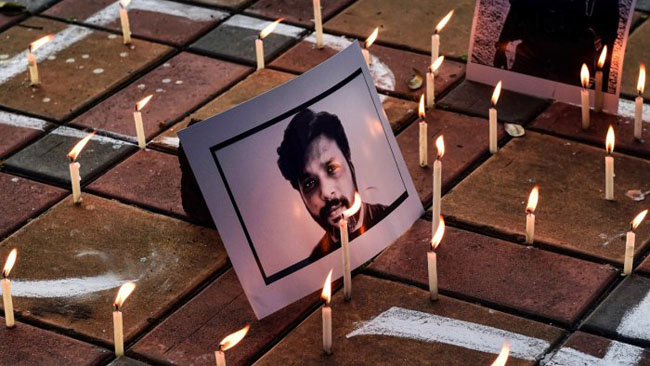
Who killed India’s most talented and courageous photojournalist Danish Siddiqui? Taliban denies role

News Network
July 17, 2021

danishsiddiqui.jpg

The Taliban has denied any role in the death of Pulitzer Prize-winning photojournalist Danish Siddiqui, who was killed while covering a clash between Afghan security forces and the insurgents.

“We are not aware during whose firing the journalist was killed. We do not know how he died," Taliban spokesperson Zabiullah Mujahid told CNN-News18.

“Any journalist entering the war zone should inform us. We will take proper care of that particular individual... We are sorry for Indian journalist Danish Siddiqui’s death," he said.

Siddiqui, an Indian national and Reuters staff journalist, was embedded with the members of Afghanistan’s elite special forces in Kandahar, a former Taliban stronghold. He was killed on Friday morning when Afghan commandos, attempting to retake a district surrounding a border crossing with Pakistan, came under Taliban fire, according to Reuters.

The slain journalist’s body was handed over to the International Committee of the Red Cross (ICRC) around 5 pm on July 19, according to the publication.

Afghanistan has long been one of the most dangerous countries in the world for journalists. Officials blame the Taliban for the murders although some assassinations have been claimed by the jihadist Islamic State.

Siddiqui is a mass communication graduate from Jamia Milia Islamia, New Delhi. Before making his foray into photojournalism, he had worked as television correspondent. 

As a photojournalist, Danish has covered several important stories in Asia, Middle East and Europe. Some of his works include covering the wars in Afghanistan and Iraq, Rohingya refugees crisis, Hong Kong protests, Nepal earthquakes, Mass Games in North Korea and living conditions of asylum seekers in Switzerland. He has also produced a photo series on Muslim converts in England.

In India, Danish Siddiqui’s covered the anti-CAA protests, farmer protests, COVID-19 and lock-down struggles. His pictures are called iconic, for they showed the truth.

Comments

Add new comment

  • Coastaldigest.com reserves the right to delete or block any comments.
  • Coastaldigset.com is not responsible for its readers’ comments.
  • Comments that are abusive, incendiary or irrelevant are strictly prohibited.
  • Please use a genuine email ID and provide your name to avoid reject.
News Network
January 23,2026

oscar.jpg

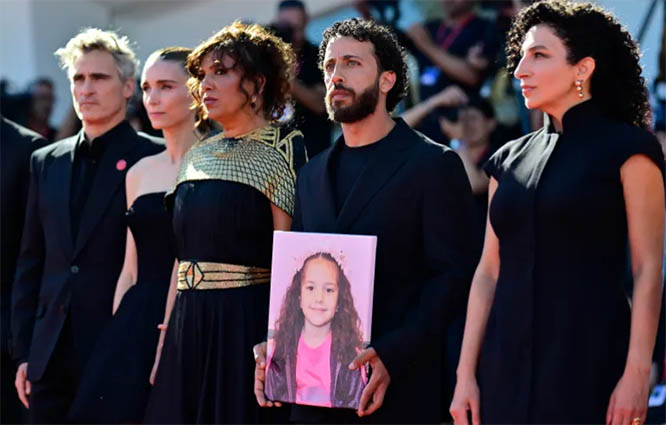
The Voice of Hind Rajab, inspired by the tragic final moments of a young Palestinian girl killed by Israeli fire in Gaza, has been nominated for an Academy Award in the Best International Feature Film category.

Directed by Tunisian filmmaker Kaouther Ben Hania, the film recounts the true story of five-year-old Hind Rajab, who lost her life in January 2024 while fleeing Israeli bombardment with her family.

The film features the real audio of Hind’s desperate call to the Palestinian Red Crescent Society, where she pleaded for help moments before the vehicle she was in was struck by 355 bullets.

The haunting narrative begins with a brief call made from the besieged Tel al-Hawa neighborhood of Gaza, where gunfire and armored vehicles drowned out every sound.

After witnessing the brutal killing of her family, she made a trembling call, her voice reduced to a whisper as she spoke of the massacre and her unbearable loneliness as the sole survivor.

Premiering at the Venice International Film Festival in September 2025, The Voice of Hind Rajab garnered widespread acclaim, receiving a record-setting 23-minute standing ovation and the Silver Lion Grand Jury Prize, the festival’s second-highest honor.

In her acceptance speech, Ben Hania dedicated the film to humanitarian workers and first responders in Gaza, emphasizing that Hind's voice symbolizes countless civilians affected by war.

She aims to give voice to victims often reduced to mere statistics, highlighting the broader suffering of civilians in war zones.

The film’s Oscar nomination underscores its powerful storytelling and ethical approach to depicting real-life tragedy, making it a crucial piece of contemporary cinema.

It serves not only as a narration of individual tragedy but also as an artistic and documentary response to the silence and censorship that often overshadow West Asian struggles and wars.

Using an innovative method she calls docufiction, Ben Hania bridges unvarnished reality and narrative structure, creating a work that is both artistically valuable and socially impactful.

Born in 1977 in Sidi Bouzid—later the epicenter of the Arab revolution—her background profoundly influenced her worldview and artistic approach.

She is a graduate of the Higher School of Audiovisual Arts of Tunis, Pantheon-Sorbonne University, and La Fémis in Paris, where her studies equipped her with the technical and theoretical tools needed to address complex subjects. 

Comments

Add new comment

  • Coastaldigest.com reserves the right to delete or block any comments.
  • Coastaldigset.com is not responsible for its readers’ comments.
  • Comments that are abusive, incendiary or irrelevant are strictly prohibited.
  • Please use a genuine email ID and provide your name to avoid reject.