The August 15, 1947 speeches remain beacons to desired future

Alok Prasanna Kumar
August 15, 2021

nehru.jpg

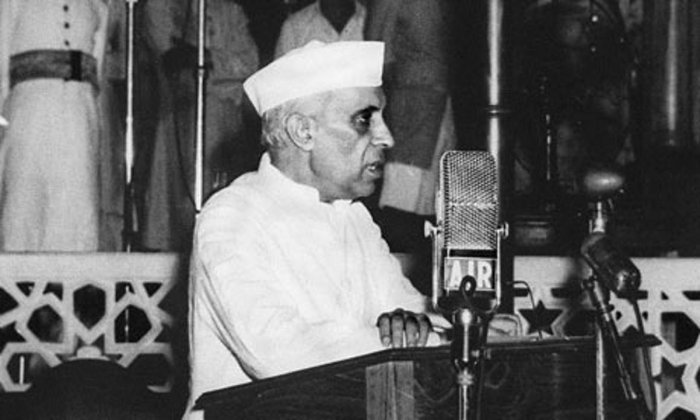
Jawaharlal Nehru made his famous “Tryst with Destiny” speech late in the night on August 14, 1947. It was delivered during one of the most momentous sessions of the Constituent Assembly, one that is well-known and well-recorded. Apart from Nehru’s speech itself, the presentation of the national flag, the singing of the national anthem, the taking of the pledge by all the members of the Assembly at the stroke of midnight are all well-known. Many evocative accounts of that moving day, by members and observers, are present and easily accessible.

But the session did not end there. The Constituent Assembly only adjourned to the morning of August 15, 1947. This day, when Nehru flew the Indian flag from the ramparts of the Red Fort, saw speeches by Governor-General Louis Mountbatten and Rajendra Prasad, in his capacity as the president of the Constituent Assembly. The speeches are revealing about the immediate circumstances in which India became independent -- what was said being as important as what was left unsaid.

The day began with the reading out of congratulatory messages received from nations far and wide. Mountbatten was then invited to speak.

The bulk of Mountbatten’s speech covered the events leading up to independence, specifically his role in the whole process. No doubt he played a key role in the exercise, but one notices not only a certain level of self-congratulation, but also self-exculpation. Self-congratulation for having advanced the date of independence from July 1948 to August 1947, when everyone thought that even June 1948 was too early. Self-exculpation for the failings that resulted from such a hasty withdrawal.

Mountbatten gave himself credit for the idea behind implementing Partition (“the leaders agreed to discuss a paper which I had laid before them on the administrative consequences of Partition”) while also subtly telling us who to blame for things that went horribly wrong (“To the ministers and officials who have laboured day and night to produce this astonishing result, the greatest credit is due”).

Prasad’s speech was almost a riposte to Mountbatten’s, focused as it was on the future, and has no mention of the speaker himself. Prasad, in this vein, outlined an almost utopian vision for what he hoped India would become.

He said: “Let us resolve to create conditions in this country when every individual will be free and provided with the wherewithal to develop and rise to his fullest stature, when poverty and squalor and ignorance and ill-health will have vanished, when the distinction between high and low, between rich and poor, will have disappeared, when religion will not only be professed and preached and practised freely but will have become a cementing force for binding man to man and not serve as a disturbing and disrupting force dividing and separating, when untouchability will have been forgotten like an unpleasant night dream, when exploitation of man by man will have ceased…”

While articulating this utopian idea, Prasad also mentioned the important task at hand -- the making of the Constitution. Even while the draft Constitution was still being framed, Prasad articulated the hope that it “will enable the people’s will to be expressed and enforced, and that will not only secure liberty to the individual but also reconcile and make that liberty subservient to the common good.”

Mountbatten’s and Prasad’s speeches were a neat contrast of old and new, of personal and societal, of individual and institutional. Where Mountbatten looked to the past, his own role and the parts played by specific individuals in getting India to independence, Prasad looked to the future -- of what independence would bring, of what the society and nation would look like, and what individuals could hope to achieve in the new country.

Both viewpoints are, however, valid. It is good to remember that India’s independence came about in hasty, confused and, eventually, bloody circumstances that continue to haunt us to this day. Yet, it was also infused with hope for a better future -- one that we have made progress towards but are a long way from achieving.


(The author is Co-founder, Vidhi Centre for Legal Policy, uses his legal training to make the case that Harry Potter is science fiction and Star Wars is fantasy)

Comments

Add new comment

  • Coastaldigest.com reserves the right to delete or block any comments.
  • Coastaldigset.com is not responsible for its readers’ comments.
  • Comments that are abusive, incendiary or irrelevant are strictly prohibited.
  • Please use a genuine email ID and provide your name to avoid reject.
News Network
December 4,2025

indigoflight.jpg

Domestic carrier IndiGo has cancelled over 180 flights from three major airports — Mumbai, Delhi and Bengaluru — on Thursday, December 4, as the airline struggles to secure the required crew to operate its flights in the wake of new flight-duty and rest-period norms for pilots.

While the number of cancellations at Mumbai airport stands at 86 (41 arrivals and 45 departures) for the day, at Bengaluru, 73 flights have been cancelled, including 41 arrivals, according to a PTI report that quoted sources.

"IndiGo cancelled over 180 flights on Thursday at three airports-Mumbai, Delhi and Bengaluru," the source told the news agency.

Besides, it had cancelled as many as 33 flights at Delhi airport for Thursday, the source said, adding, "The number of cancellations is expected to be higher by the end of the day."

The Gurugram-based airline's On-Time Performance (OTP) nosedived to 19.7 per cent at six key airports — Delhi, Mumbai, Chennai, Kolkata, Bengaluru and Hyderabad — on December 3, as it struggled to get the required crew to operate its services, down from almost half of December 2, when it was 35 per cent.

"IndiGo has been facing acute crew shortage since the implementation of the second phase of the FDTL (Flight Duty Time Limitations) norms, leading to cancellations and huge delays in its operations across the airports," a source had told PTI on Wednesday.

Chaos continued at several major airports for the third day on Thursday because of the cancellations.

A spokesperson for the Kempegowda International Airport (KIA) in Bengaluru said that 73 IndiGo flights had been cancelled on Thursday.

At least 150 flights were cancelled and dozens of others delayed on Wednesday, airport sources said, leaving thousands of travellers stranded, according to news agency Reuters.

The Directorate General of Civil Aviation (DGCA) has said it is investigating IndiGo flight disruptions and has asked the airline to submit the reasons for the current situation, as well as its plans to reduce flight cancellations and delays.

It may be mentioned here that the pilots' body, Federation of Indian Pilots (FIP), has alleged that IndiGo, despite getting a two-year preparatory window before the full implementation of new flight duty and rest period norms for cockpit crew, "inexplicably" adopted a "hiring freeze".

The FIP said it has urged the safety regulator, the DGCA, not to approve airlines' seasonal flight schedules unless they have adequate staff to operate their services "safely and reliably" in accordance with the New Flight Duty Time Limitations (FDTL) norms.

In a letter to the DGCA late on Wednesday, the FIP urged the DGCA to consider re-evaluating and reallocating slots to other airlines, which have the capacity to operate them without disruption during the peak holiday and fog season if IndiGo continues to "fail in delivering on its commitments to passengers due to its own avoidable staffing shortages."

Comments

Add new comment

  • Coastaldigest.com reserves the right to delete or block any comments.
  • Coastaldigset.com is not responsible for its readers’ comments.
  • Comments that are abusive, incendiary or irrelevant are strictly prohibited.
  • Please use a genuine email ID and provide your name to avoid reject.
News Network
December 2,2025

DKSsiddu.jpg

Bengaluru: 'Nati koli saaru' (country chicken curry) considered one of Chief Minister Siddaramaiah’s favourites along with steaming hot idlis was on the breakfast menu at Deputy CM D K Shivakumar’s residence on Tuesday, according to official sources.

The spread also included 'nati koli' fry, vada and pongal, among other items, they said.

In an apparent show of unity, Siddaramaiah visited Shivakumar’s residence for breakfast, just days after the two leaders shared a meal amid a simmering power tussle in the state Congress.

Siddaramaiah drove to the Deputy CM’s residence in Sadashivanagar, where he was received by Shivakumar and his brother D K Suresh, who is a former Congress MP.

Suresh and Kunigal MLA H D Ranganath, a relative of Shivakumar, joined them for breakfast, which featured a mix of vegetarian and non-vegetarian dishes.

Speaking to reporters later, Siddaramaiah said Shivakumar had invited him during his visit to the CM’s residence for breakfast on Saturday.

Asked about the difference between the two meals, the chief minister said, "At his (Shivakumar’s) house it was non-veg, while at my house it was veg. He is a vegetarian, I am a non-vegetarian. I had not prepared non-veg. I told DK to get chicken from the village as you won’t get the original in Bengaluru."

Shivakumar said he had initially invited Siddaramaiah to his residence, but the CM had suggested visiting his place first and reciprocating later. "It was a vegetarian breakfast at the CM’s house on Saturday," he noted.

"Today, I invited him (the CM) to my house. He enjoyed the breakfast, which had his Mysuru taste," Shivakumar added. At this point, Siddaramaiah remarked that Shivakumar’s wife is also from Mysuru.

Saturday’s breakfast at Siddaramaiah’s official residence, held as part of efforts by the Congress high command to ease tensions in the leadership dispute between the two, reportedly included idlis and sambar, according to official sources.

Comments

Add new comment

  • Coastaldigest.com reserves the right to delete or block any comments.
  • Coastaldigset.com is not responsible for its readers’ comments.
  • Comments that are abusive, incendiary or irrelevant are strictly prohibited.
  • Please use a genuine email ID and provide your name to avoid reject.
News Network
December 7,2025

SHRIMP.jpg

Mangaluru, Dec 7: A rare bamboo shrimp has been rediscovered on mainland India more than 70 years after it was last reported, confirming for the first time the presence of Atyopsis spinipes in the country. The find was made by researchers from the Centre for Climate Change Studies at Sathyabama Institute of Science and Technology, Chennai, during surveys in Karnataka and Odisha.

The team — shrimp expert Dr S Prakash, PhD scholar K Kunjulakshmi, and Mangaluru-based researcher Maclean Antony Santos — combined field surveys, ecological assessments and DNA analysis to identify the elusive species. Their findings, published in Zootaxa, resolve decades of taxonomic confusion stemming from a 1951 report that misidentified the species as Atyopsis moluccensis without strong evidence.

The shrimp has now been confirmed at two locations: the Mulki–Pavanje estuary near Mangaluru and the Kuakhai River in Bhubaneswar. Historical specimens from the Andaman Islands, previously labelled as A. moluccensis, were also found to be misidentified and actually belong to A. spinipes.

The rediscovery began after an aquarium hobbyist in Odisha spotted a shrimp in 2022, prompting systematic surveys across Udupi, Karwar and Mangaluru. Four female specimens were collected in Mulki and one in Odisha, all genetically matching.

Researchers warn the species may exist in very small, vulnerable populations as freshwater habitats face increasing pressure from pollution, sand mining and infrastructure development. All verified specimens have been deposited with the Zoological Survey of India for future reference.

Comments

Add new comment

  • Coastaldigest.com reserves the right to delete or block any comments.
  • Coastaldigset.com is not responsible for its readers’ comments.
  • Comments that are abusive, incendiary or irrelevant are strictly prohibited.
  • Please use a genuine email ID and provide your name to avoid reject.