



India’s Composite Culture and Muslim Stalwarts

Ram Puniyani
August 9, 2020

Contrary to present impression that Muslims are separatists due to whom the partition of India took place, the truth is that Muslims contributed to freedom movement and upheld India’s composite culture in equal measure. The partition process, mainly due to British policy of ‘divide and rule’ well assisted by Hindu and Muslim communalists is being hidden from the popular vision in India and Muslims in general are held responsible for the same. Not only that the communal historiography introduced by British to pursue their policies has become the bedrock of communal politics and worsening of the perceptions about Muslims is in progress in India.

Yet another example of this has been a series of tweets by the bureaucrat, who is close to retirement, K. Nageshwar Rao. Contrary to the service rules he has made statements, through his tweets which are appreciative of RSS-BJP and demonise the stalwarts Muslim leaders who not only contributed to the freedom movement but also later gave valuable service in laying the foundation of Independent India. As per Rao, his tweets he accuses Maulana Azad and the other Muslim Education ministers of “deracination of Hindus”. After naming “Maulana Abul Kalam Azad — 11 years (1947-58)”; “Humayun Kabir, M C Chagla & Fakruddin Ali Ahmed — 4 years (1963-67)”; and, “Nurul Hassan — 5 years (1972-77)”, he posts: “Remaining 10 years other Leftists like VKRV Rao.”

He points out that their policies were meant to “1. Deny Hindus their knowledge, 2. Vilify Hinduism as collection of superstitions, 3. Abrahamise Education, 4. Abrahamise Media & Entertainment, 5. Shame Hindus about their identity!  and 6. Bereft of the glue of Hinduism Hindu society dies.”

Then he goes on to praise RSS-BJP for bringing the glory back to Hindus. These statements of his on one hand promote the Hate and on the other tantamount to political statement, which civil servants should not by making. CPM politburo member Brinda Karat has written a letter to Home Minister Amit Shah to take suitable action against the erring bureaucrat.

Rao begins with Maulana Abul kalam Azad. Surely Azad was one of the major leaders of freedom movement, who was also the youngest President of INC, in 1923 and later between 1940 to 1945. He opposed the partition process tooth and nail till the very last. As the Congress President in 1923 he wrote a remarkable Para, symbolizing the urge for Hindu Muslim unity, “If an angel descends from heaven and offers me Swaraj in 24 hours on condition that I give up Hindu Muslim Unity, I will refuse. Swaraj we will get sooner or later; its delay will be a loss for India, but loss of Hindu Muslim unity will be a loss for human kind”. His biographer Syeda Hamid points out “He spoke without an iota of doubt about how debacle of Indian Muslims has been the result of the colossal mistakes committed by Muslim League’s misguided leadership. He exhorted Muslims to make common cause with their Hindu, Sikh, Christian fellow countrymen.” He was the one who promoted the translation of Hindu scriptures Ramayan and Mahabharat in to Persian.

Surely Mr. Rao, neither has read Azad or read about him nor knows his contributions to making of Modern India. While today, the ideological formation to which Mr. Rao seems to be pledging his commitment is critical of all that happened during Nehru era, it was during this period when as education minister Azad was shepherding the formations of IITs, Academies of Science, Lalit kala Academies. It was during this period that the efforts to promote Indian composite culture were undertaken through various steps.

The other stalwarts who are under the hammer have been outstanding scholars and giants in their own field of education. Humayun Kabir, Nurul Hasan, Dr.Zakir Husssain gave matchless ideas and practical contributions in different fields of education. One can say that contrary to the accusations, India could match up to the Computer era, software and associate things, due to creation of large manpower in these areas mainly due to these foundations which were laid down particularly in the field of education during this period.

The charge that these ‘Muslim’ education ministers white washed the bloody Islamic rule is a blind repetition of the offshoot of communal historiography introduced by British. While Kings were ruling for power and wealth, their courts had Hindus and Muslim both officers. The jaundiced vision sees this as a bloody Islamic rule but as a matter of fact the syncretic culture and traditions developed precisely this period. It was during this period that Bhakti Traidtion with Kabir, Tukaram, Namdeo, Tulsidas flourished. It was during this period that humane values of Sufi saints reached far and wide. It was during this period that poets like Rahim and Raskhan produced their classic literature n praise of Hindu Gods.

We also need to remind ourselves that large number of Muslims participated in the freedom Movement. Two scholars Shamsul Islam and Nasir Ahmad have come out with books on the myriad such freedom fighters, to recall just a few names. Khan Abdul Gaffar Khan, Zakir Hussain, Syed Mohammad Sharfuddin Kadri, Bakht Khan, Muzzafar Ahmad, Mohammad Abdir Rahman,, Abbas Ali, Asaf Ali, Yusuf Mehrali, Maulana Mazahrul Hague.

These are just a few of the names. The movement, led by Gandhi, definitely laid the foundations where composite Indian culture and respect for all religions, others’ religion was paramount and this is what created Indian fraternity, one of the values which finds its place in the preamble of Indian Constitution.

This blaming of Education ministers who were Muslims is an add-on to the process of Islamophobia in India. So for there have been many actions of Muslim kings which are selectively presented as being bloody, now the post Independent History, where glorious contributions have been made by Muslim leaders are being used to further deepen the divisive process. We need to pay respects to builders of modern India, irrespective of their religion.

Comments

Add new comment

  • Coastaldigest.com reserves the right to delete or block any comments.
  • Coastaldigset.com is not responsible for its readers’ comments.
  • Comments that are abusive, incendiary or irrelevant are strictly prohibited.
  • Please use a genuine email ID and provide your name to avoid reject.
News Network
January 19,2026

New Delhi: Setting speculation to the rest, the CPI(M) has made it clear that it is open to have an electoral understanding with the Congress “to defeat” the Trinamool Congress and the BJP in West Bengal Assembly election even as it is all set to take on the grand old party in Kerala accusing it of “found wanting” in fighting the Hindutva forces.

The CPI(M) also said that it will contest the Tamil Nadu election “with DMK and its allies to defeat the BJP and its allies”, amid a section in the Congress triggering confusion about its participation in the M K Stalin-led coalition over demand over power-sharing and more seats. It is also willing to join hands with Congress and others in Assam and Puducherry to defeat the BJP.

The decisions came at a three-day meeting of the CPI(M) Central Committee in Thiruvananthapuram, which ended on Sunday after reviewing the poll preparations in the poll-bound states.

The CPI(M)'s decision came even as a section led by West Bengal Congress president Subhankar Sarkar is averse to tying up with the Left Front, claiming that their party is not benefitted by the electoral understanding. Both Congress and CPI(M)-led Left Front had electoral understanding in 2016 and 2021 Assembly elections and 2024 Lok Sabha polls.

Congress and the Left Front fought together for the first time in 2016 when Congress won 44 seats and the CPI(M) got 26. In 2021, the Left Front and the Congress drew a blank. In the 2024 Lok Sabha polls, Congress managed to win one seat while the Left did not win any. In the 2019 Lok Sabha polls, both fought against each other with Congress winning two and the Left none.

“In Bengal, the party will work for the defeat of both the TMC and the BJP, which are trying to polarise the society. We will try to rally all the forces that are ready to work against them,” the CPI(M) said in a statement without naming Congress by name. Senior leaders said there is no change in its strategy of pooling all non-BJP, non-TMC votes.

However, the party was critical of the Congress in Kerala where both will fight against each other.

The CPI(M) said it would "expose the BJP-led Union government’s denial of rightful dues to Kerala, the fiscal constraints imposed and the overall attack on federalism" as also "expose the failure of the Congress to effectively counter this attack on federalism, as the largest opposition party in the Parliament".

"The Congress, especially in Kerala, was found wanting in the fight against communal RSS-BJP, ideologically and this will also be exposed before the people," it added.

In Assam, it said, the CPI(M) will work for the mobilisation of all the anti-BJP parties and forces and defeat the rabidly communal and divisive BJP government. The Left parties are cooperating with Congress in the north-eastern state. In Puducherry, it said it will work for the defeat of the BJP alliance government.

Comments

Add new comment

  • Coastaldigest.com reserves the right to delete or block any comments.
  • Coastaldigset.com is not responsible for its readers’ comments.
  • Comments that are abusive, incendiary or irrelevant are strictly prohibited.
  • Please use a genuine email ID and provide your name to avoid reject.
News Network
January 23,2026

Mangaluru: The Karnataka Government Polytechnic (KPT), Mangaluru, has achieved autonomous status from the All India Council for Technical Education (AICTE), becoming the first government polytechnic in the country to receive such recognition in its 78-year history. The status was granted by AICTE, New Delhi, and subsequently approved by the Karnataka Board of Technical Education in October last year.

Officials said the autonomy was conferred a few months ago. Until recently, AICTE extended autonomous status only to engineering colleges, excluding diploma institutions. However, with a renewed national focus on skill development, several government polytechnics across India have now been granted autonomy.

KPT, the second-largest polytechnic in Karnataka, was established in 1946 with four branches and has since expanded to offer eight diploma programmes, including computer science and polymer technology. The institution is spread across a 19-acre campus.

Ravindra M Keni, the first dean of the institution, told The Times of India that AICTE had proposed autonomous status for polytechnic institutions that are over 25 years old. “Many colleges applied. In the first round, 100 institutions were shortlisted, which was further narrowed down to 15 in the second round. We have already completed one semester after becoming an autonomous institution,” he said. He added that nearly 500 students are admitted annually across eight three-year diploma courses.

Explaining the factors that helped KPT secure autonomy, Keni said the institution has consistently recorded 100 per cent admissions and placements for its graduates. He also noted its strong performance in sports, with the college emerging champions for 12 consecutive years, along with active student participation in NCC and NSS activities.

Autonomous status allows KPT to design industry-oriented curricula, conduct examinations, prepare question papers, and manage academic documentation independently. The institution can also directly collaborate with industries and receive priority funding from AICTE or the Ministry of Education. While academic autonomy has been granted, financial control will continue to rest with the state government.

“There will be separate committees for examinations, question paper setting, boards of studies, and boards of examiners. The institution will now have the freedom to conduct admissions without government notifications and issue its own marks cards,” Keni said, adding that new academic initiatives would be planned after a year of functioning under the autonomous framework.

Comments

Add new comment

  • Coastaldigest.com reserves the right to delete or block any comments.
  • Coastaldigset.com is not responsible for its readers’ comments.
  • Comments that are abusive, incendiary or irrelevant are strictly prohibited.
  • Please use a genuine email ID and provide your name to avoid reject.
News Network
January 20,2026

iran.jpg

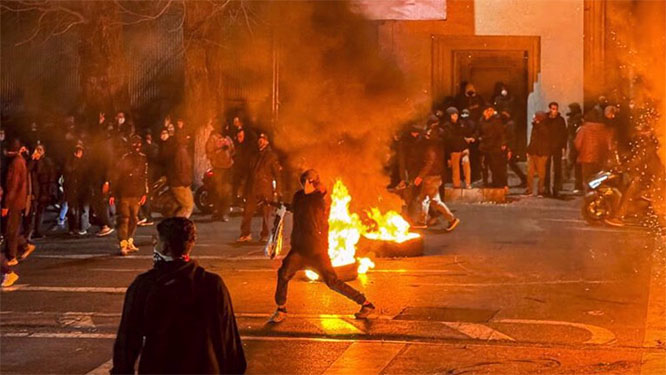
Iranian security and intelligence forces have captured more than 470 individuals in three provinces, identified as key figures behind the recent wave of violent unrest and terrorist activities linked to foreign-backed networks.

The Intelligence Ministry's provincial office in Khorasan Razavi announced on Monday the arrest of 192 armed terrorists, identified as the main agents behind recent riots in the region. 

According to an official statement, the detainees were involved in the killing of several security personnel and civilians, setting fire to mosques, public service facilities, and buses, as well as attacks on military and law enforcement centers.

The seized items from the group include several bulletproof vests, Kalashnikov rifles, hunting weapons, Winchester rifles, and various cold weapons such as daggers, swords, brass knuckles, tactical knives, crossbows, and chains.

Evidence indicates that some of the individuals were tied to hostile movements and terrorist organizations, with links overseas. Others were identified as members of violent criminal gangs, actively taking part in the unrest alongside their associates.

Simultaneously, in the western province of Lorestan, the IRGC announced the arrest of 134 individuals as the main leaders and influential field agents of a US-Israeli terrorist network.

The IRGC statement stated that these individuals formed terrorist cells during the recent unrest, committing "Daesh-like" acts.

They wounded security forces with firearms and cold weapons, and burned and destroyed public and private properties, including mosques, shops, banks, and private and public vehicles.

In the northwestern province of Zanjan, the police reported detaining 150 people identified as principal leaders and agents behind recent riots.

Authorities noted that these individuals were responsible for destroying public and private property and intentionally setting fire to vehicles in the province's squares.

Their crimes include shedding the blood of innocent people, destroying public and private property, attempting to enter military sites, disrupting public order, and spreading terror among citizens.

A variety of cold weapons were reportedly seized from the detainees.

What began late last month as peaceful protests over economic hardship across Iran turned violent after public statements by US and Israeli regime figures encouraged vandalism and disorder.

During the unrest, foreign-backed mercenaries rampaged through cities, killing security forces and civilians and damaging public property.

Comments

Add new comment

  • Coastaldigest.com reserves the right to delete or block any comments.
  • Coastaldigset.com is not responsible for its readers’ comments.
  • Comments that are abusive, incendiary or irrelevant are strictly prohibited.
  • Please use a genuine email ID and provide your name to avoid reject.