Netaji Bose: Attempted Appropriation by Hindu Nationalism

Ram Puniyani
February 5, 2021

Netaji Subhashchandra Bose’s birth anniversary was marked by various events this year (January 23). His portrait was unveiled by the President in Rashtrapati Bhavan. It was declared that his anniversary will be celebrated as Parakram Divas (Bravery day). Railway Minister announced the renaming of Howrah-Kalka Mail as Netaji Express. Mamta Bannerjee in contrast stated that his anniversary will be celebrated as Dehs Nayak Divas (National Hero Day). Through word of mouth propaganda and the social media BJP and company is spreading the falsehood that Congress did not honor Bose and that Bose supported Hindutva.

In a public meeting in Kolkata to celebrate his anniversary on 23 January when Mamata Bannerjee rose to speak a section of BJP supporters shouted Jai Shri Ram. Bannerjee said it is an insult to her and left the meeting without speaking. As such the slogan dear to Bose was Jai Hind.

All this is happening in the backdrop of forthcoming West Bengal elections where BJP is making all the attempts to win the Assembly elections. In tune with the attempt to pick up the icons by BJP; Subhash Bose is the latest on the line. He is a tall National figure and is greatly revered in WB. So far BJP never talked of putting Netaji in such a way as it is doing currently. The truth that Netaji’s ideology was totally in opposition to the one being pursued by BJP is being hidden under the carpet and strong attempt is underway to show that Netaji had ideology similar to the present ruling dispensation. Netaji was for socialism, democracy and communal amity and the present ruling party is for Hindu nation, is practicing the divisive politics and is undermining democracy through all its action.

As far as his differences with Congress party (INC) are concerned they related more to means to be employed for getting Independence. He was twice President of INC. The difference came up mainly in the wake of Second World War when Congress under the leadership of Mahatma Gandhi planned a nationwide agitation; ‘Quit India Movement’. Bose at this point of time wanted to make the British quit by allying with Germany and Japan who were Britain’s enemy countries. The majority of Congress Central committee was with Gandhi’s proposal and leaders like Patel and Nehru totally opposed the strategy proposed by Bose.

Still it was a tactical difference; Congress and Bose both were for getting freedom, while Hindu Mahasabha and RSS supported the British war efforts. Savarkar of Hindu Mahasabha was in the lead to make the British army strong by helping them to recruit Indians into British army. Bose on the contrary formed ‘Azad Hind Fauz’ (Indian National Army, INA) in Singapore with the aim of countering British army. He continued to be admirer of INC, Gandhi and Nehru; as is evident from the fact that he wrote to Mahatma Gandhi addressing him as Rashtrapita (Father of the nation). He sought Gandhi’s blessings while forming INA and two of INA Brigades were named after Gandhi and Nehru.

While Hindu Mahasabha and RSS have been totally against the state sponsored welfare programs and the concept of Socialism, Bose was a firm socialist. Within Congress he was with Nehru and other socialists for incorporation of socialist ideals in the national movement. Bose was strongly advocating for planning commission for the planned development of the country. Incidentally the planning commission which was set up after Independence was scrapped by BJP-NDA Government and replaced by Niti Ayog. When he left Congress he formed Forward Block, a socialist outfit, which had been part of the Left Alliance which ruled WB for decades.

Congress also looked at INA in a positive light and when after the end of World War II, the soldiers and officers of INA were tried in the Courts; lawyers like Bhulabhai Desai and Congress leader Jawaharlal Nehru among others fought the case for the INA. Interestingly Nehru adorned the lawyer’s gown precisely to fight the cases for the brave soldiers of INA.

One should note that Hindu Mahasabha’s Shyama Prasad Mukherjee was part of the Government of Bengal in alliance with Muslim League. When British Government was suppressing the Quit India Movement, Mukherjee promised British not to bother about the Quit India Movement in Bengal as he will deal with them properly. Parallel to this Hindu Mahasabha’s Savarkar wanted British army to be strong and chief of RSS, Golwalkar put out a circular to its branches to stick to their regular activities and not to do anything which will annoy the British.

Hindu Rashtra (Nation) has been the main plank of Hindu Mahasabha-RSS. Bose was totally opposed to the politics of communalists, Muslim League and Hindu Mahasabha. It was under his President-ship of Congress that that dual membership of communalists was barred. They no longer could be on the elective committees of Congress. Also in one of his broadcasts from Berlin he criticized these formations for their siding with British. As per him the politics of communal organizations was totally against the interests of peasants and workers. His opposition to Shyama Prasad Mukherjee joining Hindu Mahasabha’s Bengal unit was very strong.

It is not much projected as to what were the ideas of Bose on the issue of nature of Nationalism and Hindu Muslim unity.  To quote Bose from his writings, “With the advent of the Mohammedans, a new synthesis was gradually worked out. Though they did not accept the religion of the Hindus, they made India their home and shared in the common social life of the people – their joys and their sorrows. Through mutual co-operation, a new art and a new culture were (sic) evolved ….” And also that, “Indian Mohammedans” have continued to work for national freedom.” In order to uphold rights of minorities, he conceptualized a new State where “religious and cultural freedom for individuals and group” should be guaranteed and no “state-religion” would be adopted [‘Free India and her Problems’].

While sticking to ‘first comers’, RSS ideologues say that Aryans were the original inhabitants in India and from here they emigrated to parts of West Asia and Europe. In contrast Bose points out “, “The latest archeological excavations … prove unmistakably that India had reached a high level of civilization as early as 3000 B.C. … before the Aryan conquest of India.” His praise for Mohenjo-daro and Harappa is certainly a rational counter-argument based on ‘scientific findings’ against the imagination of a Hindu-Aryan origin of Indian culture. Bose was forward looking and did not subscribe to ‘golden ancient period’ thesis propounded by communalists.

Time and over again the Hindu nationalists have been trying to gain legitimacy by appropriating the national icons like Vivekanad, Sardar Patel and the like. BJP is on the lokout for those nationals icons who differed with Congress, with Gandhi or Nehru. Now with WB elections forthcoming ‘no holds barred’ efforts is on to appropriate a tall leader of freedom movement, whose ideology is totally in opposition the one of Hindu nationalists. He was a true socialist wedded to the concept of Hindu Muslim unity. He fought against British while Hindu nationalists supported them. He called Gandhi as rashtrapita, while one of the Hindu nationalist murdered him!

Comments

Add new comment

  • Coastaldigest.com reserves the right to delete or block any comments.
  • Coastaldigset.com is not responsible for its readers’ comments.
  • Comments that are abusive, incendiary or irrelevant are strictly prohibited.
  • Please use a genuine email ID and provide your name to avoid reject.
News Network
January 23,2026

Karnataka Governor Thaawarchand Gehlot read only three lines from the 122-paragraph address prepared by the Congress-led state government while addressing the joint session of the Legislature on Thursday, effectively bypassing large sections critical of the BJP-led Union government.

The omitted portions of the customary Governor’s address outlined what the state government described as a “suppressive situation in economic and policy matters” under India’s federal framework. The speech also sharply criticised the Centre’s move to replace the Mahatma Gandhi National Rural Employment Guarantee Act (MGNREGA) with the Viksit Bharat–Guarantee for Rozgar and Ajeevika Mission (Gramin) Act, commonly referred to as the VB-GRAM (G) Act.

Governor Gehlot had earlier conveyed his objection to several paragraphs that were explicitly critical of the Union government. On Thursday, he confined himself to the opening lines — “I extend a warm welcome to all of you to the joint session of the State legislature. I am extremely pleased to address this august House” — before jumping directly to the concluding sentence of the final paragraph.

He ended the address by reading the last line of paragraph 122: “Overall, my government is firmly committed to doubling the pace of the State’s economic, social and physical development. Jai Hind — Jai Karnataka.”

According to the prepared speech, the Karnataka government demanded the scrapping of the VB-GRAM (G) Act, describing it as “contractor-centric” and detrimental to rural livelihoods, and called for the full restoration of MGNREGA. The state government argued that the new law undermines decentralisation, weakens labour protections, and centralises decision-making in violation of constitutional norms.

Key points from the unread sections of the speech:

•    Karnataka facing a “suppressive” economic and policy environment within the federal system

•    Repeal of MGNREGA described as a blow to rural livelihoods

•    VB-GRAM (G) Act accused of protecting corporate and contractor interests

•    New law alleged to weaken decentralised governance

•    Decision-making said to be imposed by the Centre without consulting states

•    Rights of Adivasis, women, backward classes and agrarian communities curtailed

•    Labourers allegedly placed under contractor control

•    States facing mounting fiscal stress due to central policies

•    VB-GRAM (G) Act accused of enabling large-scale corruption

Comments

Add new comment

  • Coastaldigest.com reserves the right to delete or block any comments.
  • Coastaldigset.com is not responsible for its readers’ comments.
  • Comments that are abusive, incendiary or irrelevant are strictly prohibited.
  • Please use a genuine email ID and provide your name to avoid reject.
News Network
January 20,2026

KCFabudhabi.jpg

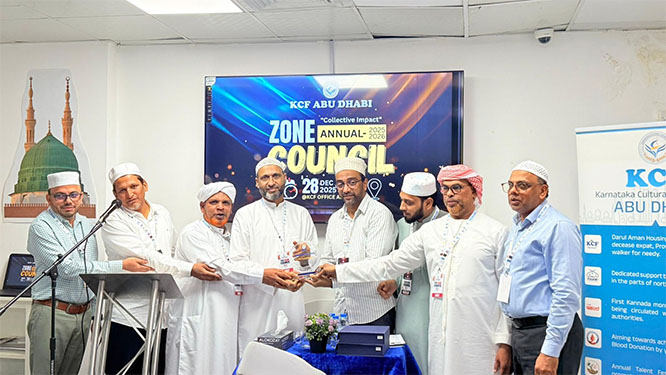
KCF, a global socio-cultural organisation of Karnataka expatriates, is actively involved in education, humanitarian initiatives and community well-being across several countries. The awardees were selected following a structured evaluation of nominations by the Annual Council Program Committee, based on the depth, consistency and long-term impact of their social service.

One of the award recipients, Abdul Razak Haji, a prominent UAE-based entrepreneur from the Qamcon Group of Companies, was honoured for his significant contributions to society. Through both his professional journey and personal initiatives, he has supported numerous employees and families, while also extending assistance in education, housing for the underprivileged and various charitable causes, largely carried out quietly over the years. His award was presented earlier during the Annual Council Program held at the KCF Abu Dhabi office.

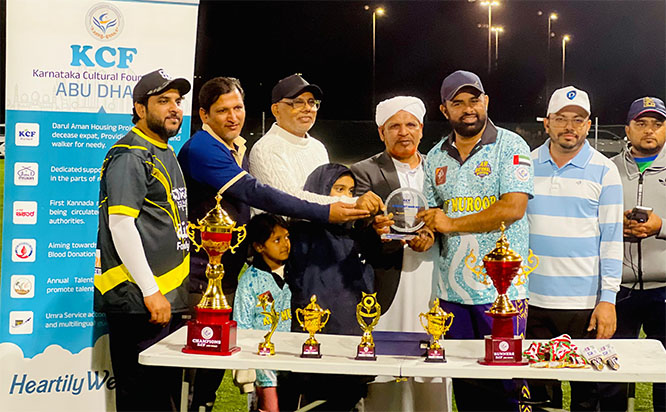
The second award was conferred on Latheef Kakkinje, a young social worker based in Abu Dhabi, in recognition of his active involvement in community engagement programmes, sports initiatives, talent festivals and family-oriented social activities. His consistent volunteering efforts and commitment to humanitarian causes were highly appreciated by the selection committee.

The award presentation ceremony for Latheef Kakkinje was held at the Zayed Cricket Stadium (Astro Turf Ground) in the presence of Kedumbady Ibrahim Saqafi, President of KCF UAE; Ibrahim, General Secretary; Kabeer Bayambady, President of KCF Abu Dhabi; Ummer Ishwaramangila, General Secretary; along with other members of the KCF Abu Dhabi cabinet.

Congratulating both awardees, KCF leaders reiterated the organisation’s commitment to recognising individuals who selflessly work for social upliftment and community service.

KCFabudhabi1.jpg

Comments

Add new comment

  • Coastaldigest.com reserves the right to delete or block any comments.
  • Coastaldigset.com is not responsible for its readers’ comments.
  • Comments that are abusive, incendiary or irrelevant are strictly prohibited.
  • Please use a genuine email ID and provide your name to avoid reject.
News Network
January 23,2026

Mangaluru: The Karnataka Government Polytechnic (KPT), Mangaluru, has achieved autonomous status from the All India Council for Technical Education (AICTE), becoming the first government polytechnic in the country to receive such recognition in its 78-year history. The status was granted by AICTE, New Delhi, and subsequently approved by the Karnataka Board of Technical Education in October last year.

Officials said the autonomy was conferred a few months ago. Until recently, AICTE extended autonomous status only to engineering colleges, excluding diploma institutions. However, with a renewed national focus on skill development, several government polytechnics across India have now been granted autonomy.

KPT, the second-largest polytechnic in Karnataka, was established in 1946 with four branches and has since expanded to offer eight diploma programmes, including computer science and polymer technology. The institution is spread across a 19-acre campus.

Ravindra M Keni, the first dean of the institution, told The Times of India that AICTE had proposed autonomous status for polytechnic institutions that are over 25 years old. “Many colleges applied. In the first round, 100 institutions were shortlisted, which was further narrowed down to 15 in the second round. We have already completed one semester after becoming an autonomous institution,” he said. He added that nearly 500 students are admitted annually across eight three-year diploma courses.

Explaining the factors that helped KPT secure autonomy, Keni said the institution has consistently recorded 100 per cent admissions and placements for its graduates. He also noted its strong performance in sports, with the college emerging champions for 12 consecutive years, along with active student participation in NCC and NSS activities.

Autonomous status allows KPT to design industry-oriented curricula, conduct examinations, prepare question papers, and manage academic documentation independently. The institution can also directly collaborate with industries and receive priority funding from AICTE or the Ministry of Education. While academic autonomy has been granted, financial control will continue to rest with the state government.

“There will be separate committees for examinations, question paper setting, boards of studies, and boards of examiners. The institution will now have the freedom to conduct admissions without government notifications and issue its own marks cards,” Keni said, adding that new academic initiatives would be planned after a year of functioning under the autonomous framework.

Comments

Add new comment

  • Coastaldigest.com reserves the right to delete or block any comments.
  • Coastaldigset.com is not responsible for its readers’ comments.
  • Comments that are abusive, incendiary or irrelevant are strictly prohibited.
  • Please use a genuine email ID and provide your name to avoid reject.