Netaji Bose: Attempted Appropriation by Hindu Nationalism

Ram Puniyani
February 5, 2021

Netaji Subhashchandra Bose’s birth anniversary was marked by various events this year (January 23). His portrait was unveiled by the President in Rashtrapati Bhavan. It was declared that his anniversary will be celebrated as Parakram Divas (Bravery day). Railway Minister announced the renaming of Howrah-Kalka Mail as Netaji Express. Mamta Bannerjee in contrast stated that his anniversary will be celebrated as Dehs Nayak Divas (National Hero Day). Through word of mouth propaganda and the social media BJP and company is spreading the falsehood that Congress did not honor Bose and that Bose supported Hindutva.

In a public meeting in Kolkata to celebrate his anniversary on 23 January when Mamata Bannerjee rose to speak a section of BJP supporters shouted Jai Shri Ram. Bannerjee said it is an insult to her and left the meeting without speaking. As such the slogan dear to Bose was Jai Hind.

All this is happening in the backdrop of forthcoming West Bengal elections where BJP is making all the attempts to win the Assembly elections. In tune with the attempt to pick up the icons by BJP; Subhash Bose is the latest on the line. He is a tall National figure and is greatly revered in WB. So far BJP never talked of putting Netaji in such a way as it is doing currently. The truth that Netaji’s ideology was totally in opposition to the one being pursued by BJP is being hidden under the carpet and strong attempt is underway to show that Netaji had ideology similar to the present ruling dispensation. Netaji was for socialism, democracy and communal amity and the present ruling party is for Hindu nation, is practicing the divisive politics and is undermining democracy through all its action.

As far as his differences with Congress party (INC) are concerned they related more to means to be employed for getting Independence. He was twice President of INC. The difference came up mainly in the wake of Second World War when Congress under the leadership of Mahatma Gandhi planned a nationwide agitation; ‘Quit India Movement’. Bose at this point of time wanted to make the British quit by allying with Germany and Japan who were Britain’s enemy countries. The majority of Congress Central committee was with Gandhi’s proposal and leaders like Patel and Nehru totally opposed the strategy proposed by Bose.

Still it was a tactical difference; Congress and Bose both were for getting freedom, while Hindu Mahasabha and RSS supported the British war efforts. Savarkar of Hindu Mahasabha was in the lead to make the British army strong by helping them to recruit Indians into British army. Bose on the contrary formed ‘Azad Hind Fauz’ (Indian National Army, INA) in Singapore with the aim of countering British army. He continued to be admirer of INC, Gandhi and Nehru; as is evident from the fact that he wrote to Mahatma Gandhi addressing him as Rashtrapita (Father of the nation). He sought Gandhi’s blessings while forming INA and two of INA Brigades were named after Gandhi and Nehru.

While Hindu Mahasabha and RSS have been totally against the state sponsored welfare programs and the concept of Socialism, Bose was a firm socialist. Within Congress he was with Nehru and other socialists for incorporation of socialist ideals in the national movement. Bose was strongly advocating for planning commission for the planned development of the country. Incidentally the planning commission which was set up after Independence was scrapped by BJP-NDA Government and replaced by Niti Ayog. When he left Congress he formed Forward Block, a socialist outfit, which had been part of the Left Alliance which ruled WB for decades.

Congress also looked at INA in a positive light and when after the end of World War II, the soldiers and officers of INA were tried in the Courts; lawyers like Bhulabhai Desai and Congress leader Jawaharlal Nehru among others fought the case for the INA. Interestingly Nehru adorned the lawyer’s gown precisely to fight the cases for the brave soldiers of INA.

One should note that Hindu Mahasabha’s Shyama Prasad Mukherjee was part of the Government of Bengal in alliance with Muslim League. When British Government was suppressing the Quit India Movement, Mukherjee promised British not to bother about the Quit India Movement in Bengal as he will deal with them properly. Parallel to this Hindu Mahasabha’s Savarkar wanted British army to be strong and chief of RSS, Golwalkar put out a circular to its branches to stick to their regular activities and not to do anything which will annoy the British.

Hindu Rashtra (Nation) has been the main plank of Hindu Mahasabha-RSS. Bose was totally opposed to the politics of communalists, Muslim League and Hindu Mahasabha. It was under his President-ship of Congress that that dual membership of communalists was barred. They no longer could be on the elective committees of Congress. Also in one of his broadcasts from Berlin he criticized these formations for their siding with British. As per him the politics of communal organizations was totally against the interests of peasants and workers. His opposition to Shyama Prasad Mukherjee joining Hindu Mahasabha’s Bengal unit was very strong.

It is not much projected as to what were the ideas of Bose on the issue of nature of Nationalism and Hindu Muslim unity.  To quote Bose from his writings, “With the advent of the Mohammedans, a new synthesis was gradually worked out. Though they did not accept the religion of the Hindus, they made India their home and shared in the common social life of the people – their joys and their sorrows. Through mutual co-operation, a new art and a new culture were (sic) evolved ….” And also that, “Indian Mohammedans” have continued to work for national freedom.” In order to uphold rights of minorities, he conceptualized a new State where “religious and cultural freedom for individuals and group” should be guaranteed and no “state-religion” would be adopted [‘Free India and her Problems’].

While sticking to ‘first comers’, RSS ideologues say that Aryans were the original inhabitants in India and from here they emigrated to parts of West Asia and Europe. In contrast Bose points out “, “The latest archeological excavations … prove unmistakably that India had reached a high level of civilization as early as 3000 B.C. … before the Aryan conquest of India.” His praise for Mohenjo-daro and Harappa is certainly a rational counter-argument based on ‘scientific findings’ against the imagination of a Hindu-Aryan origin of Indian culture. Bose was forward looking and did not subscribe to ‘golden ancient period’ thesis propounded by communalists.

Time and over again the Hindu nationalists have been trying to gain legitimacy by appropriating the national icons like Vivekanad, Sardar Patel and the like. BJP is on the lokout for those nationals icons who differed with Congress, with Gandhi or Nehru. Now with WB elections forthcoming ‘no holds barred’ efforts is on to appropriate a tall leader of freedom movement, whose ideology is totally in opposition the one of Hindu nationalists. He was a true socialist wedded to the concept of Hindu Muslim unity. He fought against British while Hindu nationalists supported them. He called Gandhi as rashtrapita, while one of the Hindu nationalist murdered him!

Comments

Add new comment

  • Coastaldigest.com reserves the right to delete or block any comments.
  • Coastaldigset.com is not responsible for its readers’ comments.
  • Comments that are abusive, incendiary or irrelevant are strictly prohibited.
  • Please use a genuine email ID and provide your name to avoid reject.
News Network
January 19,2026

trump.jpg

Donald Trump has linked his repeated threats to seize Greenland to his failure to win the Nobel Peace Prize, in a letter to Norwegian Prime Minister Jonas Gahr Støre.

The authenticity of the letter, in which Trump says he no longer feels obligated to “think purely of peace,” was confirmed by Støre to the Norwegian newspaper VG.

“Considering your country decided not to give me the Nobel Peace Prize for having stopped eight wars plus, I no longer feel an obligation to think purely of peace,” Trump wrote, adding he can now “think about what is good and proper for the United States.”

Støre said Trump’s letter was in response to a short message he had sent earlier, on behalf of himself and Finland’s President Alexander Stubb.

Trump has escalated rhetoric toward Greenland, a self-governing Danish territory, insisting the US will take control “one way or the other.” Over the weekend, he tweeted: “Now it is time, and it will be done!!!”

On Saturday, Trump threatened a 10% tariff on imports from Denmark, Norway, Sweden, France, Germany, the UK, the Netherlands, and Finland from 1 February until the US is allowed to purchase the island. EU diplomats met for emergency talks on possible retaliatory tariffs and sanctions.

In his letter, Trump argued Denmark “cannot protect” Greenland from Russia or China, questioning Danish ownership: “There are no written documents; it’s only that a boat landed there hundreds of years ago.” He added that NATO should support the US, claiming the world is “not secure unless we have complete and total control of Greenland.”

Trump’s stance has unsettled the EU and NATO, as he refused to rule out military action to take control of the mineral-rich island.

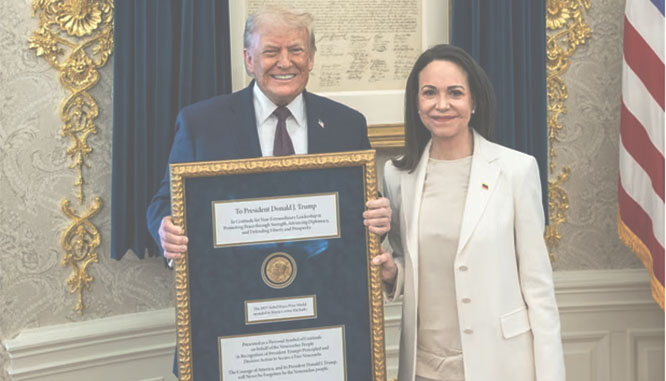
The Nobel Peace Prize is awarded by the independent Norwegian Nobel Committee, not the government. Trump had campaigned for last year’s prize, which went to Venezuelan opposition leader María Corina Machado, who dedicated her award to him.

Støre reiterated that the Nobel Prize decision rests solely with the committee.

Comments

Add new comment

  • Coastaldigest.com reserves the right to delete or block any comments.
  • Coastaldigset.com is not responsible for its readers’ comments.
  • Comments that are abusive, incendiary or irrelevant are strictly prohibited.
  • Please use a genuine email ID and provide your name to avoid reject.
News Network
January 23,2026

oscar.jpg

The Voice of Hind Rajab, inspired by the tragic final moments of a young Palestinian girl killed by Israeli fire in Gaza, has been nominated for an Academy Award in the Best International Feature Film category.

Directed by Tunisian filmmaker Kaouther Ben Hania, the film recounts the true story of five-year-old Hind Rajab, who lost her life in January 2024 while fleeing Israeli bombardment with her family.

The film features the real audio of Hind’s desperate call to the Palestinian Red Crescent Society, where she pleaded for help moments before the vehicle she was in was struck by 355 bullets.

The haunting narrative begins with a brief call made from the besieged Tel al-Hawa neighborhood of Gaza, where gunfire and armored vehicles drowned out every sound.

After witnessing the brutal killing of her family, she made a trembling call, her voice reduced to a whisper as she spoke of the massacre and her unbearable loneliness as the sole survivor.

Premiering at the Venice International Film Festival in September 2025, The Voice of Hind Rajab garnered widespread acclaim, receiving a record-setting 23-minute standing ovation and the Silver Lion Grand Jury Prize, the festival’s second-highest honor.

In her acceptance speech, Ben Hania dedicated the film to humanitarian workers and first responders in Gaza, emphasizing that Hind's voice symbolizes countless civilians affected by war.

She aims to give voice to victims often reduced to mere statistics, highlighting the broader suffering of civilians in war zones.

The film’s Oscar nomination underscores its powerful storytelling and ethical approach to depicting real-life tragedy, making it a crucial piece of contemporary cinema.

It serves not only as a narration of individual tragedy but also as an artistic and documentary response to the silence and censorship that often overshadow West Asian struggles and wars.

Using an innovative method she calls docufiction, Ben Hania bridges unvarnished reality and narrative structure, creating a work that is both artistically valuable and socially impactful.

Born in 1977 in Sidi Bouzid—later the epicenter of the Arab revolution—her background profoundly influenced her worldview and artistic approach.

She is a graduate of the Higher School of Audiovisual Arts of Tunis, Pantheon-Sorbonne University, and La Fémis in Paris, where her studies equipped her with the technical and theoretical tools needed to address complex subjects. 

Comments

Add new comment

  • Coastaldigest.com reserves the right to delete or block any comments.
  • Coastaldigset.com is not responsible for its readers’ comments.
  • Comments that are abusive, incendiary or irrelevant are strictly prohibited.
  • Please use a genuine email ID and provide your name to avoid reject.
News Network
January 23,2026

Karnataka Governor Thaawarchand Gehlot read only three lines from the 122-paragraph address prepared by the Congress-led state government while addressing the joint session of the Legislature on Thursday, effectively bypassing large sections critical of the BJP-led Union government.

The omitted portions of the customary Governor’s address outlined what the state government described as a “suppressive situation in economic and policy matters” under India’s federal framework. The speech also sharply criticised the Centre’s move to replace the Mahatma Gandhi National Rural Employment Guarantee Act (MGNREGA) with the Viksit Bharat–Guarantee for Rozgar and Ajeevika Mission (Gramin) Act, commonly referred to as the VB-GRAM (G) Act.

Governor Gehlot had earlier conveyed his objection to several paragraphs that were explicitly critical of the Union government. On Thursday, he confined himself to the opening lines — “I extend a warm welcome to all of you to the joint session of the State legislature. I am extremely pleased to address this august House” — before jumping directly to the concluding sentence of the final paragraph.

He ended the address by reading the last line of paragraph 122: “Overall, my government is firmly committed to doubling the pace of the State’s economic, social and physical development. Jai Hind — Jai Karnataka.”

According to the prepared speech, the Karnataka government demanded the scrapping of the VB-GRAM (G) Act, describing it as “contractor-centric” and detrimental to rural livelihoods, and called for the full restoration of MGNREGA. The state government argued that the new law undermines decentralisation, weakens labour protections, and centralises decision-making in violation of constitutional norms.

Key points from the unread sections of the speech:

•    Karnataka facing a “suppressive” economic and policy environment within the federal system

•    Repeal of MGNREGA described as a blow to rural livelihoods

•    VB-GRAM (G) Act accused of protecting corporate and contractor interests

•    New law alleged to weaken decentralised governance

•    Decision-making said to be imposed by the Centre without consulting states

•    Rights of Adivasis, women, backward classes and agrarian communities curtailed

•    Labourers allegedly placed under contractor control

•    States facing mounting fiscal stress due to central policies

•    VB-GRAM (G) Act accused of enabling large-scale corruption

Comments

Add new comment

  • Coastaldigest.com reserves the right to delete or block any comments.
  • Coastaldigset.com is not responsible for its readers’ comments.
  • Comments that are abusive, incendiary or irrelevant are strictly prohibited.
  • Please use a genuine email ID and provide your name to avoid reject.