Why is the govt underreporting COVID deaths all over India?

Mafazah Sharafuddin
May 5, 2021

cd1.jpg

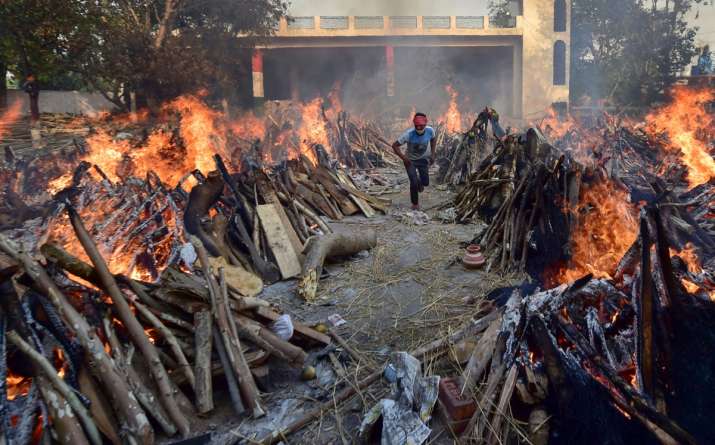
There have been several claims of undercounting the number of COVID deaths on the part of the government. This is a result of several factors, but most significantly, the number of corpses piling up in crematoriums and burial grounds. According to those who run crematoriums, the number of deaths due to COVID sent for cremation is much higher than what is disclosed by the government.
 
This issue isn’t limited to any one state, as there have been reports of the same in several states, including Karnataka, UP and the capital, Delhi. The crisis of having too many bodies and insufficient means to dispose of them is making people notice. NGOs are helping with cremations outside crematoriums, in parks etc. The crematoriums themselves are working towards building more cremation platforms. 

People running burial grounds and crematoriums are not turning people away. This has led to long queues for the same. In an interview with NDTV, a man who had lost his father to COVID said, “Earlier we were struggling to get oxygen, now we are struggling for cremation. The Government is useless.”

The owners of certain crematoriums state that those who die at home are not reported as COVID deaths in an official capacity, despite having succumbed to COVID. Several people are at home due to a lack of hospital beds and oxygen. They are being turned away from the hospitals. 

There have been mixed reactions to these claims. Most state governments are paying it no heed, and continuing to report deaths as they did prior to it. Adithyanath, however, has reacted with having the open sides of Rajghat covered up with cloth and plastic banners. This blocks the view to the cremation grounds and any bodies that might be piling up there. The banners claim that photography and videography of the cremations within the grounds would be considered criminal activity. It cites religious sanctity as its reason. 

The situation is dire. Overwhelming evidence states that the number of deaths of people diagnosed with COVID may be much higher than that being reported. This does not even begin to count the fact that there are plenty of people unable to get tested. This paints a truly grim picture of the COVID situation in India. 

The Madras HC on Monday severely reprimanded the Election Commission for allowing campaign rallies to take place during the pandemic. They went as far to say “Your institution is singularly responsible for the second wave of Covid-19. Election Commission officers should be booked on murder charges probably.”

The Co-Win portal and the announcement of vaccines for those aged 18-44 followed by the lack of production is another factor causing people to raise their voice. There are far too many accusations of improper administration for it to be brushed off without address. 

A report in the Financial Times stated that the, “numbers of Covid victims who have been cremated are 10x larger than official Covid death counts in same areas.” The state India is in is capturing global attention. 

The situation right now calls for many questions. What are the true numbers? How many decisions, like the EC’s decision to give parties the go ahead, were promoted by political reasons? How many were financially motivated? Where does public welfare stand among the list of reasons?

The glaring question, of course, is why?

Why is the government underreporting the COVID deaths all over the country?

The number of deaths, the state of the hospitals, the lack of vaccines, and the political rallies etc. all point towards one thing. Inefficient administration. The possibility that the underreporting is a ploy by the government to seem like they have a better handle on the situation is becoming more and more likely. 

It isn’t a new concept for governments to cover up things leading up to the election. There are thousands of cartoons that just speak about deceit before the election. 

It is an insidious idea, but that does not make it less likely. This is a matter of national and global importance. Underreporting the deaths due to COVID could skew research studying the fatality of this wave of the virus. It is also vital that the citizen see the gravity of the situation. The government must address the disparity in the numbers and provide clarity to the citizens.


Comments

MOHAMED S SULTAN
 - 
Friday, 7 May 2021

This is man made problem.
We(You) paid very dearly as the consequences of choosing our governments.
At least learn from this UNFORGETTABLE LESSON, what type of party and leaders you have to select for ruling.

costly lesson, never ever forget and pass it to all generations until end of the planet.

Add new comment

  • Coastaldigest.com reserves the right to delete or block any comments.
  • Coastaldigset.com is not responsible for its readers’ comments.
  • Comments that are abusive, incendiary or irrelevant are strictly prohibited.
  • Please use a genuine email ID and provide your name to avoid reject.
News Network
January 23,2026

Karnataka Governor Thaawarchand Gehlot read only three lines from the 122-paragraph address prepared by the Congress-led state government while addressing the joint session of the Legislature on Thursday, effectively bypassing large sections critical of the BJP-led Union government.

The omitted portions of the customary Governor’s address outlined what the state government described as a “suppressive situation in economic and policy matters” under India’s federal framework. The speech also sharply criticised the Centre’s move to replace the Mahatma Gandhi National Rural Employment Guarantee Act (MGNREGA) with the Viksit Bharat–Guarantee for Rozgar and Ajeevika Mission (Gramin) Act, commonly referred to as the VB-GRAM (G) Act.

Governor Gehlot had earlier conveyed his objection to several paragraphs that were explicitly critical of the Union government. On Thursday, he confined himself to the opening lines — “I extend a warm welcome to all of you to the joint session of the State legislature. I am extremely pleased to address this august House” — before jumping directly to the concluding sentence of the final paragraph.

He ended the address by reading the last line of paragraph 122: “Overall, my government is firmly committed to doubling the pace of the State’s economic, social and physical development. Jai Hind — Jai Karnataka.”

According to the prepared speech, the Karnataka government demanded the scrapping of the VB-GRAM (G) Act, describing it as “contractor-centric” and detrimental to rural livelihoods, and called for the full restoration of MGNREGA. The state government argued that the new law undermines decentralisation, weakens labour protections, and centralises decision-making in violation of constitutional norms.

Key points from the unread sections of the speech:

•    Karnataka facing a “suppressive” economic and policy environment within the federal system

•    Repeal of MGNREGA described as a blow to rural livelihoods

•    VB-GRAM (G) Act accused of protecting corporate and contractor interests

•    New law alleged to weaken decentralised governance

•    Decision-making said to be imposed by the Centre without consulting states

•    Rights of Adivasis, women, backward classes and agrarian communities curtailed

•    Labourers allegedly placed under contractor control

•    States facing mounting fiscal stress due to central policies

•    VB-GRAM (G) Act accused of enabling large-scale corruption

Comments

Add new comment

  • Coastaldigest.com reserves the right to delete or block any comments.
  • Coastaldigset.com is not responsible for its readers’ comments.
  • Comments that are abusive, incendiary or irrelevant are strictly prohibited.
  • Please use a genuine email ID and provide your name to avoid reject.
News Network
January 20,2026

KCFabudhabi.jpg

KCF, a global socio-cultural organisation of Karnataka expatriates, is actively involved in education, humanitarian initiatives and community well-being across several countries. The awardees were selected following a structured evaluation of nominations by the Annual Council Program Committee, based on the depth, consistency and long-term impact of their social service.

One of the award recipients, Abdul Razak Haji, a prominent UAE-based entrepreneur from the Qamcon Group of Companies, was honoured for his significant contributions to society. Through both his professional journey and personal initiatives, he has supported numerous employees and families, while also extending assistance in education, housing for the underprivileged and various charitable causes, largely carried out quietly over the years. His award was presented earlier during the Annual Council Program held at the KCF Abu Dhabi office.

The second award was conferred on Latheef Kakkinje, a young social worker based in Abu Dhabi, in recognition of his active involvement in community engagement programmes, sports initiatives, talent festivals and family-oriented social activities. His consistent volunteering efforts and commitment to humanitarian causes were highly appreciated by the selection committee.

The award presentation ceremony for Latheef Kakkinje was held at the Zayed Cricket Stadium (Astro Turf Ground) in the presence of Kedumbady Ibrahim Saqafi, President of KCF UAE; Ibrahim, General Secretary; Kabeer Bayambady, President of KCF Abu Dhabi; Ummer Ishwaramangila, General Secretary; along with other members of the KCF Abu Dhabi cabinet.

Congratulating both awardees, KCF leaders reiterated the organisation’s commitment to recognising individuals who selflessly work for social upliftment and community service.

KCFabudhabi1.jpg

Comments

Add new comment

  • Coastaldigest.com reserves the right to delete or block any comments.
  • Coastaldigset.com is not responsible for its readers’ comments.
  • Comments that are abusive, incendiary or irrelevant are strictly prohibited.
  • Please use a genuine email ID and provide your name to avoid reject.
News Network
January 20,2026

Mangaluru: In a major step towards strengthening rural innovation, the Office of the Principal Scientific Adviser (PSA) to the Government of India is supporting the establishment of RuTAGe Smart Village Centres (RSVCs) across the country through collaborations with academic institutions, civil society organisations and philanthropic partners.

As part of this national initiative, Nitte (Deemed to be University) will set up the first RSVCs in the region at Nitte GP in Udupi district and at the Nitte Health Centre, Sevanjali Trust, Farangipete, in Dakshina Kannada district. The centres will be inaugurated on January 21. In South India, the programme is being implemented by the Section Infin-8 Foundation (SI-8).

Speaking to reporters on Monday, SI-8 founder-director Vishwas US said experts from Nitte University and SI-8 would work closely with farmers, students, youth and local entrepreneurs to adapt and deploy technologies tailored to local needs.

Project head Prof Iddya Karunasagar, representing Nitte DU, said the RSVCs at Nitte and Farangipete would serve as demonstration hubs for a wide range of agriculture, energy, skill-development and assistive technologies. These include solar dryers for fruits, vegetables and crops; soil-testing solutions; power weeders and women-friendly farm tools; wind-powered devices for rural artisans; grain storage systems; grass-cutting and tree-climbing equipment; and liquid fertiliser production using cowshed waste.

SI-8 CEO Aravind C Kumar said the centres would also provide access to digital and knowledge-based platforms such as ISRO applications, government scheme portals, market linkage tools and gamified learning resources, along with assistive technologies for persons with visual impairments.

Highlighting the broader impact of the initiative, Principal Scientific Adviser Prof Ajay Kumar Sood said it demonstrated how applied research could bridge the rural–urban divide and help create self-reliant, technology-enabled villages.

The initiative has been made possible through philanthropic support from Dr NC Murthy of ACM Business Solutions, LLC, USA. Dr Sapna Poti, Director (Strategic Alliances) at the Office of the Principal Scientific Adviser, said the long-term objective is to build self-sufficient, technology-driven communities capable of generating sustainable livelihoods on their own.

Comments

Add new comment

  • Coastaldigest.com reserves the right to delete or block any comments.
  • Coastaldigset.com is not responsible for its readers’ comments.
  • Comments that are abusive, incendiary or irrelevant are strictly prohibited.
  • Please use a genuine email ID and provide your name to avoid reject.