



Why most Indians may be protected from Omicron

News Network
November 30, 2021

ShahidJameel.jpg

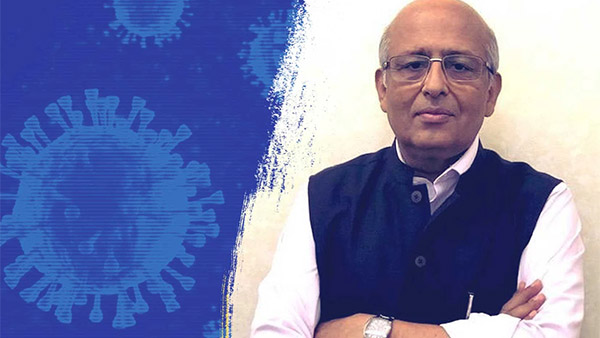
A “very large” number of Indians are likely to remain protected from Omicron or any other variant of Covid-19 and there is no need to panic, eminent virologist Dr Shahid Jameel has said.

Jameel, who is the former head of the advisory group to the Indian SARS-COV-2 Genomics Consortia (INASACOG), said people must be cautious and keep wearing masks.

"While we should be cautious, there is no need to panic. India's second wave due to the Delta variant was huge, infecting more people than we imagined. This is reflected in the fourth National Sero-survey that showed 67 per cent of Indians to have Covid antibodies. That is about 930-940 million people at a time when the vaccination levels were very low, and so it came mainly from infection," he said in an interview.

"More recently, Delhi showed 97 per cent with antibodies, Mumbai around 85-90 per cent and so on. All this means that a very large fraction of Indians will be protected from severe disease caused by Omicron or any other variant," Jameel said.

A new variant of Covid-19, feared to have a high amount of spike mutations, has been detected in South Africa. On November 26, the WHO had designated B.1.1.529 as a variant of concern and named it Omicron.

Speaking on the effectiveness of vaccines against the new variant, Jameel said more data is awaited but vaccine effectiveness against the variant may dip by a few points. However, vaccines will not become useless, he said.

"We don't have this data available yet. It may take another one to two weeks for the first laboratory results to become available. My hunch is that vaccine effectiveness against this variant may dip a few points, but vaccines will not become useless. They will continue to protect from severe disease," he said.

On how India can prepare to tackle the new variant, he said people should not panic, and continue to wear mask while the government should increase the rate of vaccination.

"We are fortunate to have sufficient vaccines and the ability to vaccinate. Along this line, it may help to reduce the duration between two doses of Covishield from 16 weeks to 12 weeks. This will get more people vaccinated quickly, especially those in vulnerable age groups (elderly), those with comorbidities and those in high risk occupations (health care)," he said.

On what role a booster dose of vaccine can play against the new variant to tackle waning immunity against Covid-19, he said booster shots help, but it is more important to first get more people vaccinated with two doses.

"Further, about 90 per cent of doses in India are Covishield, and this has limited use as a booster. For that we will need either RNA, DNA or protein vaccines. For the moment, just make sure more and more people get the two doses," he said.

Responding to reports claiming that the variant mainly affects people below 25 years of age, he said there is no data available on the subject.

"So far, the few known patients are in this age group. I doubt it will pose a bigger threat to children who naturally have no or mild disease to this virus," Jameel said.

Comments

Add new comment

  • Coastaldigest.com reserves the right to delete or block any comments.
  • Coastaldigset.com is not responsible for its readers’ comments.
  • Comments that are abusive, incendiary or irrelevant are strictly prohibited.
  • Please use a genuine email ID and provide your name to avoid reject.
News Network
January 23,2026

Karnataka Governor Thaawarchand Gehlot read only three lines from the 122-paragraph address prepared by the Congress-led state government while addressing the joint session of the Legislature on Thursday, effectively bypassing large sections critical of the BJP-led Union government.

The omitted portions of the customary Governor’s address outlined what the state government described as a “suppressive situation in economic and policy matters” under India’s federal framework. The speech also sharply criticised the Centre’s move to replace the Mahatma Gandhi National Rural Employment Guarantee Act (MGNREGA) with the Viksit Bharat–Guarantee for Rozgar and Ajeevika Mission (Gramin) Act, commonly referred to as the VB-GRAM (G) Act.

Governor Gehlot had earlier conveyed his objection to several paragraphs that were explicitly critical of the Union government. On Thursday, he confined himself to the opening lines — “I extend a warm welcome to all of you to the joint session of the State legislature. I am extremely pleased to address this august House” — before jumping directly to the concluding sentence of the final paragraph.

He ended the address by reading the last line of paragraph 122: “Overall, my government is firmly committed to doubling the pace of the State’s economic, social and physical development. Jai Hind — Jai Karnataka.”

According to the prepared speech, the Karnataka government demanded the scrapping of the VB-GRAM (G) Act, describing it as “contractor-centric” and detrimental to rural livelihoods, and called for the full restoration of MGNREGA. The state government argued that the new law undermines decentralisation, weakens labour protections, and centralises decision-making in violation of constitutional norms.

Key points from the unread sections of the speech:

•    Karnataka facing a “suppressive” economic and policy environment within the federal system

•    Repeal of MGNREGA described as a blow to rural livelihoods

•    VB-GRAM (G) Act accused of protecting corporate and contractor interests

•    New law alleged to weaken decentralised governance

•    Decision-making said to be imposed by the Centre without consulting states

•    Rights of Adivasis, women, backward classes and agrarian communities curtailed

•    Labourers allegedly placed under contractor control

•    States facing mounting fiscal stress due to central policies

•    VB-GRAM (G) Act accused of enabling large-scale corruption

Comments

Add new comment

  • Coastaldigest.com reserves the right to delete or block any comments.
  • Coastaldigset.com is not responsible for its readers’ comments.
  • Comments that are abusive, incendiary or irrelevant are strictly prohibited.
  • Please use a genuine email ID and provide your name to avoid reject.