



Media organisations and journalists are using Twitter, Facebook and WhatsApp to disseminate news and gain new audience like never before. Indeed “shares” and “likes” have become important parameters with which we judge the reach (and success) of a story today. The Times Group has, in fact, linked journalists’ salaries to their Twitter and WhatsApp activity.
But these social networks are also emerging as powerful newsgathering tools for journalists across print, TV and new media. While this enables journalists to act fast and churn out news at lightning speed, it can backfire in the absence of due diligence and multiple layers of fact-checking.
Two recent incidents show how placing too much reliance on social media apps and networks can do more harm than good to journalistic credibility and reputation.
Syria in Pathankot
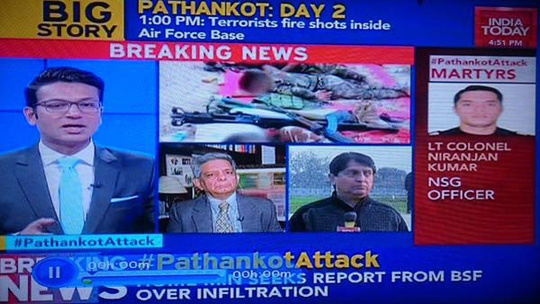
An image from war-torn Syria found its way to India Today.
The channel used the image, claiming these were the terrorists shot dead in the Pathankot operation. India Today along with CNN-IBN also tweeted out this image reiterating that these were the men behind the Pathankot attack.
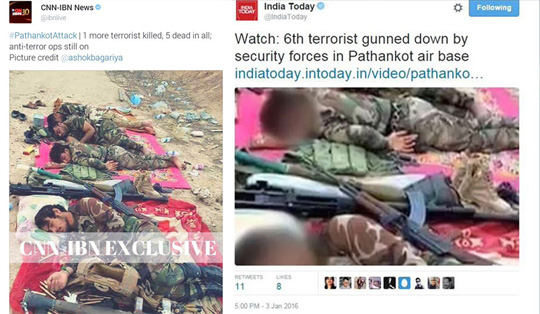
The gaffe caught the eye of certain discerning Tweeples, including journalist Kanchan Gupta, who pointed out that CNN-IBN was passing off an image from Syria as Pathankot.
Shame on @ibnlive for tweeting a June 2015 Syria pic as its exclusive pic of #PathankotAttack Truly shameful. pic.twitter.com/VawyN3nJKQ
— ?????? ????? (@KanchanGupta) January 3, 2016
Within hours, both the channels deleted the picture without tendering an apology or a clarification. CNN IBN had attributed the image to Ashok Bagariya, legal editor at the channel. Since both the channels used the same image as “exclusive” and “breaking news”, it is likely that they got the image from the same source.
We tried to find out where the two channels got the image from. Bagariya refused to comment and did not respond to our multiple tweets, emails, calls and text messages. Sources in the editorial department at CNN-IBN admitted to the “goof-up”, but refused to comment on where the channel had sourced the image from.
Newslaundry also contacted India Today and was informed by one of its senior editors that the source of the image was, in fact, a senior official in Indian Army. The editor told us that they got the image from an official WhatsApp group of defence journalists and senior Army officials.
The source told us that a senior Army officer, who also handles press liaisons, had forwarded the image to the group where it was first cited as an image from Pathankot. Journalists, in turn, eager to break the story first, rushed to use the image. The Army officer in question got back to them a few hours later asking them to take it down since he had accidently sent the wrong image.
WhatsApp groups are used by many journalists to get quick alerts from various sources, but should journalists act on the alert without spending precious time cross-checking, especially when it is something as sensitive as a terror operation? It is important to note that Tweeples were quick to spot the error that escaped the trained eyes of reporters and editors in two sizeable newsrooms.
Old-new criticism of odd-even
On Monday, Aaj Tak tweeted a picture of a very crowded Rajiv Chowk metro station. The tweet implied that the rush at Rajiv Chow was not a usual occurrence and was owing to the odd-even plan currently underway in Delhi.
Taking a cue from Aaj Tak, various journalists went on to repost this image seemingly to make the point that the odd-even plan was inconveniencing commuters.
Great work by SM vol ?????? ?? ???? ??? ???? ?????? ????? ???? ?????? ?? ????? ???? ???? #?????_????_?????_????pic.twitter.com/tbUkQn6Hsv
— Rahis Khan (@rahis28) January 4, 2016
Within a day, Aaj Tak’s official twitter handle issued a clarification and retweeted the image saying that it was an old picture shared by a metro passenger, and was in no way related to the Delhi government’s odd-even formula.
?? ???? ?????? ?? ???? ?????? ?? ???? ?? ??. ??-??? ?? ?? ?????? ?????? ?? ??? ????-???? ???? ??. pic.twitter.com/TYOo80X5Rl
— ?? ?? (@aajtak) January 4, 2016
But not before Tweeples had begun pointing out that the image may be old. Journalists like Shiv Aroor and Rajeep Sardesai also issued clarifications, and Sardesai even chided “Twitter friends” for sharing “fake” images. No questions asked of fact-checkers at Aaj Tak, though.
Reporting in the times of social media
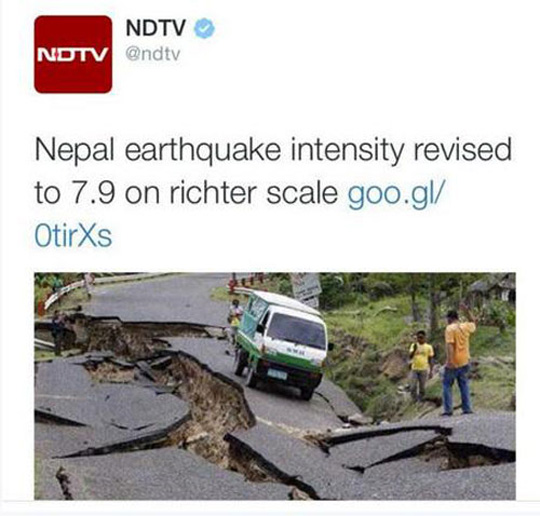
These incidents are hardly new. In April 2015, after the Nepal Earthquake, NDTV tweeted images of broken roads and buildings, stating they were from Nepal. It turns out the pictures were from Philippines. In a rush to give its audience a visual after the devastating earthquake, NDTV accidently used the “wrong image” from the “wrong country”.
Back in June 2015 when the Indian Army carried out a cross-border operation to hit Naga militants, this image was tweeted out by ANI, calming that these were the men behind the operation.
Army team that destroyed militant camp in Myanmar. No casualties. Faces blurred to protect identity. pic.twitter.com/fXAVAmxLSM
— ANI (@ANI_news) June 10, 2015
The caption categorically stated that this was the team that “destroyed militant camp in Myanmar”. This image was then picked up by various media houses and newspapers including The Indian Express, Aaj Tak, Firstpost and so on. A day later Sitanshu Kar, defence ministry spokesperson, tweeted a clarification that the ministry had not released any photo of the operation “so far”. Hindustan Times quoted ANI multimedia head Sanjay Mehra, who had said, “The image was duly authorised for use by the ADG PI (Additional Directorate General of Public Information) of the Army, with the specific request that the faces of the persons be morphed, which we duly did before release.” The ADG PI, though, refuted the claim. An Army officer later stated that the image was approved as a “representative picture”.
Most archival departments in media conglomerates use software like photoforensic that can identify whether an image has been tampered with, but can’t verify the authenticity of the image. Sources at CNN-IBN told us that every image is supposed to be vetted by the editorial department before being published. This protocol, however, is often disregarded to be the first to curate unique and exclusive content.
The dominant process chosen by most media houses places the primary responsibility of authentication on reporters. In case of local news, or where reporters have access to primary sources, they receive images directly through a web of informants. Often, the exchange of such “exclusive” images that are pivotal to the story takes place through WhatsApp in order to quicken the process. One can, then, imagine the authentication task at hand for reporters.
It is standard practice to go beyond press releases and hand-outs while reporting and journalists are usually trained in cutting through PR spiel. Information coming in from sources — who often have a stake in the news being reported — on WhatsApp and social media should perhaps be treated with similar suspicion or at least should not be taken at face value.


Comments
Great News !!! Good coverage From CD ..
We should Appreciate the thinkers , Coverage & People who open the eyes of True Indian .
Very Good --- The Reality of Media is exposed by some honest people... All these days Most of the people are living in HATRED cos of the media coverage of FAKE NEWS...
People are waking up ... its a GOOD Sign for the society.. May ALLAH guide those who are honest and want to do good to people & society.
Add new comment