



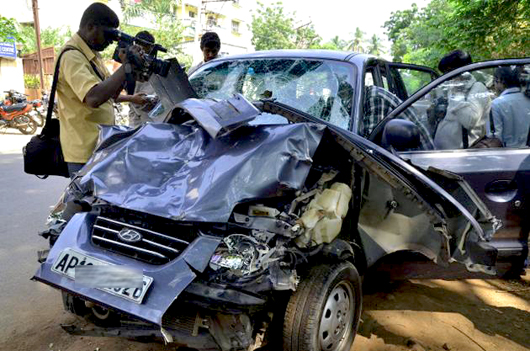
India's popular small cars fail crash tests: Report

January 31, 2014
Cars_fail_crash

New Delhi, Jan 31: Some of the most popular small cars sold in India, including Maruti Alto 800, Tata Nano, Ford Figo, Hyundai i10 and Volkswagen Polo, have failed crash tests showing high risk of life-threatening injuries in road accidents, according to Global NCAP.

As per the tests done by Global NCAP, an independent charity based in UK focused on consumer orientated vehicle safety initiatives, these cars received zero for adult protection ratings in a frontal impact at 64km/hr.

The combined sales of these five cars account for around 20 per cent of all the new cars sold in India last year, Global NCAP said.

As per Society of Indian Automobile Manufacturers, total car sales in India stood at 18,07,011 units in 2013.

Global NCAP Chairman Max Mosley said: "Poor structural integrity and the absence of airbags are putting the lives of Indian consumers at risk. They have a right to know how safe their vehicles are and to expect the same basic levels of safety as standard as customers in other part of the world."

India is now a major global market and production centre for small cars, so it's worrying to see levels of safety that are 20 years behind the five-star standards now common in Europe and North America, he added.

When contacted, spokespersons of the companies named said their products met Indian safety norms.
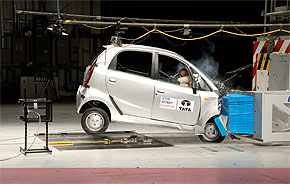
Crash_tests
According to the findings, in Maruti Alto 800, Tata Nano and Hyundai i10, the vehicle structures proved inadequate and collapsed to varying degrees, resulting in high risks of life-threatening injuries to the occupants.

"The extent of the structural weaknesses in these models were such that fitting airbags would not be effective in reducing the risk of serious injury," it said.

Ford Figo and Volkswagen Polo had structures that remained stable – and, therefore, with airbags fitted, protection for the driver and front passenger would be much improved, it added.

Global NCAP said it also assessed the same models against the UN's basic crash test of 40 per cent offset frontal impact test at 56km/hr, now widely applied by major manufacturing countries and regions, including Australia, China, European Union, Japan and Malaysia.

"All but one of the cars tested failed to pass even this minimum standard," it said.

The Global Plan for the UN's Decade of Action for Road Safety recommends that all Member States apply this standard, although it is not yet applied in India.

Calling for India to follow minimum crash safety standards, Institute of Road Traffic Education (IRTE) President Rohit Baluja said: "These results show that India would benefit enormously from the introduction of minimum crash safety standards and clearer information for consumers about the protection new cars offer."

Many cars made in India for export meet these standards already, so it's not a question of know-how or capability: India's automobile industry just needs the right incentives, he added.

Commenting on the Global NCAP findings, Tata Motors Head – Advanced and Product Engineering, Engineering Research Centre, Tim Leverton said safety is of paramount importance to Tata Motors.

"All our vehicles, including the Tata Nano meets all Indian safety regulations, including the frontal barrier crash test at 48 kmph, as mandated by the government. All our cars on Indian roads, including the Nano are engineered for safety in view of Indian road and traffic conditions," he added.

A Hyundai Motor India spokesperson said: "Hyundai Motor India Ltd affirms that Hyundai vehicles are designed and build to meet all the prescribed safety standards set by Indian Regulatory Authorities."

Commenting on the development, a Ford India spokesperson said safety is one of the highest priorities in the design of the company's vehicles.

"Our vehicles consistently meet or exceed applicable industry safety standards. We are monitoring the progress of this review and will work with Indian authorities, GNCAP and the other relevant stake holders as appropriate," she added.

Volkswagen Passenger Cars, Volkswagen Group Sales India, Managing Director Arvind Saxena said the company is happy that the Volkswagen Polo has secured a four-Star safety rating for adult occupant protection.

"With our recent introduction of dual front airbags as standard fitment on all variants of the Polo in India, the Polo is now the safest premium-segment hatchback in the country. We believe this demonstrates Volkswagen's commitment to building better, safer cars for the Indian consumer," Saxena added.

Comments

Mildred
 - 
Sunday, 31 Jan 2016

magnificent points altogether, you just received a new reader.
What could you suggest about your post that you simply
made a few days ago? Any sure?

Stop by my blog post - google
plus adwords: http://Gek.Szie.hu/alumni/node/47739

Add new comment

  • Coastaldigest.com reserves the right to delete or block any comments.
  • Coastaldigset.com is not responsible for its readers’ comments.
  • Comments that are abusive, incendiary or irrelevant are strictly prohibited.
  • Please use a genuine email ID and provide your name to avoid reject.
News Network
December 2,2025

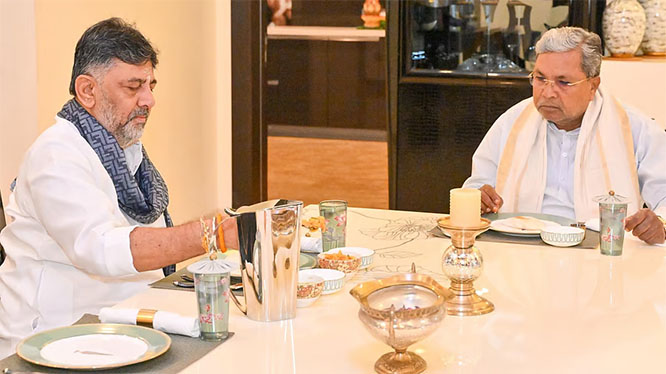
DKSsiddu.jpg

Bengaluru: 'Nati koli saaru' (country chicken curry) considered one of Chief Minister Siddaramaiah’s favourites along with steaming hot idlis was on the breakfast menu at Deputy CM D K Shivakumar’s residence on Tuesday, according to official sources.

The spread also included 'nati koli' fry, vada and pongal, among other items, they said.

In an apparent show of unity, Siddaramaiah visited Shivakumar’s residence for breakfast, just days after the two leaders shared a meal amid a simmering power tussle in the state Congress.

Siddaramaiah drove to the Deputy CM’s residence in Sadashivanagar, where he was received by Shivakumar and his brother D K Suresh, who is a former Congress MP.

Suresh and Kunigal MLA H D Ranganath, a relative of Shivakumar, joined them for breakfast, which featured a mix of vegetarian and non-vegetarian dishes.

Speaking to reporters later, Siddaramaiah said Shivakumar had invited him during his visit to the CM’s residence for breakfast on Saturday.

Asked about the difference between the two meals, the chief minister said, "At his (Shivakumar’s) house it was non-veg, while at my house it was veg. He is a vegetarian, I am a non-vegetarian. I had not prepared non-veg. I told DK to get chicken from the village as you won’t get the original in Bengaluru."

Shivakumar said he had initially invited Siddaramaiah to his residence, but the CM had suggested visiting his place first and reciprocating later. "It was a vegetarian breakfast at the CM’s house on Saturday," he noted.

"Today, I invited him (the CM) to my house. He enjoyed the breakfast, which had his Mysuru taste," Shivakumar added. At this point, Siddaramaiah remarked that Shivakumar’s wife is also from Mysuru.

Saturday’s breakfast at Siddaramaiah’s official residence, held as part of efforts by the Congress high command to ease tensions in the leadership dispute between the two, reportedly included idlis and sambar, according to official sources.

Comments

Add new comment

  • Coastaldigest.com reserves the right to delete or block any comments.
  • Coastaldigset.com is not responsible for its readers’ comments.
  • Comments that are abusive, incendiary or irrelevant are strictly prohibited.
  • Please use a genuine email ID and provide your name to avoid reject.
News Network
December 4,2025

Mangaluru: Chaos erupted at Mangaluru International Airport (MIA) after IndiGo flight 6E 5150, bound for Mumbai, was repeatedly delayed and ultimately cancelled, leaving around 100 passengers stranded overnight. The incident highlights the ongoing country-wide operational disruptions affecting the airline, largely due to the implementation of new Flight Duty Time Limitations (FDTL) norms for crew.

The flight was initially scheduled for 9:25 PM on Tuesday but was first postponed to 11:40 PM, then midnight, before being cancelled around 3:00 AM. Passengers expressed frustration over last-minute communication and the lack of clarity, with elderly and ailing travellers particularly affected. “Though the airline arranged food, there was no proper communication, leaving us confused,” said one family member.

An IndiGo executive at MIA cited the FDTL rules, designed to prevent pilot fatigue by limiting crew working hours, as the cause of the cancellation. While alternative arrangements, including hotel stays, were offered, about 100 passengers chose to remain at the airport, creating tension. A replacement flight was arranged but also faced delays due to the same constraints, finally departing for Mumbai around 1:45 PM on Wednesday. Passengers either flew, requested refunds, or postponed their travel.

The Mangaluru delay is part of a broader crisis for IndiGo. The airline has been forced to make “calibrated schedule adjustments”—a euphemism for widespread cancellations and delays—after stricter FDTL norms came into effect on November 1.

While an IndiGo spokesperson acknowledged unavoidable flight disruptions due to technology issues, operational requirements, and the updated crew rostering rules, the DGCA has intervened, summoning senior airline officials to explain the chaos and outline corrective measures.

The ripple effect has been felt across the country, with major hubs like Bengaluru and Mumbai reporting numerous cancellations. The Mangaluru incident underscores the systemic operational strain currently confronting India’s largest carrier, leaving passengers nationwide grappling with uncertainty and delays.

Comments

Add new comment

  • Coastaldigest.com reserves the right to delete or block any comments.
  • Coastaldigset.com is not responsible for its readers’ comments.
  • Comments that are abusive, incendiary or irrelevant are strictly prohibited.
  • Please use a genuine email ID and provide your name to avoid reject.
News Network
December 2,2025

Puttur: The long-cherished dream of a government medical college in Puttur has moved a decisive step closer to reality, with the Karnataka State Finance Department granting its official approval for the construction of a new 300-bed hospital.

Puttur MLA Ashok Kumar Rai announced the crucial development to reporters on Monday, confirming that the official communication from the finance department was issued on November 27. This 300-bed facility is intended to be the cornerstone for the establishment of the government medical college, a project announced in the state budget.

Fast-Track Implementation

The MLA outlined an aggressive timeline for the project:

•    A Detailed Project Report (DPR) for the hospital is expected to be ready within 45 days.

•    The tender process for the construction will be completed within two months.

Following the completion of the tender process, Chief Minister Siddaramaiah is scheduled to lay the foundation stone for the project.

"Setting up a medical college in Puttur is a historical decision by the Congress government in Karnataka," Rai stated. The project has an estimated budget allocation of Rs 1,000 crore for the medical college.

Focus on Medical Education Department

The MLA highlighted a key strategic move: requesting the government to implement the hospital construction through the Medical Education Department instead of the Health and Family Welfare Department. This is intended to streamline the entire process of establishing the full medical college, ensuring the facilities—including labs, operation theatres, and other necessary infrastructure—adhere to the strict guidelines set by the Medical Council of India (MCI). The proposed site for the project is in Bannur.

Rai also took the opportunity to address political criticism, stating that the government has fulfilled its promise despite "apprehensions" and "mocking and criticising" from opposition parties who had failed to take similar initiatives when they were in power. "Chief Minister Siddaramaiah has kept his word," he added.

Comments

Add new comment

  • Coastaldigest.com reserves the right to delete or block any comments.
  • Coastaldigset.com is not responsible for its readers’ comments.
  • Comments that are abusive, incendiary or irrelevant are strictly prohibited.
  • Please use a genuine email ID and provide your name to avoid reject.