Contemporary Nationalism and ‘Bharat Mata ki Jai’

Ram Puniyani
February 29, 2020

Like most of the political phenomenon, even the practice of Nationalism is not a static one. It changes with the changing political equations of the political forces and assumes the expressions which are very diverse. As such the phenomenon of Nationalism has a long journey and various state policies in particular have used it for purposes which relate more to the power of the state ‘vis a vis’ its people, power of the state ‘vis a vis’ the neighboring countries among others.

In India there has been a certain change in the practices of the state which have transformed the meaning of Nationalism during last few years. Particularly with BJP, the Hindu Nationalist outfit gaining simple majority, it has unfolded the policies where one can discern the drastic change in the meaning and application of Nationalism in regard to its citizens, particularly those belonging to minority community, with regard to those who are liberal, and with those who stand with the concept of Human rights.

Our former Prime Minister of Dr. Manmohan Singh hit the nail on the head when he said that “Nationalism and the "Bharat Mata Ki Jai" slogan are being misused to construct a "militant and purely emotional" idea of India that excludes millions of residents and citizens. Former Prime Minister recently stated this in an apparent attack on the BJP.” The occasion was the release of a book, ‘Who is Bharat Mata’, edited by Purushottam Agarwal and Radhakrishna. This is a compilation of significant extracts from writings of Nehru, and important assessments of and contributions of Nehru by prominent personalities.

Dr. Singh went on to add "With an inimitable style…Nehru laid the foundation of the universities, academies and cultural institutions of Modern India. But for Nehru's leadership, independent India would not have become what it is today," This statement of Dr. Singh has great importance in contemporary times, as Nehru is being denigrated by Hindu nationalists for all the problems which India is facing today and attempts are on to undermine his role and glorifying Sardar Vallabh Bhai Patel. This is also significant as it gives us the glimpses of what Nationalism meant for Nehru.

As Singh’s statement captures the present nationalism being practiced by BJP and company, the Hindu nationalists, immediately shot back saying that Dr. Singh is supporting the anti India activities at JNU and Jamia and his party is supporting the anti India nationalists. They asked whether Singh likes the nationalism of the likes of Shashi Tharoor or Manishankar Ayer who are provoking the Shaheen Bagh protest rather than making the protestors quiet. Whether he likes the anti national protests which go on at JNU or Jamia? As per them there is no Nationalism in Congress. One more example being cited is the private visit of Shatrughan Sinha who talked to Pakistani President during his visit there recently!

Most of the arguments being used to oppose Dr. Singh are very superficial. What is being referred to; is not opposition to Indian nationalism and its central values which were the core of anti colonial struggles. While ‘Bharat Mata Ki Jai’ may not be acceptable to a section of population, even the book he was releasing has the title ‘Who is Bharat Mata’. What is being stated by Singh is the twist which slogan ‘Bharat Mata ki Jai’ has been used by Hindu nationalists to frighten the religious minorities.

Indian nation came into being on the values, which later were the foundation of Indian Constitution. Indian Constitution carefully picked up the terminology which was away from the concepts of Hindu or Muslim nationalism. That’s how the country came to be called as ‘India that is Bharat’. The freedom of expression which was the hallmark of freedom movement and it was given a pride of place in our Constitution. It respected the diversity and formulated rules where the nation was not based on particular culture, as Hindu nationalists will like us to believe, but cultural diversity was centrally recognized in the Constitution. In addition promoting good relations with neighbors and other countries of the World was also part of our principles.

JNU, Jamia and AMU are being demonized as most institutions so far regard the freedom of expression as a core part of Indian democracy. These institutions have been thriving on discussions and debates which have base in liberalism. Deliberately some slogans have been constructed to defame these institutions. While Constitution mandates good relations with neighbors, creation of ‘Anti Pakistan hysteria’ is the prime motive of many a channels and sections of other media, which are servile to the ideology of ruling Government. They also violate most of the norms of ethical journalism, where the criticism of the ruling party is an important factor to keep the ruling dispensation in toes.

A stifling atmosphere has been created during last six years. In this the Prime Minster can take a detour, land in Pakistan to have a cup of tea with Pakistan PM, but a Congress leader talking to Pakistani President is a sign of being anti National. Students taking out a march while reading the preamble of Indian Constitution are labeled as anti-national; and are stopped while those openly wielding guns near Jamia or Shaheen Bagh roam freely.

Nationalism should promote amity and love of the people; it should pave the way for growth and development. Currently the nationalism which is dominant and stalking the streets has weakened the very fraternity, which is one of the pillars of our democracy. Nehru did explain that Bharat Mata is not just our mountains, rivers and land but primarily the people who inhabit the land. Which nationalism to follow was settled during the freedom movement when Muslim nationalism and Hindu nationalism were rejected by the majority of people of India in favor of the Nationalism of Gandhi, Nehru, Patel and Maulana Azad, where minorities are equal citizens, deserving affirmative action. In today’s scenario the Hindu nationalists cannot accept any criticism of their policies.

Comments

Add new comment

  • Coastaldigest.com reserves the right to delete or block any comments.
  • Coastaldigset.com is not responsible for its readers’ comments.
  • Comments that are abusive, incendiary or irrelevant are strictly prohibited.
  • Please use a genuine email ID and provide your name to avoid reject.
coastaldigest.com news network
January 19,2026

badriya.jpg

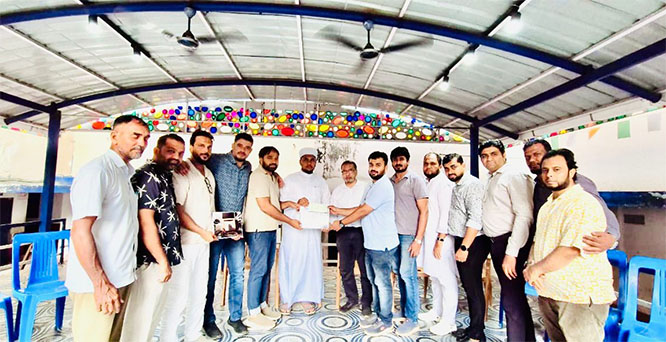
Mangaluru: The Phase I project of Badria Vision 2028 was formally launched at a ceremony held at the Badria Campus on January 17, marking an important step in the institution’s long-term development roadmap.

The programme was attended by P.B. Abdul Hameed, Secretary of the MEA, and P.C. Hasir, Correspondent of the MEA, who presided over the event and underscored the institution’s commitment to growth and academic excellence.

Office-bearers of the Badria Alumni Association were present in large numbers, including A.K. Sajid (President), Shamsuddin and S.M. Farooq (Vice-Presidents), Shaheed (General Secretary), and Khaleel (Treasurer), reflecting strong alumni engagement in the initiative.

The gathering was blessed by Sayyid Shamsuddeen Basith Thangal Kukkaje, Qateeb of Zeenat Yatheem Bakshi, who led a special dua seeking divine guidance and success for the project.

The ceremony also witnessed the participation of prominent alumnus and local corporate professional Abdul Latheef, along with alumni members Naushad, Kalandar, Safwan, members of the core committee, and several other former students.

A key moment of the event was the formal handover of a cheque to Ameen Woodland Architect, signalling the immediate commencement of construction work under Phase I of the project.

Organisers said the launch of Phase I reflects a shared vision, institutional unity, and collective resolve to realise the objectives of Badria Vision 2028.

Comments

Add new comment

  • Coastaldigest.com reserves the right to delete or block any comments.
  • Coastaldigset.com is not responsible for its readers’ comments.
  • Comments that are abusive, incendiary or irrelevant are strictly prohibited.
  • Please use a genuine email ID and provide your name to avoid reject.
News Network
January 23,2026

Mangaluru: The Karnataka Government Polytechnic (KPT), Mangaluru, has achieved autonomous status from the All India Council for Technical Education (AICTE), becoming the first government polytechnic in the country to receive such recognition in its 78-year history. The status was granted by AICTE, New Delhi, and subsequently approved by the Karnataka Board of Technical Education in October last year.

Officials said the autonomy was conferred a few months ago. Until recently, AICTE extended autonomous status only to engineering colleges, excluding diploma institutions. However, with a renewed national focus on skill development, several government polytechnics across India have now been granted autonomy.

KPT, the second-largest polytechnic in Karnataka, was established in 1946 with four branches and has since expanded to offer eight diploma programmes, including computer science and polymer technology. The institution is spread across a 19-acre campus.

Ravindra M Keni, the first dean of the institution, told The Times of India that AICTE had proposed autonomous status for polytechnic institutions that are over 25 years old. “Many colleges applied. In the first round, 100 institutions were shortlisted, which was further narrowed down to 15 in the second round. We have already completed one semester after becoming an autonomous institution,” he said. He added that nearly 500 students are admitted annually across eight three-year diploma courses.

Explaining the factors that helped KPT secure autonomy, Keni said the institution has consistently recorded 100 per cent admissions and placements for its graduates. He also noted its strong performance in sports, with the college emerging champions for 12 consecutive years, along with active student participation in NCC and NSS activities.

Autonomous status allows KPT to design industry-oriented curricula, conduct examinations, prepare question papers, and manage academic documentation independently. The institution can also directly collaborate with industries and receive priority funding from AICTE or the Ministry of Education. While academic autonomy has been granted, financial control will continue to rest with the state government.

“There will be separate committees for examinations, question paper setting, boards of studies, and boards of examiners. The institution will now have the freedom to conduct admissions without government notifications and issue its own marks cards,” Keni said, adding that new academic initiatives would be planned after a year of functioning under the autonomous framework.

Comments

Add new comment

  • Coastaldigest.com reserves the right to delete or block any comments.
  • Coastaldigset.com is not responsible for its readers’ comments.
  • Comments that are abusive, incendiary or irrelevant are strictly prohibited.
  • Please use a genuine email ID and provide your name to avoid reject.
coastaldigest.com news network
January 19,2026

rizwanzameer.jpg

Bengaluru: As the dust settles on the recent legislative session, the corridors of Vidhana Soudha are buzzing with more than just policy talk. A high-stakes game of political musical chairs has begun, exposing a deepening rift within the Congress party’s Muslim leadership as a major Cabinet reshuffle looms.

With the party hierarchy signaling a "50% refresh" to gear up for the 2028 Assembly elections, the race to fill three projected Muslim ministerial berths has transformed from a strategic discussion into an all-out turf war.

The "Star Son" Spark

The internal friction turned public this week following provocative remarks by Zaid Khan, actor and son of Wakf Minister Zameer Ahmed Khan. Zaid’s claim—that his father "helped" secure a ticket for Shivajinagar MLA Rizwan Arshad in 2023—has acted as a lightning rod for resentment.

Rizwan’s camp was quick to fire back, dismissing the comment as a desperate attempt by Zameer to manufacture seniority. "Rizwan’s political pedigree was forged in the NSUI and Youth Congress long before Zameer even stepped into the party," a supporter noted, highlighting Rizwan’s tenure as an AICC secretary and his two-term presidency of the State Youth Congress.

A Tale of Two Loyalists

While both Zameer Ahmed Khan and Rizwan Arshad are staunch allies of Chief Minister Siddaramaiah and represent Bengaluru strongholds, their political DNA could not be more different:

•    Zameer Ahmed Khan: A four-time MLA who crossed over from JD(S) in 2018. Known for his "overzealous" and often polarizing outreach during communal flashpoints—from the DJ Halli riots to the recent Wakf land notice controversy—his style has frequently left the Congress high command in a state of "discomfort."

•    Rizwan Arshad: A homegrown organizational man. Seen as a "quiet performer," Arshad represents the sophisticated, moderate face of the party, preferred by those who find Zameer’s brand of politics too volatile.

The Outsiders Looking In

The bickering isn't limited to a duo. The "Beary" community, represented by leaders like N A Haris and Saleem Ahmed, is demanding its pound of flesh. Saleem Ahmed, the Chief Whip in the Legislative Council, has dropped the veil of diplomacy, openly declaring his ministerial aspirations.

"I was the only working president not included in the Cabinet last time," Saleem noted pointedly, signaling that the "loyalty quota" is no longer enough to keep the peace.

As Chief Minister Siddaramaiah prepares to finalize the list, he faces a delicate balancing act: rewarding the aggressive grassroots mobilization of Zameer’s camp without alienating the organizational stalwarts and minority sub-sects who feel increasingly sidelined by the "Chamarajpet-Shivajinagar" binary.

Comments

Add new comment

  • Coastaldigest.com reserves the right to delete or block any comments.
  • Coastaldigset.com is not responsible for its readers’ comments.
  • Comments that are abusive, incendiary or irrelevant are strictly prohibited.
  • Please use a genuine email ID and provide your name to avoid reject.