D-company resurface with new route to pump fake notes into India

Agencies
June 2, 2019

New Delhi, Jun 2: After a brief interval, high-quality Fake Indian Currency Notes (FICN) are again being printed across India`s eastern borders and are being pumped into the country at an alarming rate. An ongoing investigation of the National Investigation Agency (NIA) has revealed that nexus between Pakistan`s ISI and the D-Company has resumed to supply fake currency notes into the Indian economy.

The nexus was uncovered after the police in Nepal arrested kingpin of the fake currency notes racket, Yunus Ansari, following a tip-off by Indian intelligence agencies. According to Indian officials, Ansari is considered to have close links with the ISI and Dawood Ibrahim who is said to be the biggest player in the fake currency notes racket.

Along with Ansari, three other Pakistani nationals identified as Muhammad Akhtar, Nadia Anwar and Nasiruddin were also arrested. At the time of arrest, Ansari and his associates had fake currency notes with face value of over Rs 7 crore, an official added.

However, Ansari`s arrest has also highlighted that Nepal, once used as the prime conduit to pump in fake currency notes into India, is no longer being used by Pakistan for the purpose. The fake currency is now being sent into India across its eastern border with Bangladesh. This was highlighted by NIA`s investigations in various cases of fake currency circulations. The most recent was a case in January where a man from West Bengal was arrested from Anand Vihar railway station here with fake currency notes with the face value of Rs 10 lakh.

During investigation, the accused had revealed that the notes were printed in Bangladesh and he was supposed to circulate them in busy markets and shops in the national capital. In another case, the NIA filed a chargesheet in a Gujarat court in May against three accused involved in a case of circulation of fake currency notes, who had been utilising their contacts in Bangladesh.

Sanjay Kumar Mohanbhai Devadiya was arrested from Gujarat`s Junagadh by the state police`s Anti-Terrorism Squad in October last year and on being interrogated revealed that two other accused - Mavajibhai Lathidadiya alias Guruji and Tahir Saikh - were also involved in the racket and were operating from West Bengal, where they could easily get fake currency from Bangladesh. While Guruji is already lodged at Presidency Correctional Home in Kolkata, Saikh was arrested from Malda in February this year.

The latest case of the arrest of two people - Wasim (20) and Qasim (44) - from Gurugram`s sector 48 area by the NIA and the Gurugram Police on Wednesday night and seizure of a cache of fake currency from them, has made it clear that the nexus behind the spread of fake currency has been able to achieve a very high quality of printing and the eastern border has become a new gateway for the counterfeit currency to enter India.

Comments

Add new comment

  • Coastaldigest.com reserves the right to delete or block any comments.
  • Coastaldigset.com is not responsible for its readers’ comments.
  • Comments that are abusive, incendiary or irrelevant are strictly prohibited.
  • Please use a genuine email ID and provide your name to avoid reject.
News Network
December 16,2025

jordan.jpg

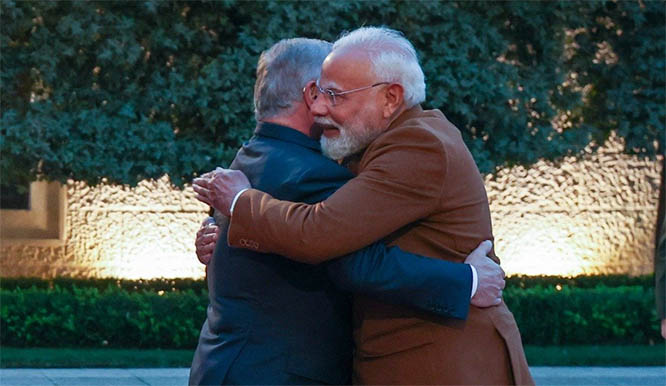
Prime Minister Narendra Modi on Monday held talks with Jordan’s King Abdullah II in Amman, during which the two leaders discussed ways to further strengthen bilateral relations, with the Prime Minister outlining an eight-point vision covering key areas of cooperation.

Describing the meeting as “productive”, PM Modi said he shared a roadmap focused on trade and economy, fertilisers and agriculture, information technology, healthcare, infrastructure, critical and strategic minerals, civil nuclear cooperation, and people-to-people ties.

In a post on social media platform X, the Prime Minister praised King Abdullah II’s personal commitment to advancing India–Jordan relations, particularly as both countries mark the 75th anniversary of the establishment of diplomatic ties this year.

“Held productive discussions with His Majesty King Abdullah II in Amman. His personal commitment towards vibrant India-Jordan relations is noteworthy. This year, we are celebrating the 75th anniversary of our bilateral diplomatic relations,” PM Modi said.

The meeting took place at the Al Husseiniya Palace, where the two leaders also exchanged views on regional and global issues of mutual interest. According to the Ministry of External Affairs (MEA), both sides agreed to further deepen cooperation in areas including trade and investment, defence and security, counter-terrorism and de-radicalisation, fertilisers and agriculture, infrastructure, renewable energy, tourism, and heritage.

The MEA said both leaders reaffirmed their united stand against terrorism.

PM Modi arrived in Amman earlier on Monday and was received by Jordanian Prime Minister Jafar Hassan, who accorded him a formal welcome. Following the talks, King Abdullah II hosted a banquet dinner in honour of the Prime Minister, reflecting the warmth of bilateral ties.

Jordan is the first leg of PM Modi’s three-nation tour. From Amman, the Prime Minister will travel to Ethiopia at the invitation of Prime Minister Abiy Ahmed Ali, marking his first official visit to the African nation. The tour will conclude with a visit to Oman.

Comments

Add new comment

  • Coastaldigest.com reserves the right to delete or block any comments.
  • Coastaldigset.com is not responsible for its readers’ comments.
  • Comments that are abusive, incendiary or irrelevant are strictly prohibited.
  • Please use a genuine email ID and provide your name to avoid reject.
News Network
December 7,2025

envoy.jpg

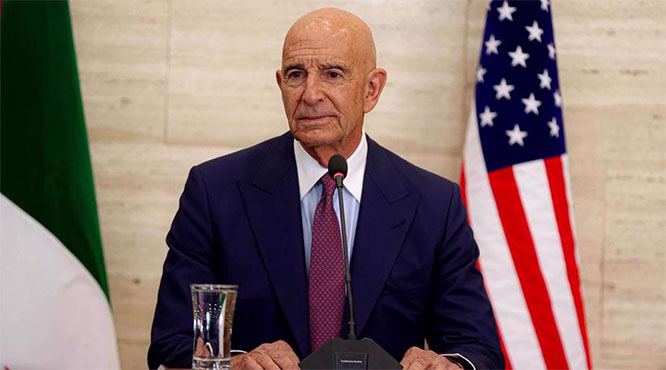
Since 1946, the United States has attempted 93 coups or “regime change” operations across the world — including two in Iran, US Special Envoy for Syria Tom Barrack has admitted.

Speaking to the UAE-based IMI Media Group, in remarks published by The National, Barrack said Washington tried twice to overthrow the Iranian government but failed both times. 

“For (Trump) then to be imputed with regime change — we had two regime changes in Iran already. Neither one worked. So I think wisely leave it to the region to solve,” said Barrack, who also serves as the US ambassador to Turkey.

His comments come six months after the US joined Israel in airstrikes against Iran during ongoing indirect nuclear negotiations between Tehran and Washington.

On June 13, Israel launched an attack on Iran that killed at least 1,064 people and hit civilian infrastructure. Days later, the United States targeted three nuclear facilities — Fordow, Natanz and Isfahan — in what Iran called a clear violation of international law. Iranian retaliation eventually forced a halt to the assault on June 24.

Barrack further claimed that US President Donald Trump and Foreign Secretary Marco Rubio are “not into regime change” and prefer a regional approach driven by Middle Eastern countries themselves. According to him, regional dialogue and non-interference by outside powers offer a more durable path forward.

He added that Washington is still open to an agreement with Tehran if Iranian authorities show “seriousness” and willingness to engage constructively.

However, Iran maintains the US has not shown readiness for meaningful talks. In an interview with Japan’s Kyodo News, Iranian Foreign Minister Abbas Araghchi said negotiations could advance only if Washington acknowledges Iran’s right to peaceful nuclear energy and lifts unilateral sanctions.

Comments

Add new comment

  • Coastaldigest.com reserves the right to delete or block any comments.
  • Coastaldigset.com is not responsible for its readers’ comments.
  • Comments that are abusive, incendiary or irrelevant are strictly prohibited.
  • Please use a genuine email ID and provide your name to avoid reject.
News Network
December 19,2025

Saudi Arabia has abolished fees on expatriate workers employed in licensed industrial establishments, signaling a strong push to empower national factories and enhance the Kingdom’s global industrial competitiveness. The move reflects the leadership’s commitment to building a sustainable and resilient industrial economy under Saudi Vision 2030.

The decision was approved by the Council of Ministers, chaired by Crown Prince and Prime Minister Mohammed bin Salman, following a recommendation from the Council of Economic and Development Affairs (CEDA). It forms part of a broader strategy to support, modernize, and strengthen the industrial sector.

By removing fees on foreign workers, industrial establishments gain greater operational flexibility and relief from financial pressures. This is expected to help factories expand production, improve efficiency, and compete more effectively in international markets, while reinforcing long-term sustainability.

The initiative aligns closely with Saudi Vision 2030, which identifies industry as a key pillar of economic diversification. A competitive and resilient industrial base is viewed as essential for driving innovation, attracting investment, and sustaining long-term economic growth.

Overall, the fee exemption underscores the Kingdom’s commitment to creating a supportive environment for industrial development and ensuring that Saudi factories remain globally competitive and capable of leading the nation’s economic transformation.

Comments

Add new comment

  • Coastaldigest.com reserves the right to delete or block any comments.
  • Coastaldigset.com is not responsible for its readers’ comments.
  • Comments that are abusive, incendiary or irrelevant are strictly prohibited.
  • Please use a genuine email ID and provide your name to avoid reject.