



New Delhi, Jul 1: Prime Minister Narendra Modi termed the new Goods and Services Tax (GST) regime, to be implemented from Saturday, as a ‘Good and Simple Tax’ and said its introduction was not just a tax or economic reform, but a social reform that would nudge people on the path to honesty and benefit the poor the most.
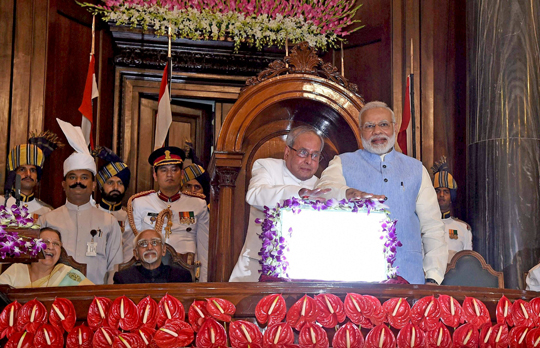
Speaking at a special function at Parliament’s Central Hall, where President Pranab Mukherjee launched the new indirect tax regime at the stroke of midnight on Friday, Mr. Modi said the practice of giving out kachcha (informal) bills would become history as the GST presented an opportunity to stop black money and corruption, and give people a chance to do honest business.
‘More transparent’
Calling the GST a simpler, modern and more transparent taxation system that will do away with 500 different taxes levied across the country’s 29 States and seven Union Territories, Mr. Modi said that it would end the spectre of tax terrorism and Inspector Raj that India’s businesses have had to endure for long.
This, he said, would be an outcome of the technological backing for GST implementation, which would do away with grey areas and the resultant discretion the bureaucracy enjoyed over tax payers.
Mr. Mukherjee, who as Finance Minister introduced the Constitutional Amendment Bill for enabling GST in 2011, said the tax is “no doubt a disruptive change,” but is similar to the introduction of the VAT (value-added tax) regime which met resistance initially.
“There will be teething troubles, which we have to solve swiftly so that it doesn’t impact the growth of the economy. The GST Council, Centre and States should continuously improve and refine the GST in the same spirit that we have seen till now,” he said.
Stressing that GST would make it easier for global investors to bet on the Indian market, Mr. Modi sought to allay the anxiety in the business community about the preparedness for the transition to the new tax regime, and said that even though not everyone is familiar with technology, each family will have a Class X or XII student who can help carry out the GST compliance requirement of filing an online return each month.
While Opposition parties, including the Congress, the Trinamool Congress and the DMK, chose to stay away from the function, the Prime Minister was wholehearted in his acknowledgement of the role of all parties in the GST’s journey and compared the deliberations over different governments on GST to the prolonged debate over the Constitution that started in the same Central Hall of Parliament in November 1946.
“If Sardar Patel hadn’t unified the country’s 500 provinces after independence, what would the country have been like today? Just like that national integration, GST today will help integrate India’s economy,” the Prime Minister asserted.
NCP leader Sharad Pawar, Vijay Kelkar who originally authored a report on implementing the GST reform during the Atal Bihari Vajpayee government, Tata Group chairman Ratan Tata, former West Bengal Finance Minister Asim Dasgupta and Kerala Congress leader K.M. Mani — both of whom headed the empowered committee of State Finance Ministers during different periods — were present.
Former Prime Minister H.D. Deve Gowda shared the dais with the President and the PM, while the only Congress MP present was P.J. Kurien, who was there in his capacity as Rajya Sabha Deputy Chairperson.
Hours prior to the official launch, the GST Council chaired by Finance Minister Arun Jaitley slashed the tax rate on fertilizers from 12% to 5% and tractor parts from 28% to 18%, in a bid to make the new tax regime more farmer-friendly.
“A lot of States had some concern that the tax rate on fertilizers that was fixed at 12% should not lead to an increase in prices. We had received a lot of representations against this. The current tax incidence was considered, but some States had kept a tax rate lower than that, so keeping all that in mind, it was decided that the GST on fertilizers would be 5%,” Mr. Jaitley said.
The Council also approved additional rules for GST implementation, the Finance Minister said, while the Finance Ministry said on its Twitter handle that the GST rate on ‘exclusive parts of tractors’ has been reduced from 28% to 18%.
Meanwhile, a last-ditch attempt on Friday by Jammu and Kashmir to pass the necessary legislation to enable a simultaneous rollout of GST with the rest of the country failed, as no consensus could be reached. A special session of the J&K Assembly will be held from July 4 to discuss the issue.
Mr. Jaitley had earlier warned the State about the adverse impact on its consumers as well as businesses if they fail to roll out GST in sync with the other States.
The government’s think tank Niti Aayog sought to play down expectations of the economy growing faster due to the GST regime, with its member Bibek Debroy stressing that the new dispensation with multiple tax rates is ‘far from ideal’ and hopes of GDP growing by 1%-1.5% were pinned on an ‘ideal GST’, not an ‘imperfect one.’


Comments
Add new comment