



Gujaratis dominate Forbes India rich list

September 22, 2016

Singapore, Sep 22: Gujaratis seem to be among the most dominant communities when it comes to wealth creation, with Ambanis, Adanis, Shanghvis and Patels cornering a large number of top positions on the list of India's richest 100 released by Forbes today.
forbes

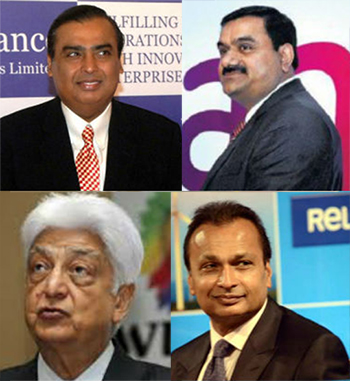
Industrialist Mukesh Ambani was named India's richest person for a ninth year in a row with a sharp increase in networth to USD 22.7 billion, while his younger brother Anil Ambani was ranked 32nd with a networth of USD 3.4 billion.

Sun Pharma's Dilip Shanghvi, another Gujarati, was placed second with USD 16.9 billion, while Wipro's Azim Premji came in fourth with a networth of USD 15 billion, followed by Uday Kotak (11th, USD 8.3 billion) and Gautam Adani (13th, USD 6.3 billion).

Shashi and Ravi Ruia, who have a networth of USD 5.8 billion, have a significant presence in Gujarat.

Other Gujaratis on the list include Pankaj Patel, ranked 23rd with a networth of USD 4.5 billion, Karsanbhai Patel (52, USD 2.24 billion), Rajesh Mehta (61, USD 1.88 billion) and Nirav Modi (71, USD 1.74 billion), among others.

The list also features many Parsis, who migrated from Iran and landed in this coastal state many centuries ago.

Among the noted Parsis, Pallonji Mistry was ranked 5th on the coveted list with a networth of USD 13.9 billion, while the Godrej family was at the 7th place with USD 12.4 billion, followed by Cyrus Poonawalla (10th, USD 8.6 billion).

According to Forbes, the combined networth of India's 100 wealthiest is USD 381 billion (nearly Rs 25.5 lakh crore), a rise of 10 per cent from USD 345 billion in 2015.

"In a post-Brexit world, India appears a steady ship with an economy growing at 7 per cent-plus. The majority of India's 100 richest have notched up handsome gains as their companies have outperformed the stock market in the past year.

"As the domestic investment cycle starts kicking in, we can expect more gains and new names in the future," Forbes Asia's India Editor Naazneen Karmali said.

Forbes said the list was compiled using shareholding and financial information obtained from the families and individuals, stock exchanges, analysts and regulators.


Comments

Add new comment

  • Coastaldigest.com reserves the right to delete or block any comments.
  • Coastaldigset.com is not responsible for its readers’ comments.
  • Comments that are abusive, incendiary or irrelevant are strictly prohibited.
  • Please use a genuine email ID and provide your name to avoid reject.
News Network
December 6,2025

pilot.jpg

New Delhi: IndiGo, India’s largest airline, faced major operational turbulence this week after failing to prepare for new pilot-fatigue regulations issued by the Directorate General of Civil Aviation (DGCA). The stricter rules—designed to improve flight safety—took effect in phases through 2024, with the latest implementation on November 1. IndiGo has acknowledged that inadequate roster planning led to widespread cancellations and delays.

Below are the key DGCA rules that affected IndiGo’s operations:

1. Longer Mandatory Weekly Rest

Weekly rest for pilots has been increased from 36 hours to 48 hours.

The government says the extended break is essential to curb cumulative fatigue. This rule remains in force despite the current crisis.

2. Cap on Night Landings

Pilots can now perform only two night landings per week—a steep reduction from the earlier limit of six.

Night hours, defined as midnight to early morning, are considered the least alert period for pilots.

Given the disruptions, this rule has been temporarily relaxed for IndiGo until February 10.

3. Reduced Maximum Night Flight Duty

Flight duty that stretches into the night is now capped at 10 hours.

This measure has also been kept on hold for IndiGo until February 10 to stabilize operations.

4. Weekly Rest Cannot Be Replaced With Personal Leave

Airlines can no longer count a pilot’s personal leave as part of the mandatory 48-hour rest.

Pilots say this closes a loophole that previously reduced actual rest time.

Currently, all airlines are exempt from this rule to normalise travel.

5. Mandatory Fatigue Monitoring

Airlines must submit quarterly fatigue reports along with corrective actions to DGCA.

This system aims to create a transparent fatigue-tracking framework across the industry.

The DGCA has stressed that these rules were crafted to strengthen flight safety and align India with global fatigue-management standards. The temporary relaxations are expected to remain until February 2025, giving IndiGo time to stabilise its schedules and restore normal air travel.

Comments

Add new comment

  • Coastaldigest.com reserves the right to delete or block any comments.
  • Coastaldigset.com is not responsible for its readers’ comments.
  • Comments that are abusive, incendiary or irrelevant are strictly prohibited.
  • Please use a genuine email ID and provide your name to avoid reject.