Here's why RBI went for an unconventional rate cut

Agencies
August 22, 2019

New Delhi, Aug 22: The Reserve Bank of India had raised quite a few eyebrows when it announced an unconventional 35 basis points rate cut during its bi-monthly policy meet earlier this month.

RBI Governor Shaktikanta Das, according to the minutes of the meeting released on Wednesday, said that "the economy needs a larger push" and a reduction in the policy repo rate by conventional 25 bps will be inadequate.

Voting for a 35 basis points (bps) rate cut, Das said that "a policy rate adjustment of 25 bps or multiples thereof may not always be consistent with the evolving macroeconomic situation. Hence, at times it is apposite to calibrate the size of the conventional rate adjustment".

Noting that there was clear evidence of domestic demand slowing down further, he said that investment activity has been losing traction and the weakening of the global economy in the face of intensifying trade and geo-political tensions has severely impacted India's exports, which may further impact investment activity.

The Reserve Bank of India's (RBI) MPC voted by a 4:2 margin to cut its repo, or short-term lending rate for commercial banks, by an unprecedented 35 bps to 5.4 per cent.

Indicating future course of action, Michael Debabrata Patra, who was among the four who voted for a 35 bps cut, said that "from here on, the space for monetary policy action has to be calibrated to the evolving situation, especially as the nature and depth of the slowdown is still unravelling and elbow room may be needed if it deepens".

"A more broad-sided response involving all levers of policy acquires the highest priority now. The overarching goal is to reinvigorate domestic demand and the time to do it is now," Patra added.

Ravindra H. Dholakia had expressed that he would like to cut the policy rate by 40 bps, "but I do not mind going with majority opinion of cutting the rate by 35 bps this time, and maintaining the accommodative stance".

Voting for a 25 bps, external MPC member Chetan Ghate had said that by agreeing to a 35 bps cut, the RBI could be burning through monetary policy space.

Opposing the four MPC members who voted for a 35 bps cut, he said that there has been inadequate monetary transmission given the quantum of past rate cuts.

"..the WALR (weighted average lending rate) on fresh rupee loans in the banking system has come down by only 29 bps despite the MPC cutting rates by 75 bps in the February-June window. By a large cut (35 bps), I feel we will be burning through monetary policy space without much to show for it," Ghate said, according to the minutes.

"While the real economy needs some support, we should wait for more transmission to happen," he added.

External member Pami Dua, who also recommended a 25 basis point cut, said that it was also important to recognize that, while monetary policy can impact cyclical factors, it has its "limitations with respect to significantly impacting structural factors".

According to Dua, investment-focused fiscal policy and active continuation of structural reforms were imperative at this juncture to complement the already substantial easing in central bank rates that have been delivered since February 2019.

The rate cut earlier this month was the fourth in succession adding up to a total of 110 bps.

Comments

Add new comment

  • Coastaldigest.com reserves the right to delete or block any comments.
  • Coastaldigset.com is not responsible for its readers’ comments.
  • Comments that are abusive, incendiary or irrelevant are strictly prohibited.
  • Please use a genuine email ID and provide your name to avoid reject.
News Network
December 22,2025

saudisnow.jpg

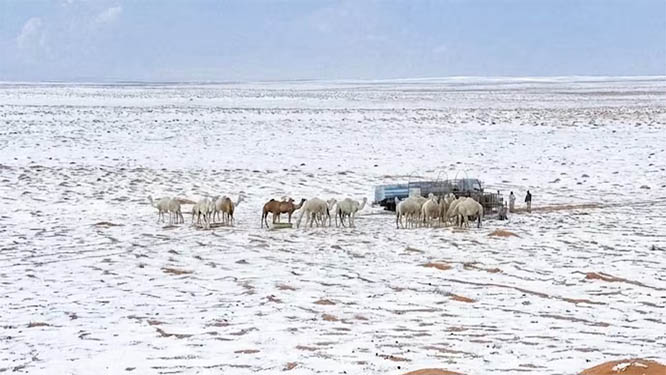
Saudi Arabia has witnessed rare snowfall in several parts of the country, including the northern regions, where such an event has been reported for the first time in 30 years, leaving residents in awe. 

The white blanket of snow covered vast desert areas, from the Tuwaiq mountain range in the west to regions near Riyadh. The rare event has sparked excitement and disbelief among residents, who have shared videos and photos of the Gulf nation blanketed in white.

A video shared on X captured an unusual scene: a group of camels standing in a desert area covered in snow, with dark clouds looming overhead.

Snowfall transformed parts of the country into an unexpected winter playground. Another video showed adults enjoying the snow by skiing, celebrating, and capturing a scene rarely seen in the Kingdom.

Local TV channels have described the snowfall as historic, while many residents have expressed concerns over the cold conditions and icy roads. The National Meteorology Center (NCM) had earlier warned of a sharp drop in temperatures and urged the public to take safety precautions.

Additionally, the Trojena Highlands and parts of the Tabuk region experienced unusually low temperatures due to snow last week. Jabal Al-Lawz in Tabuk reported heavy snowfall on Wednesday, accompanied by thick fog and strong winds, according to the Saudi Gazette.

The NCM has forecast a high chance of snow in the Qassim region and northern parts of Riyadh on Thursday, as an intense weather system continues to affect large areas of the kingdom. Authorities have cautioned the public to exercise extreme care during the severe weather.

While snow in Saudi Arabia is rare, it is not unprecedented. Last February, the Trojena Mountains saw snowfall and sub-zero temperatures, and parts of Al-Jawf reportedly experienced snow for the first time.

Comments

Add new comment

  • Coastaldigest.com reserves the right to delete or block any comments.
  • Coastaldigset.com is not responsible for its readers’ comments.
  • Comments that are abusive, incendiary or irrelevant are strictly prohibited.
  • Please use a genuine email ID and provide your name to avoid reject.
News Network
December 13,2025

New Delhi: School-going children are picking up drug and smoking habits and engaging in consumption of alcohol, with the average age of introduction to such harmful substances found to be around 13 years, suggesting a need for earlier interventions as early as primary school, a multi-city survey by AIIMS-Delhi said.

The findings also showed substance use increased in higher grades, with grade XI/XII students two times more likely to report use of substances when compared with grade VIII students. This emphasised the importance of continued prevention and intervention through middle and high school.

The study led by Dr Anju Dhawan of AIIMS's National Drug Dependence Treatment Centre, published in the National Medical Journal of India this month, looks at adolescent substance use across diverse regions.

The survey included 5,920 students from classes 8, 9, 11 and 12 in urban government, private and rural schools across 10 cities -- Bengaluru, Chandigarh, Delhi, Dibrugarh, Hyderabad, Imphal, Jammu, Lucknow, Mumbai, and Ranchi. The data were collected between May 2018 and June 2019.

The average age of initiation for any substance was 12.9 (2.8) years. It was lowest for inhalants (11.3 years) followed by heroin (12.3 years) and opioid pharmaceuticals (without prescription; 12.5 years).

Overall, 15.1 per cent of participants reported lifetime use, 10.3 per cent reported past year use, and 7.2 per cent reported use in the past month of any substance, the study found.

The most common substances used in the past year, after tobacco (4 per cent) and alcohol (3.8 per cent), were opioids (2.8 per cent), followed by cannabis (2 per cent) and inhalants (1.9 per cent). Use of non-prescribed pharmaceutical opioids was most common among opioid users (90.2 per cent).

On being asked, 'Do you think this substance is easily available for a person of your age' separately for each substance category, nearly half the students (46.3 per cent) endorsed that tobacco products and more than one-third of the students (36.5 per cent) agreed that a person of their age can easily procure alcohol products.

Similarly, for Bhang (21.9 per cent), ganja/charas (16.1 per cent), inhalants (15.2 per cent), sedatives (13.7 per cent), opium and heroin (10 per cent each), the students endorsed that these can be easily procured.

About 95 per cent of the children, irrespective of their grade, agreed with the statement that 'drug use is harmful'.

The rates of substance use (any) among boys were significantly higher than those of girls for substance use (ever), use in the past year and use in the past 30 days. Compared to grade VIII students, grade IX students were more likely, and grade XI/XII students were twice as likely to have used any substance (ever).

The likelihood of past-year use of any substance was also higher for grade IX students and for grade XI/XII students as compared to grade VIII students.

About 40 per cent of students mentioned that they had a family member who used tobacco or alcohol each. The use of cannabis (any product) and opioid (any product) by a family member was reported by 8.2 per cent and 3.9 per cent of students, respectively, while the use of other substances, such as inhalants/sedatives by family was 2-3 per cent, the study found.

A relatively smaller percentage of students reported use of tobacco or alcohol among peers as compared to among family members, while a higher percentage reported inhalants, sedatives, cannabis or opioid use among peers.

Children using substances (past year) compared to non-users reported significantly higher any substance use by their family members and peers.

There were 25.7 per cent students who replied 'yes' to the question 'conflicts/fights often occur in your family'. Most students also replied affirmatively to 'family members are aware of how their time is being spent' and 'damily members are aware of with whom they spend their time'.

Comments

Add new comment

  • Coastaldigest.com reserves the right to delete or block any comments.
  • Coastaldigset.com is not responsible for its readers’ comments.
  • Comments that are abusive, incendiary or irrelevant are strictly prohibited.
  • Please use a genuine email ID and provide your name to avoid reject.
News Network
December 15,2025

Mangaluru, Dec 15: Air India Express has announced that it will resume direct flight services between Mangaluru and Muscat from March 2026, restoring an important international air link for passengers from the coastal region.

Airport authorities said the service will operate twice a week—on Sundays and Tuesdays—from March 1. The initial flights are scheduled on March 3, 8 and 10, followed by March 15 and 17, with the same operating pattern to continue thereafter. The flight duration is approximately three hours and 25 minutes.

The Mangaluru–Muscat route was earlier operated under the 2025 summer schedule, with services beginning on July 14. At that time, Air India Express had operated four flights a week before suspending the service.

Officials said the summer schedule will come into effect from March 29, after which changes in flight timings and departure schedules from Mangaluru are expected. Passengers have been advised to check the latest schedules while planning their travel.

The resumption of direct flights to Muscat is expected to significantly benefit expatriates, business travellers and others, further strengthening Mangaluru’s air connectivity with the Gulf region.

Comments

Add new comment

  • Coastaldigest.com reserves the right to delete or block any comments.
  • Coastaldigset.com is not responsible for its readers’ comments.
  • Comments that are abusive, incendiary or irrelevant are strictly prohibited.
  • Please use a genuine email ID and provide your name to avoid reject.