



Highlights of Union Budget 2019 presented by Nirmala Sitharaman

News Network
July 5, 2019

* From 1.85 trillion dollars in 2014, the economy has reached 2.7 trillion US dollars; We can very well reach 5 trillion dollars in the next few years. The Indian economy will grow to become a 3 trillion dollar economy this year itself.

* The plan to reach $5 trillion economy will involve development of heavy investment in infrastructure, digital economy and job creation.

Employment

* 80 Livelihood business incubators and 20 technology business incubators to be set up in 2019-20 under ASPIRE to develop 75,000 skilled entrepreneurs in agro-rural industries.

* Increase focus on skill sets required by the youth to apply for job opportunities abroad like language skills and artificial intelligence (AI).

* We propose to start a television programme on DD National, exclusively for startups. This programme will be designed and executed by startup's themselves.

Banks

* Government considering to go below 51% to an appropriate level of ownership stake in non-financial public sector undertakings on case by case basis.

* Public Sector Banks (PSBs) to be provided Rs 70,000 crore to boost capital and improve credit.

* PSBs will use technology, enabling customer of one PSB to access service across all PSBs as well.

* For purchase of high-rated pooled assets of financially sound Non Banking Finance Companies (NBFCs) amounting to Rs 1 lakh crore during 2019-20, one-time six-month partial credit guarantee to be given to PSBs.

* Proposals for strengthening regulatory authority of RBI over NBFCs have been made.

* Regulation authority over housing finance sector to be returned from National Housing Bank to RBI.

Railways

* Railway infra would need an investment of 50 lakh crores between 2018 and 2030; PPP to be used to unleash faster development and delivery of passenger freight services.

* Railways to be encouraged to invest more in suburban railways through Special Purpose Vehicles (SPV) structures such as Rapid Regional Transport System (RRTS); more Public Private Partner (PPP) initiatives to be encouraged in rail sector.

* Massive programme of railway station modernization to be launched in 2019.

GST

* Rs 350 crore allocated for 2% interest subvention for all GST-registered MSMEs on fresh or incremental loans.

* Government has already moved GST council to lower the GST rate on electric vehicles (EV) from 12% to 5%. Also to make EVs affordable for consumers our government will provide additional income tax deduction of Rs 1.5 lakh on the interest paid on the loans taken to purchase EVs.

Connectivity

* FAME II scheme aims to encourage faster adoption of electric vehicles by right incentives and charging infrastructure. Comprehensive restructuring of National Highways Programme to be done, to ensure creation of National Highways Grid of desirable capacity. Government envisions using rivers for cargo transportation, which will also decongest roads and railways.

* 657 km of metro rail network has become operational in the country.

* The government has given a massive push to all forms of physical connectivity via PMGSY, Industrial corridors, Dedicated freight corridors, Bharatmala, Sagarmala, Jal Marg vikas and UDAN schemes.

Swachh Bharat Mission

* Proposal to expand Swachh Bharat mission to undertake solid waste management in every village.

* India to be open defecation free (ODF) by October 2 2019. To mark this occasion, Rashtriya Swachhata Kendra to be inaugurated at Raj Ghat, on the same day.

Gandhi-pedia

* 'Gandhi-pedia' too to be developed on the lines of Encyclopedia to help promote Gandhian school of thought.

Education and research

* Establish a National Research Foundation to fund, to coordinate and to promote research in the country.

* National Research Foundation to be set up to strengthen overall research ecosystem in the country; funds available under all Ministries to be integrated with NRF.

* New National Educational Policy to be brought in to transform Indian educational system; major changes in higher as well as school system to be introduced.

* Rs 400 crore under head, World Class Institutions in 2019-20, more than three times the revised estimates of previous year. 'Study In India' to be started to bring in foreign students into Indian higher education system.

'Naari tu Narayaani'

* I draw attention to the women of India, 'Naari tu Narayaani'. This government believes that we can progress, with greater women participation.

* To further encourage women entrepreneurship, Women Self-help Groups (SHGs) Interest Subvention Programme to be expanded to all districts in India.

* An overdraft of Rs 5,000 will be allowed for every verified woman SHG member having a Jan Dhan account.

* One woman in every SHG shall be made eligible for a loan of 1 lakh rupees under MUDRA scheme.

Rural

* By 2022, every single rural family except those who are unwilling to take the connection, will have an electricity and a clean cooking facility.

* In second phase of PMAY-Gramin, 1.95 crore houses to be provided to eligible beneficiaries, during 2019-20 to 2021-22; they will have amenities such as LPG, electricity and toilets.

Pension

* Pension benefit to be extended to around 3 crore retail traders and shopkeepers with an annual turnover less than Rs 1.5 crore under Pradhan Mantri Karam Yogi Man Dhan Scheme.

Space

* To harness India's space ability commercially, a public sector enterprise, New Space India Limited (NSIL) has been incorporated to tap the benefits of Isro.

Social stock exchange

* Electronic fundraising platform, a social stock exchange, to be set up to list social enterprises and voluntary organizations working for social welfare objectives.

NRIs

* Aadhaar card for NRIs with Indian passports to be issued after their arrival in India, without waiting for the mandatory 180 days.

* To provide NRIs seamless access to Indian equities, NRI portfolio investment route to be merged with foreign portfolio investment route.

Bahi-khata

* Sitharaman departed from the 'colonial' practice of bringing the Budget documents in a leather briefcase and instead switched to a four-fold red-cotton cloth called a 'bahi-khata'.

* This is the 89th Union Budget, which is the financial statement of the government, detailing its revenue and expenditure in the past, as well as estimated spending and projections for the coming year.

Comments

Add new comment

  • Coastaldigest.com reserves the right to delete or block any comments.
  • Coastaldigset.com is not responsible for its readers’ comments.
  • Comments that are abusive, incendiary or irrelevant are strictly prohibited.
  • Please use a genuine email ID and provide your name to avoid reject.
News Network
December 15,2025

Udupi, Dec 15: What was meant to be a post-pilgrimage gathering turned tragic in Padukere village of Brahmavar taluk, Udupi district, late Sunday night, when a clash among youths escalated into a fatal assault, leaving one man dead.

The victim has been identified as 30-year-old Santosh Mogaveera, a resident of Padukere.

According to preliminary information, the incident took place during a late-night drinking party involving a group of local youths who had recently returned after completing their pilgrimage to the Sabarimala shrine. An argument reportedly broke out among the group and soon escalated into a violent confrontation.

During the ensuing brawl, Santosh Mogaveera was allegedly assaulted and collapsed at the spot after sustaining serious injuries. He was rushed by local residents to a private hospital in Brahmavar, where doctors declared him dead.

On receiving information, senior police officials, including Brahmavar Circle Inspector Gopikrishna, Kota Police Sub-Inspector Praveen Kumar T, Station ASI Manthesh Jabagoudar, and head constables Pradeep and Ashok, visited the spot and conducted an inspection.

Police have taken four youths into custody in connection with the incident. A case has been registered at the Kota police station, and further investigation is underway to ascertain the exact sequence of events leading to the death.

Comments

Add new comment

  • Coastaldigest.com reserves the right to delete or block any comments.
  • Coastaldigset.com is not responsible for its readers’ comments.
  • Comments that are abusive, incendiary or irrelevant are strictly prohibited.
  • Please use a genuine email ID and provide your name to avoid reject.
News Network
December 5,2025

indigoCEO.jpg

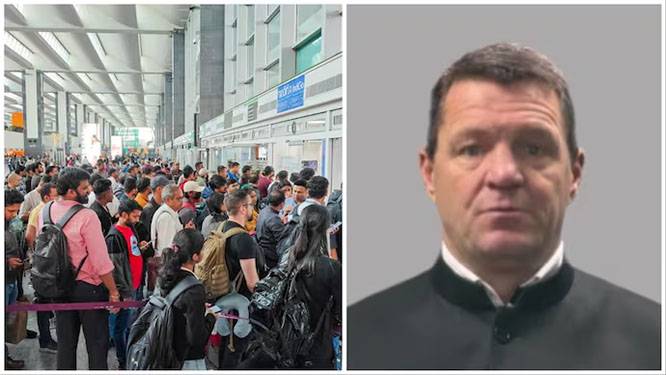
New Delhi, Dec 5: IndiGo CEO Pieter Elbers issued a public apology this evening after more than a thousand flights were cancelled today, making it the "most severely impacted day" in terms of cancellations. The biggest airline of the country cancelled "more than half" of its daily number of flights on Friday, said Elbers. He also said that even though the crisis will persist on Saturday, the airline anticipates fewer than 1,000 flight cancellations.

"Full normalisation is expected between December 10 and 15, though IndiGo cautions that recovery will take time due to the scale of operations," the IndiGo CEO said. 

IndiGo operates around 2,300 domestic and international flights daily.

Pieter Elbers, while apologising for the major inconvenience due to delays and cancellations, said the situation is a result of various causes.

The crisis at IndiGo stems from new regulations that boost pilots' weekly rest requirements by 12 hours to 48 and allow only two night-time landings per week, down from six. IndiGo has attributed the mass cancellations to "misjudgment and planning gaps".

Elbers also listed three lines of action that the airline will adopt to address the issue.

"Firstly, customer communication and addressing your needs, for this, messages have been sent on social media. And just now, a more detailed communication with information, refunds, cancellations and other customer support measures was sent," he said.

The airline has also stepped up its call centre capacity.

"Secondly, due to yesterday's situation, we had customers stranded mostly at the nation's largest airports. Our focus was for all of them to be able to travel today itself, which will be achieved. For this, we also ask customers whose flights are cancelled not to come to the airports as notifications are sent," the CEO said.

"Thirdly, cancellations were made for today to align our crew and planes to be where they need to start tomorrow morning afresh. Earlier measures of the last few days, regrettable, have proven not to be enough, but we have decided today to reboot all our systems and schedules, resulting in the highest numbers of cancellations so far, but imperative for progressive improvements starting from tomorrow," he added.

As airports witnessed chaotic scenes, the Directorate General of Civil Aviation (DGCA) stepped in to grant IndiGo a temporary exemption from stricter night duty rules for pilots. It also allowed substitution of leaves with a weekly rest period. 

Civil Aviation Minister Ram Mohan Naidu has said a high-level inquiry will be ordered and accountability will be fixed.

Comments

Add new comment

  • Coastaldigest.com reserves the right to delete or block any comments.
  • Coastaldigset.com is not responsible for its readers’ comments.
  • Comments that are abusive, incendiary or irrelevant are strictly prohibited.
  • Please use a genuine email ID and provide your name to avoid reject.
News Network
December 13,2025

New Delhi: School-going children are picking up drug and smoking habits and engaging in consumption of alcohol, with the average age of introduction to such harmful substances found to be around 13 years, suggesting a need for earlier interventions as early as primary school, a multi-city survey by AIIMS-Delhi said.

The findings also showed substance use increased in higher grades, with grade XI/XII students two times more likely to report use of substances when compared with grade VIII students. This emphasised the importance of continued prevention and intervention through middle and high school.

The study led by Dr Anju Dhawan of AIIMS's National Drug Dependence Treatment Centre, published in the National Medical Journal of India this month, looks at adolescent substance use across diverse regions.

The survey included 5,920 students from classes 8, 9, 11 and 12 in urban government, private and rural schools across 10 cities -- Bengaluru, Chandigarh, Delhi, Dibrugarh, Hyderabad, Imphal, Jammu, Lucknow, Mumbai, and Ranchi. The data were collected between May 2018 and June 2019.

The average age of initiation for any substance was 12.9 (2.8) years. It was lowest for inhalants (11.3 years) followed by heroin (12.3 years) and opioid pharmaceuticals (without prescription; 12.5 years).

Overall, 15.1 per cent of participants reported lifetime use, 10.3 per cent reported past year use, and 7.2 per cent reported use in the past month of any substance, the study found.

The most common substances used in the past year, after tobacco (4 per cent) and alcohol (3.8 per cent), were opioids (2.8 per cent), followed by cannabis (2 per cent) and inhalants (1.9 per cent). Use of non-prescribed pharmaceutical opioids was most common among opioid users (90.2 per cent).

On being asked, 'Do you think this substance is easily available for a person of your age' separately for each substance category, nearly half the students (46.3 per cent) endorsed that tobacco products and more than one-third of the students (36.5 per cent) agreed that a person of their age can easily procure alcohol products.

Similarly, for Bhang (21.9 per cent), ganja/charas (16.1 per cent), inhalants (15.2 per cent), sedatives (13.7 per cent), opium and heroin (10 per cent each), the students endorsed that these can be easily procured.

About 95 per cent of the children, irrespective of their grade, agreed with the statement that 'drug use is harmful'.

The rates of substance use (any) among boys were significantly higher than those of girls for substance use (ever), use in the past year and use in the past 30 days. Compared to grade VIII students, grade IX students were more likely, and grade XI/XII students were twice as likely to have used any substance (ever).

The likelihood of past-year use of any substance was also higher for grade IX students and for grade XI/XII students as compared to grade VIII students.

About 40 per cent of students mentioned that they had a family member who used tobacco or alcohol each. The use of cannabis (any product) and opioid (any product) by a family member was reported by 8.2 per cent and 3.9 per cent of students, respectively, while the use of other substances, such as inhalants/sedatives by family was 2-3 per cent, the study found.

A relatively smaller percentage of students reported use of tobacco or alcohol among peers as compared to among family members, while a higher percentage reported inhalants, sedatives, cannabis or opioid use among peers.

Children using substances (past year) compared to non-users reported significantly higher any substance use by their family members and peers.

There were 25.7 per cent students who replied 'yes' to the question 'conflicts/fights often occur in your family'. Most students also replied affirmatively to 'family members are aware of how their time is being spent' and 'damily members are aware of with whom they spend their time'.

Comments

Add new comment

  • Coastaldigest.com reserves the right to delete or block any comments.
  • Coastaldigset.com is not responsible for its readers’ comments.
  • Comments that are abusive, incendiary or irrelevant are strictly prohibited.
  • Please use a genuine email ID and provide your name to avoid reject.