



I am Rajiv Gandhi’s daughter: Priyanka’s reply to Modi

May 1, 2014

Amethi/New Delhi, May 1: “I am Rajiv Gandhi’s daughter,” was Priyanka Gandhi terse reply on Friday to purported comments by Narendra Modi that he considers her as his daughter. Ms. Gandhi, who is on a campaign trail in Amethi, reacted sharply when she was asked by reporters to comment on purported remarks by the BJP prime ministerial candidate that she was like a daughter to him. Priyanka’s brother Rahul is the Congress candidate from Amethi in Uttar Pradesh.
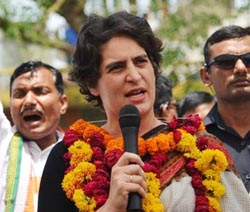
Priyanka_gandhi

“Main Rajiv Gandhi ki beti hoon’( I am Rajiv Gandhi’s daughter),” she said. Ms. Gandhi was in her SUV and halted briefly to shake hands with some supporters. Initially she did not answer the question but later came out of the SUV and with a stern face replied to the query and left without answering any other question.

Ms. Gandhi’s curt reply came even as senior Congress leader and Finance Minister P. Chidambaram said he was not sure if the Congress president Sonia Gandhi’s daughter will consider the Gujarat Chief Minister as a “father figure”.

“I am happy that Narendra Modi considers Priyanka Gandhi as his daughter but I am not sure if she will be happy to consider Modi as a father figure,” he said. Mr. Chidambaram was reacting to questions at a news conference in Delhi over Mr. Modi’s purported comments in an interview to Doordarshan that he considers Ms. Gandhi is daughter. Some portions of the interview, including Mr. Modi’s “daughter” comments on Ms. Gandhi, were reportedly not telecast. Mr. Chidamabaram said he was not aware of what was said and what was edited.

He said his own recent interview to a television channel underwent some editing as “that is prerogative of the editor” of the news channel in terms of the schedule and size of the programme. Mr. Modi’s interview was telecast on April 27, reportedly two days after it was recorded, following a buzz in social media that it was being dropped.

During the interview, Mr. Modi is reported to have said that over the years he had been “blacked-out” by the Doordarshan Kendra in Gujarat and he was surprised to get a request from the public broadcaster.

Comments

Add new comment

  • Coastaldigest.com reserves the right to delete or block any comments.
  • Coastaldigset.com is not responsible for its readers’ comments.
  • Comments that are abusive, incendiary or irrelevant are strictly prohibited.
  • Please use a genuine email ID and provide your name to avoid reject.
News Network
December 13,2025

New Delhi: School-going children are picking up drug and smoking habits and engaging in consumption of alcohol, with the average age of introduction to such harmful substances found to be around 13 years, suggesting a need for earlier interventions as early as primary school, a multi-city survey by AIIMS-Delhi said.

The findings also showed substance use increased in higher grades, with grade XI/XII students two times more likely to report use of substances when compared with grade VIII students. This emphasised the importance of continued prevention and intervention through middle and high school.

The study led by Dr Anju Dhawan of AIIMS's National Drug Dependence Treatment Centre, published in the National Medical Journal of India this month, looks at adolescent substance use across diverse regions.

The survey included 5,920 students from classes 8, 9, 11 and 12 in urban government, private and rural schools across 10 cities -- Bengaluru, Chandigarh, Delhi, Dibrugarh, Hyderabad, Imphal, Jammu, Lucknow, Mumbai, and Ranchi. The data were collected between May 2018 and June 2019.

The average age of initiation for any substance was 12.9 (2.8) years. It was lowest for inhalants (11.3 years) followed by heroin (12.3 years) and opioid pharmaceuticals (without prescription; 12.5 years).

Overall, 15.1 per cent of participants reported lifetime use, 10.3 per cent reported past year use, and 7.2 per cent reported use in the past month of any substance, the study found.

The most common substances used in the past year, after tobacco (4 per cent) and alcohol (3.8 per cent), were opioids (2.8 per cent), followed by cannabis (2 per cent) and inhalants (1.9 per cent). Use of non-prescribed pharmaceutical opioids was most common among opioid users (90.2 per cent).

On being asked, 'Do you think this substance is easily available for a person of your age' separately for each substance category, nearly half the students (46.3 per cent) endorsed that tobacco products and more than one-third of the students (36.5 per cent) agreed that a person of their age can easily procure alcohol products.

Similarly, for Bhang (21.9 per cent), ganja/charas (16.1 per cent), inhalants (15.2 per cent), sedatives (13.7 per cent), opium and heroin (10 per cent each), the students endorsed that these can be easily procured.

About 95 per cent of the children, irrespective of their grade, agreed with the statement that 'drug use is harmful'.

The rates of substance use (any) among boys were significantly higher than those of girls for substance use (ever), use in the past year and use in the past 30 days. Compared to grade VIII students, grade IX students were more likely, and grade XI/XII students were twice as likely to have used any substance (ever).

The likelihood of past-year use of any substance was also higher for grade IX students and for grade XI/XII students as compared to grade VIII students.

About 40 per cent of students mentioned that they had a family member who used tobacco or alcohol each. The use of cannabis (any product) and opioid (any product) by a family member was reported by 8.2 per cent and 3.9 per cent of students, respectively, while the use of other substances, such as inhalants/sedatives by family was 2-3 per cent, the study found.

A relatively smaller percentage of students reported use of tobacco or alcohol among peers as compared to among family members, while a higher percentage reported inhalants, sedatives, cannabis or opioid use among peers.

Children using substances (past year) compared to non-users reported significantly higher any substance use by their family members and peers.

There were 25.7 per cent students who replied 'yes' to the question 'conflicts/fights often occur in your family'. Most students also replied affirmatively to 'family members are aware of how their time is being spent' and 'damily members are aware of with whom they spend their time'.

Comments

Add new comment

  • Coastaldigest.com reserves the right to delete or block any comments.
  • Coastaldigset.com is not responsible for its readers’ comments.
  • Comments that are abusive, incendiary or irrelevant are strictly prohibited.
  • Please use a genuine email ID and provide your name to avoid reject.