India finally receives first Rafale fighter jet from France

Agencies
October 8, 2019

Merignac, Oct 8: Defence Minister Rajnath Singh on Tuesday formally received the Indian Air Force’s first Rafale fighter jet from a series of 36 such aircraft purchased from France.

Mr. Singh attended the handover ceremony along with his French counterpart Florence Parly at aircraft maker Dassault Aviation facility in Merignac, southwestern France.

The Minister performed a brief Shastra Puja on the new aircraft as he emblazoned it with an ‘Om’ tilak and laid flowers and a coconut, just before he took off in it for a sortie. He was joined by senior representatives of the Indian Armed Forces to mark the induction ceremony.

"Our Air Force is the fourth-largest in the world and I believe that the Rafale Medium Multi-Role Combat Aircraft will make us even stronger and will give a boost to India's air dominance exponentially to ensure peace and security in the region," Mr. Singh said, addressing the gathering in Hindi.

"I have been told that the French word Rafale means andhi in Hindi or gust of wind. I am sure that the aircraft will live up to its name, he said.

The RB001 Rafale, denoting the initials of Air Chief Marshal Rakesh Bhadauria who played a key role in striking the deal for the jets in his previous role as IAF deputy chief, was unveiled just moments ago behind him, with the Indian tricolour as its backdrop.

"Today marks a new milestone in the Indo-French strategic partnership and indeed a new high in the bilateral defence cooperation. Such achievements encourage us to do more and that will be on my agenda when I meet minister Parly today," Mr. Singh said, in reference to the annual Indo-French Defence Dialgoue scheduled for later on Tuesday in Paris.

"This is a historic and landmark day for the Indian Armed forces, which reflects the depth of strategic partnership between India and France. Today marks Vijayadashami — the victory of good over evil — as also the 87th Indian Air Force Day. And therefore a symbolic day in so many ways," he added.

'Make in India'

Ms. Parly described the Rafale as a symbol of the best France has to offer India to protect its sovereignty and also of the French commitment to the 'Make in India' initiative.

"It is no coincidence that this ceremony falls on Dussehra and also the Indian Air Force's 87th anniversary. It is a reflection of the paramount importance we give to our cooperation with India, said Ms. Parly.

"This is just the first step of a long journey, as we are committed to meet all needs of the Indian Army. It marks a big day in the history of our industrial cooperation and we remain fully committed to the 'Make in India' initiative," she said.

This range of Rafale fighter jets has been specially designed to meet the needs of the IAF, which its manufacturer described as a new step in the company's long-standing relationship with India.

"The history of our relationship started in 1953 with delivery of Toofani for the Indian Air Force and since then we have had a continuous and unfailing commitment to this country, supported by successive French governments,” said Eric Trappier, CEO of Dassault Aviation.

"These aircraft, which are on course to be delivered on scheduled as per the agreement signed in September 2016, have been created to meet the highly demanding needs of the Indian Air Force, which operates in a very sensitive geopolitical environment," he said.

It was revealed that an Indian Rafale project monitoring team has been based in France since August 2017 to ensure the smooth implementation of the project, aimed at considerably enhancing India’s air combat fleet.

'Great honour'

In Bordeaux, Mr. Singh began with a tour of Dassault Aviation's final Rafale assembly line before the induction ceremony, which concluded with the Shastra Puja. He was then prepped for a sortie in the newly-acquired two-seater jet.

“It is indeed a great honour to be able to fly in this new fighter jet,” said Mr. Singh, just before take off.

The Minister was accompanied by Armed Forces personnel, including Air Marshall Harjit Singh Arora. Representatives of the top military brass from the French side were also present on the occasion.

India had ordered 36 Rafale fighter jets from France in a deal worth Rs 59,000 crore in September 2016.

While the formal handover ceremony takes place this week, the first batch of four Rafale jets will fly to their home base in India by May 2020. All 36 jets are expected to arrive in India by September 2022, for which the IAF has been reportedly undertaking preparations, including readying required infrastructure and training of pilots.

The Rafale is a twin-jet fighter aircraft able to operate from both an aircraft carrier and a shore base. The manufacturers describe it as a fully versatile aircraft which can carry out all combat aviation missions to achieve air superiority and air defence, close air support, in-depth strikes, reconnaissance, anti-ship strikes and nuclear deterrence.


Comments

Add new comment

  • Coastaldigest.com reserves the right to delete or block any comments.
  • Coastaldigset.com is not responsible for its readers’ comments.
  • Comments that are abusive, incendiary or irrelevant are strictly prohibited.
  • Please use a genuine email ID and provide your name to avoid reject.
News Network
December 6,2025

pilot.jpg

New Delhi: IndiGo, India’s largest airline, faced major operational turbulence this week after failing to prepare for new pilot-fatigue regulations issued by the Directorate General of Civil Aviation (DGCA). The stricter rules—designed to improve flight safety—took effect in phases through 2024, with the latest implementation on November 1. IndiGo has acknowledged that inadequate roster planning led to widespread cancellations and delays.

Below are the key DGCA rules that affected IndiGo’s operations:

1. Longer Mandatory Weekly Rest

Weekly rest for pilots has been increased from 36 hours to 48 hours.

The government says the extended break is essential to curb cumulative fatigue. This rule remains in force despite the current crisis.

2. Cap on Night Landings

Pilots can now perform only two night landings per week—a steep reduction from the earlier limit of six.

Night hours, defined as midnight to early morning, are considered the least alert period for pilots.

Given the disruptions, this rule has been temporarily relaxed for IndiGo until February 10.

3. Reduced Maximum Night Flight Duty

Flight duty that stretches into the night is now capped at 10 hours.

This measure has also been kept on hold for IndiGo until February 10 to stabilize operations.

4. Weekly Rest Cannot Be Replaced With Personal Leave

Airlines can no longer count a pilot’s personal leave as part of the mandatory 48-hour rest.

Pilots say this closes a loophole that previously reduced actual rest time.

Currently, all airlines are exempt from this rule to normalise travel.

5. Mandatory Fatigue Monitoring

Airlines must submit quarterly fatigue reports along with corrective actions to DGCA.

This system aims to create a transparent fatigue-tracking framework across the industry.

The DGCA has stressed that these rules were crafted to strengthen flight safety and align India with global fatigue-management standards. The temporary relaxations are expected to remain until February 2025, giving IndiGo time to stabilise its schedules and restore normal air travel.

Comments

Add new comment

  • Coastaldigest.com reserves the right to delete or block any comments.
  • Coastaldigset.com is not responsible for its readers’ comments.
  • Comments that are abusive, incendiary or irrelevant are strictly prohibited.
  • Please use a genuine email ID and provide your name to avoid reject.
News Network
December 7,2025

envoy.jpg

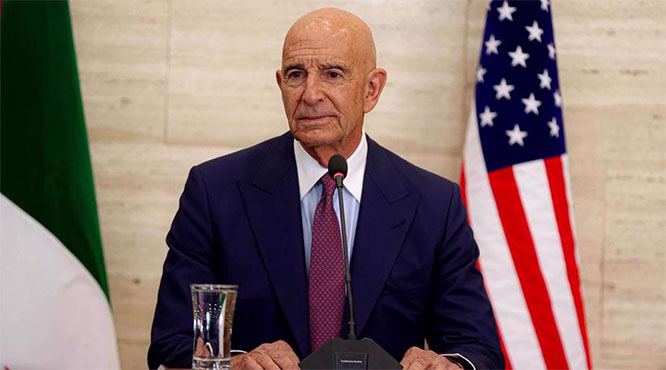
Since 1946, the United States has attempted 93 coups or “regime change” operations across the world — including two in Iran, US Special Envoy for Syria Tom Barrack has admitted.

Speaking to the UAE-based IMI Media Group, in remarks published by The National, Barrack said Washington tried twice to overthrow the Iranian government but failed both times. 

“For (Trump) then to be imputed with regime change — we had two regime changes in Iran already. Neither one worked. So I think wisely leave it to the region to solve,” said Barrack, who also serves as the US ambassador to Turkey.

His comments come six months after the US joined Israel in airstrikes against Iran during ongoing indirect nuclear negotiations between Tehran and Washington.

On June 13, Israel launched an attack on Iran that killed at least 1,064 people and hit civilian infrastructure. Days later, the United States targeted three nuclear facilities — Fordow, Natanz and Isfahan — in what Iran called a clear violation of international law. Iranian retaliation eventually forced a halt to the assault on June 24.

Barrack further claimed that US President Donald Trump and Foreign Secretary Marco Rubio are “not into regime change” and prefer a regional approach driven by Middle Eastern countries themselves. According to him, regional dialogue and non-interference by outside powers offer a more durable path forward.

He added that Washington is still open to an agreement with Tehran if Iranian authorities show “seriousness” and willingness to engage constructively.

However, Iran maintains the US has not shown readiness for meaningful talks. In an interview with Japan’s Kyodo News, Iranian Foreign Minister Abbas Araghchi said negotiations could advance only if Washington acknowledges Iran’s right to peaceful nuclear energy and lifts unilateral sanctions.

Comments

Add new comment

  • Coastaldigest.com reserves the right to delete or block any comments.
  • Coastaldigset.com is not responsible for its readers’ comments.
  • Comments that are abusive, incendiary or irrelevant are strictly prohibited.
  • Please use a genuine email ID and provide your name to avoid reject.
News Network
December 13,2025

New Delhi: School-going children are picking up drug and smoking habits and engaging in consumption of alcohol, with the average age of introduction to such harmful substances found to be around 13 years, suggesting a need for earlier interventions as early as primary school, a multi-city survey by AIIMS-Delhi said.

The findings also showed substance use increased in higher grades, with grade XI/XII students two times more likely to report use of substances when compared with grade VIII students. This emphasised the importance of continued prevention and intervention through middle and high school.

The study led by Dr Anju Dhawan of AIIMS's National Drug Dependence Treatment Centre, published in the National Medical Journal of India this month, looks at adolescent substance use across diverse regions.

The survey included 5,920 students from classes 8, 9, 11 and 12 in urban government, private and rural schools across 10 cities -- Bengaluru, Chandigarh, Delhi, Dibrugarh, Hyderabad, Imphal, Jammu, Lucknow, Mumbai, and Ranchi. The data were collected between May 2018 and June 2019.

The average age of initiation for any substance was 12.9 (2.8) years. It was lowest for inhalants (11.3 years) followed by heroin (12.3 years) and opioid pharmaceuticals (without prescription; 12.5 years).

Overall, 15.1 per cent of participants reported lifetime use, 10.3 per cent reported past year use, and 7.2 per cent reported use in the past month of any substance, the study found.

The most common substances used in the past year, after tobacco (4 per cent) and alcohol (3.8 per cent), were opioids (2.8 per cent), followed by cannabis (2 per cent) and inhalants (1.9 per cent). Use of non-prescribed pharmaceutical opioids was most common among opioid users (90.2 per cent).

On being asked, 'Do you think this substance is easily available for a person of your age' separately for each substance category, nearly half the students (46.3 per cent) endorsed that tobacco products and more than one-third of the students (36.5 per cent) agreed that a person of their age can easily procure alcohol products.

Similarly, for Bhang (21.9 per cent), ganja/charas (16.1 per cent), inhalants (15.2 per cent), sedatives (13.7 per cent), opium and heroin (10 per cent each), the students endorsed that these can be easily procured.

About 95 per cent of the children, irrespective of their grade, agreed with the statement that 'drug use is harmful'.

The rates of substance use (any) among boys were significantly higher than those of girls for substance use (ever), use in the past year and use in the past 30 days. Compared to grade VIII students, grade IX students were more likely, and grade XI/XII students were twice as likely to have used any substance (ever).

The likelihood of past-year use of any substance was also higher for grade IX students and for grade XI/XII students as compared to grade VIII students.

About 40 per cent of students mentioned that they had a family member who used tobacco or alcohol each. The use of cannabis (any product) and opioid (any product) by a family member was reported by 8.2 per cent and 3.9 per cent of students, respectively, while the use of other substances, such as inhalants/sedatives by family was 2-3 per cent, the study found.

A relatively smaller percentage of students reported use of tobacco or alcohol among peers as compared to among family members, while a higher percentage reported inhalants, sedatives, cannabis or opioid use among peers.

Children using substances (past year) compared to non-users reported significantly higher any substance use by their family members and peers.

There were 25.7 per cent students who replied 'yes' to the question 'conflicts/fights often occur in your family'. Most students also replied affirmatively to 'family members are aware of how their time is being spent' and 'damily members are aware of with whom they spend their time'.

Comments

Add new comment

  • Coastaldigest.com reserves the right to delete or block any comments.
  • Coastaldigset.com is not responsible for its readers’ comments.
  • Comments that are abusive, incendiary or irrelevant are strictly prohibited.
  • Please use a genuine email ID and provide your name to avoid reject.