India to stop importing oil from Iran; make up lost volumes from alternate sources

Agencies
April 23, 2019

New Delhi, Apr 23: India will stop importing crude oil from Iran following the US move to end sanction waivers, and will use alternate supply sources such as Saudi Arabia to make up for the lost volumes, top officials and industry sources said Tuesday.

The Trump administration on Monday decided not to renew waiver that let countries like India buy Iranian oil without facing US sanctions.

"Until the waivers are not restored back, I don't think India can buy oil from Iran. We will stop importing oil from Iran," a top official said.

New Delhi is likely to press with the US government for continuation of beyond its expiry on May 2 in talks scheduled later this month, he said. "But purchases cannot be made in anticipation. We will not be importing any oil from Iran."

India was the second biggest buyer of Iranian crude oil after China. It bought some 24 million tonnes of crude oil from Iran in the fiscal ended March 31 (2018-19). Iran supplied more than a tenth of its oil needs.

The shortfall will be made from alternate supply sources available in Saudi Arabia, Kuwait, UAE and Mexico.

Oil Minister Dharmendra Pradhan in a tweet said "a robust plan for an adequate supply of crude oil to Indian refineries" is in place.

"There will be additional supplies from other major oil-producing countries; Indian refineries are fully prepared to meet the national demand for petrol, diesel & other petroleum products," he said.

The oil ministry too in a statement said a plan was in place to ensure supplies of crude oil from May when the waiver ends.

Indian Oil Corp (IOC) Chairman Sanjiv Singh said refiners import crude oil from a wide range of sources and had been lining up alternate supplies for the past months.

The US was to take a decision on waiver extension this month and Indian refineries had prepared plans for all eventualities.

"We have alternate sources lined up to make up for any shortfall," he said.

US President Donald Trump last year withdrew from the 2015 nuclear deal between Iran and world powers, and revived a range of sanctions against the Persian Gulf nation. It, however, granted a six-month waiver from sanctions to eight countries - China, India, Japan, South Korea, Taiwan, Turkey, Italy, and Greece - but with a condition that they would reduce their purchases of Iranian oil.

The waiver began in November 2018 and was to expire on May 2.

India had agreed to restrict its monthly purchase to 1.25 million tonnes to get the waiver. But since it had made robust purchases in the period prior to November 2018, India's overall crude oil imports from Iran totalled nearly 24 million tonnes in 2018-19 as compared to 22.6 million tonnes bought in the 2017-18.

"We have optional volumes (over and above the term contracts) from a number of suppliers which we can exercise to make up for any shortfall from Iran," Singh said. "We can also go to the spot (or current) market to source crude."

"As far as Indian Oil is concerned, supplies will not be a problem. We have already lined up alternate sources," he said, adding the impact of the US decision may reflect on global oil prices which may temporarily go up.

IOC has the option to take 0.7 million tonnes of crude oil from Mexico on top of its committed purchase of 0.7 million tonnes during the year. From Saudi Arabia, it has an optional volume of 2 million tonnes on top of a term contract of 5.6 million tonnes.

Similarly, it has optional volumes of 1.5 million tonnes from Kuwait and another 1 million tonnes from the UAE.

"We have all the supplies tied up and I think globally crude will be readily available but it is difficult to say what the impact will be on price," he added.

The price of Brent crude, the global oil benchmark, gained 0.6 per cent to USD 74.46 a barrel, the highest in almost six months. It had risen by 3 per cent on Monday.

When Trump first pulled out of the nuclear deal, oil shot up to over USD 85 a barrel and it fell to near USD 50 after the US administration unexpectedly granted the waivers.

US sanctions on Iran's oil buyers snap back next month that will block the American financial system for importers.

India, the world's third-biggest oil consumer, meets more than 80 per cent of its oil needs through imports. Iran in 2017-18 was its third-largest supplier after Iraq and Saudi Arabia and meets about 10 per cent of total needs.

Trump in May withdrew from the 2015 nuclear accord with Iran, re-imposing economic sanctions against the Persian Gulf nation. Some sanctions took effect from August 6, while those affecting the oil and banking sectors were to start from November 5, 2018. A six-month waiver was granted that was to expire on May 2.

Iran was India's second biggest supplier of crude oil after Saudi Arabia till 2010-11 but Western sanctions over its suspected nuclear programme relegated it to the seventh spot in the subsequent years. In 2013-14 and 2014-15, India bought 11 million tonnes and 10.95 million tonnes, respectively from it.

Sourcing from Iran increased to 12.7 million tonnes in 2015-16, giving it the sixth spot. In the following year, the Iranian supplies jumped to 27.2 million tonnes to catapult it to the third spot.

Iranian oil is a lucrative buy for refiners as the Persian Gulf nation provides 60 days of credit for purchases, terms not available from suppliers of substitute crudes -- Saudi Arabia, Kuwait, Iraq, Nigeria, and the US.


Comments

Add new comment

  • Coastaldigest.com reserves the right to delete or block any comments.
  • Coastaldigset.com is not responsible for its readers’ comments.
  • Comments that are abusive, incendiary or irrelevant are strictly prohibited.
  • Please use a genuine email ID and provide your name to avoid reject.
News Network
December 7,2025

SHRIMP.jpg

Mangaluru, Dec 7: A rare bamboo shrimp has been rediscovered on mainland India more than 70 years after it was last reported, confirming for the first time the presence of Atyopsis spinipes in the country. The find was made by researchers from the Centre for Climate Change Studies at Sathyabama Institute of Science and Technology, Chennai, during surveys in Karnataka and Odisha.

The team — shrimp expert Dr S Prakash, PhD scholar K Kunjulakshmi, and Mangaluru-based researcher Maclean Antony Santos — combined field surveys, ecological assessments and DNA analysis to identify the elusive species. Their findings, published in Zootaxa, resolve decades of taxonomic confusion stemming from a 1951 report that misidentified the species as Atyopsis moluccensis without strong evidence.

The shrimp has now been confirmed at two locations: the Mulki–Pavanje estuary near Mangaluru and the Kuakhai River in Bhubaneswar. Historical specimens from the Andaman Islands, previously labelled as A. moluccensis, were also found to be misidentified and actually belong to A. spinipes.

The rediscovery began after an aquarium hobbyist in Odisha spotted a shrimp in 2022, prompting systematic surveys across Udupi, Karwar and Mangaluru. Four female specimens were collected in Mulki and one in Odisha, all genetically matching.

Researchers warn the species may exist in very small, vulnerable populations as freshwater habitats face increasing pressure from pollution, sand mining and infrastructure development. All verified specimens have been deposited with the Zoological Survey of India for future reference.

Comments

Add new comment

  • Coastaldigest.com reserves the right to delete or block any comments.
  • Coastaldigset.com is not responsible for its readers’ comments.
  • Comments that are abusive, incendiary or irrelevant are strictly prohibited.
  • Please use a genuine email ID and provide your name to avoid reject.
News Network
December 6,2025

pilot.jpg

New Delhi: IndiGo, India’s largest airline, faced major operational turbulence this week after failing to prepare for new pilot-fatigue regulations issued by the Directorate General of Civil Aviation (DGCA). The stricter rules—designed to improve flight safety—took effect in phases through 2024, with the latest implementation on November 1. IndiGo has acknowledged that inadequate roster planning led to widespread cancellations and delays.

Below are the key DGCA rules that affected IndiGo’s operations:

1. Longer Mandatory Weekly Rest

Weekly rest for pilots has been increased from 36 hours to 48 hours.

The government says the extended break is essential to curb cumulative fatigue. This rule remains in force despite the current crisis.

2. Cap on Night Landings

Pilots can now perform only two night landings per week—a steep reduction from the earlier limit of six.

Night hours, defined as midnight to early morning, are considered the least alert period for pilots.

Given the disruptions, this rule has been temporarily relaxed for IndiGo until February 10.

3. Reduced Maximum Night Flight Duty

Flight duty that stretches into the night is now capped at 10 hours.

This measure has also been kept on hold for IndiGo until February 10 to stabilize operations.

4. Weekly Rest Cannot Be Replaced With Personal Leave

Airlines can no longer count a pilot’s personal leave as part of the mandatory 48-hour rest.

Pilots say this closes a loophole that previously reduced actual rest time.

Currently, all airlines are exempt from this rule to normalise travel.

5. Mandatory Fatigue Monitoring

Airlines must submit quarterly fatigue reports along with corrective actions to DGCA.

This system aims to create a transparent fatigue-tracking framework across the industry.

The DGCA has stressed that these rules were crafted to strengthen flight safety and align India with global fatigue-management standards. The temporary relaxations are expected to remain until February 2025, giving IndiGo time to stabilise its schedules and restore normal air travel.

Comments

Add new comment

  • Coastaldigest.com reserves the right to delete or block any comments.
  • Coastaldigset.com is not responsible for its readers’ comments.
  • Comments that are abusive, incendiary or irrelevant are strictly prohibited.
  • Please use a genuine email ID and provide your name to avoid reject.
News Network
December 6,2025

indigoticket.jpg

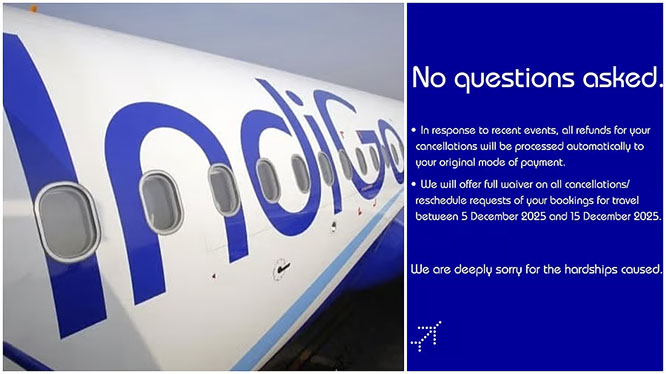
With IndiGo flight disruptions impacting thousands of passengers, the airline on Saturday said that it will offer full waiver on all cancellations/reschedule requests for travel bookings between December 5, 2025 and December 15, 2025.

Earlier in the day, the civil aviation ministry had directed the airline to complete the ticket refund process for the cancelled flights by Sunday evening, as well as ensure baggage separated from the travellers are delivered in the next two days.

In a post on X, titled 'No questions asked', IndiGo wrote, "In response to recent events, all refunds for your cancellations will be processed automatically to your original mode of payment."

"We are deeply sorry for the hardships caused," it further added.

Several passengers, however, complained of not getting full refund as promised by the airline.

Netizens have shared screenchots of getting charged for airline cancellation fee and convenience fee.

"Please tell me why u have did this airline cancellation charges when u say full amount will be refunded (sic)," a user wrote sharing a screenshot of the refund page.

"Well, but you have still debited the convenience charges," wrote another.

Passengers have also raised concerns about the "cancel" option being disabled on the IndiGo app. "First enable the 'Cancel' button on your App & offer full refund on tickets cancelled by customers between the said dates," wrote a user.

A day after the country's largest airline, IndiGo, cancelled more than 1,000 flights and caused disruptions for the fifth day on Saturday, the ministry said that any delay or non-compliance in refund processing will invite immediate regulatory action.

The refund process for all cancelled or disrupted flights must be completed by 8 pm on Sunday, the ministry said in a statement.

"Airlines have also been instructed not to levy any rescheduling charges for passengers whose travel plans were affected by cancellations," it said.

On Saturday, more than 400 flights were cancelled at various airports.

IndiGo has also been instructed to set up dedicated passenger support and refund facilitation cells.

Comments

Add new comment

  • Coastaldigest.com reserves the right to delete or block any comments.
  • Coastaldigset.com is not responsible for its readers’ comments.
  • Comments that are abusive, incendiary or irrelevant are strictly prohibited.
  • Please use a genuine email ID and provide your name to avoid reject.