



326 sedition cases filed in India from 2014 to 2019; six convicted

News Network
July 18, 2021

News Network, July 18: A total of 326 cases were registered in the country under the controversial colonial-era penal law on sedition between 2014 and 2019 in which just six persons were convicted.

The Supreme Court last week observed that Section 124 (A) of the IPC -- offence of sedition -- has been enormously misused and asked the Centre why it was not repealing the provision used by the British to "silence" people like Mahatma Gandhi to suppress the freedom movement.

According to the Union Home Ministry data, a total of 326 cases were registered under the sedition law between 2014 and 2019, with the highest 54 cases in Assam.

Out of these cases, charge sheets were filed in 141 cases while just six people were convicted for the offence during the six-year period.

The data of 2020 has not been compiled by the home ministry yet, officials said.

In Assam, out of the 54 sedition cases registered, charge sheets were filed in 26 cases and trials were completed in 25 cases.

However, there has not been a single conviction in the state in any of the cases between 2014 and 2019, the data says.

Jharkhand has registered 40 cases under Section 124 (A) of IPC during the six years in which charge sheets were filed in 29 cases and trials were completed in 16 cases in which just one person has been convicted.

In Haryana, 31 cases were registered under the sedition law in which charge sheets were filed in 19 cases and trials were completed in six cases in which just one person has been convicted.

Bihar, Jammu and Kashmir and Kerala have registered 25 cases each.

While Bihar and Kerala could not file a charge sheet in any of the cases, Jammu and Kashmir filed a charge sheet in three cases. However, no one was convicted in any of the three states between 2014 and 2019.

As many as 22 sedition cases were filed in Karnataka in which charge sheets were filed in 17 cases, but the trial could be completed in just one case. However, no one was convicted in any case in the period.

A total of 17 sedition cases were filed in Uttar Pradesh and eight in West Bengal between 2014 and 2019.

While charge sheets were filed in eight cases in UP and five cases in West Bengal, no one was convicted in the two states.

In Delhi, four sedition cases were registered between 2014 and 2019 but no charge sheet has been filed in any case.

No sedition case was filed in states and UTs of Meghalaya, Mizoram, Tripura, Sikkim, Andaman and Nicobar Islands, Lakshadweep, Puducherry, Chandigarh, Daman and Diu, Dadra and Nagar Haveli in the six years.

One each sedition case was filed in three states -- Maharashtra (in 2015), Punjab (2015) and Uttarakhand (2017).

According to the home ministry data, 2019 saw the highest number of 93 sedition cases registered in the country, followed by 70 in 2018, 51 in 2017, 47 in 2014, 35 in 2016 and 30 in 2015.

While 40 charge sheets were filed in the country in 2019 under the sedition law, 38 were filed in 2018, 27 in 2017, 16 in 2016, 14 in 2014 and six in 2015.

Among the six convicted, two were sentenced in 2018 and one each in 2019, 2017, 2016 and 2014. No one was convicted in 2015.

On July 15, a Supreme Court bench headed by Chief Justice N V Ramana agreed to examine the pleas filed by the Editors Guild of India and a former major general challenging the Constitutionality of Section 124A (sedition) in the IPC.

The court said its main concern was the "misuse of law" leading to the rise in the number of cases.

The non-bailable provision makes any speech or expression that brings or attempts to bring into hatred or contempt or excites or attempts to excite disaffection towards the government established by law in India a criminal offence punishable with a maximum sentence of life imprisonment.

"Mr Attorney (General), we want to ask some questions. This is the colonial-era law and the same law was used by the British to suppress the freedom movement. It was used by the British to silence Mahatma Gandhi, Gokhale and others.

"Is it still necessary to keep this in statute even after 75 years of independence?" asked the bench which also comprised justices A S Bopanna and Hrishikesh Roy.

Comments

Ramesh Mishra
 - 
Monday, 19 Jul 2021

SEDITION CASES IN INDIA
In every Democratic country of the world, the Courts exist to uphold, interpret, and apply the law. India became free from Britain in 1947, India is following the Colonial Laws, even today India interpret the law by British lenses and irreparably injuring the public. In a Democratic Country, due process balances the power of law of the land and protects the individual person from it. When A Government harm a person without following the exact course of the law, this constitutes a due process violation, which offends the Rule of Law. The Indian Government is misapplying sedition law on their enemies, opposition and whoever Government decides to destroy. The sedition laws of India are inhumane and must be abolished and the Government is accountable for abusing the due process of law.

Ramesh Mishra
Victoria, BC, CANADA

Add new comment

  • Coastaldigest.com reserves the right to delete or block any comments.
  • Coastaldigset.com is not responsible for its readers’ comments.
  • Comments that are abusive, incendiary or irrelevant are strictly prohibited.
  • Please use a genuine email ID and provide your name to avoid reject.
News Network
December 15,2025

Mangaluru police have arrested a 27-year-old NRI on his return from Saudi Arabia in connection with an Instagram post allegedly containing derogatory and provocative remarks about the Hindu religion, officials said on Monday.

The accused, Abdul Khader Nehad, a resident of Ulaibettu in Mangaluru, was working in Saudi Arabia when the post was uploaded, police said.

A suo motu case was registered at the Bajpe police station on October 11 after an allegedly offensive post circulated from the Instagram account ‘team_sdpi_2025’. Police said the content was flagged for being provocative and derogatory in nature.

During the investigation, technical analysis traced the Instagram post to Nehad, who was residing abroad at the time, a senior police officer said. Based on these findings, a Look Out Circular (LOC) was issued against him.

On December 14, Nehad arrived from Saudi Arabia at Calicut International Airport in Kerala, where he was taken into custody on arrival. Police said further investigation is underway.

Comments

Add new comment

  • Coastaldigest.com reserves the right to delete or block any comments.
  • Coastaldigset.com is not responsible for its readers’ comments.
  • Comments that are abusive, incendiary or irrelevant are strictly prohibited.
  • Please use a genuine email ID and provide your name to avoid reject.
News Network
December 13,2025

New Delhi: School-going children are picking up drug and smoking habits and engaging in consumption of alcohol, with the average age of introduction to such harmful substances found to be around 13 years, suggesting a need for earlier interventions as early as primary school, a multi-city survey by AIIMS-Delhi said.

The findings also showed substance use increased in higher grades, with grade XI/XII students two times more likely to report use of substances when compared with grade VIII students. This emphasised the importance of continued prevention and intervention through middle and high school.

The study led by Dr Anju Dhawan of AIIMS's National Drug Dependence Treatment Centre, published in the National Medical Journal of India this month, looks at adolescent substance use across diverse regions.

The survey included 5,920 students from classes 8, 9, 11 and 12 in urban government, private and rural schools across 10 cities -- Bengaluru, Chandigarh, Delhi, Dibrugarh, Hyderabad, Imphal, Jammu, Lucknow, Mumbai, and Ranchi. The data were collected between May 2018 and June 2019.

The average age of initiation for any substance was 12.9 (2.8) years. It was lowest for inhalants (11.3 years) followed by heroin (12.3 years) and opioid pharmaceuticals (without prescription; 12.5 years).

Overall, 15.1 per cent of participants reported lifetime use, 10.3 per cent reported past year use, and 7.2 per cent reported use in the past month of any substance, the study found.

The most common substances used in the past year, after tobacco (4 per cent) and alcohol (3.8 per cent), were opioids (2.8 per cent), followed by cannabis (2 per cent) and inhalants (1.9 per cent). Use of non-prescribed pharmaceutical opioids was most common among opioid users (90.2 per cent).

On being asked, 'Do you think this substance is easily available for a person of your age' separately for each substance category, nearly half the students (46.3 per cent) endorsed that tobacco products and more than one-third of the students (36.5 per cent) agreed that a person of their age can easily procure alcohol products.

Similarly, for Bhang (21.9 per cent), ganja/charas (16.1 per cent), inhalants (15.2 per cent), sedatives (13.7 per cent), opium and heroin (10 per cent each), the students endorsed that these can be easily procured.

About 95 per cent of the children, irrespective of their grade, agreed with the statement that 'drug use is harmful'.

The rates of substance use (any) among boys were significantly higher than those of girls for substance use (ever), use in the past year and use in the past 30 days. Compared to grade VIII students, grade IX students were more likely, and grade XI/XII students were twice as likely to have used any substance (ever).

The likelihood of past-year use of any substance was also higher for grade IX students and for grade XI/XII students as compared to grade VIII students.

About 40 per cent of students mentioned that they had a family member who used tobacco or alcohol each. The use of cannabis (any product) and opioid (any product) by a family member was reported by 8.2 per cent and 3.9 per cent of students, respectively, while the use of other substances, such as inhalants/sedatives by family was 2-3 per cent, the study found.

A relatively smaller percentage of students reported use of tobacco or alcohol among peers as compared to among family members, while a higher percentage reported inhalants, sedatives, cannabis or opioid use among peers.

Children using substances (past year) compared to non-users reported significantly higher any substance use by their family members and peers.

There were 25.7 per cent students who replied 'yes' to the question 'conflicts/fights often occur in your family'. Most students also replied affirmatively to 'family members are aware of how their time is being spent' and 'damily members are aware of with whom they spend their time'.

Comments

Add new comment

  • Coastaldigest.com reserves the right to delete or block any comments.
  • Coastaldigset.com is not responsible for its readers’ comments.
  • Comments that are abusive, incendiary or irrelevant are strictly prohibited.
  • Please use a genuine email ID and provide your name to avoid reject.
News Network
December 7,2025

envoy.jpg

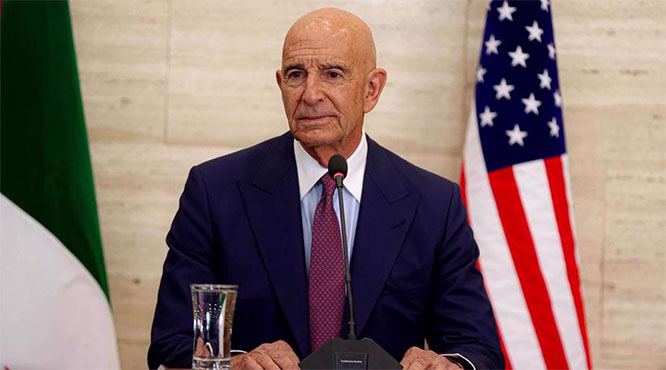
Since 1946, the United States has attempted 93 coups or “regime change” operations across the world — including two in Iran, US Special Envoy for Syria Tom Barrack has admitted.

Speaking to the UAE-based IMI Media Group, in remarks published by The National, Barrack said Washington tried twice to overthrow the Iranian government but failed both times. 

“For (Trump) then to be imputed with regime change — we had two regime changes in Iran already. Neither one worked. So I think wisely leave it to the region to solve,” said Barrack, who also serves as the US ambassador to Turkey.

His comments come six months after the US joined Israel in airstrikes against Iran during ongoing indirect nuclear negotiations between Tehran and Washington.

On June 13, Israel launched an attack on Iran that killed at least 1,064 people and hit civilian infrastructure. Days later, the United States targeted three nuclear facilities — Fordow, Natanz and Isfahan — in what Iran called a clear violation of international law. Iranian retaliation eventually forced a halt to the assault on June 24.

Barrack further claimed that US President Donald Trump and Foreign Secretary Marco Rubio are “not into regime change” and prefer a regional approach driven by Middle Eastern countries themselves. According to him, regional dialogue and non-interference by outside powers offer a more durable path forward.

He added that Washington is still open to an agreement with Tehran if Iranian authorities show “seriousness” and willingness to engage constructively.

However, Iran maintains the US has not shown readiness for meaningful talks. In an interview with Japan’s Kyodo News, Iranian Foreign Minister Abbas Araghchi said negotiations could advance only if Washington acknowledges Iran’s right to peaceful nuclear energy and lifts unilateral sanctions.

Comments

Add new comment

  • Coastaldigest.com reserves the right to delete or block any comments.
  • Coastaldigset.com is not responsible for its readers’ comments.
  • Comments that are abusive, incendiary or irrelevant are strictly prohibited.
  • Please use a genuine email ID and provide your name to avoid reject.