



Bharat Bandh on Mar 28, 29: what is open, what is closed?

News Network
March 27, 2022

New Delhi, Mar 26: A joint forum of central trade unions have given a call for a nationwide strike on March 28 and 29. However, day-to-day activities are unlikely to be hit.

The March 22 statement by the forum said that roadways, transport workers and electricity workers have decided to join the strike in spite of the impending threat of ESMA (Haryana and Chandigarh, respectively).

The central trade unions that are members of this joint forum are Hind Mazdoor Sabha (HMS), Centre of Indian Trade Unions (CITU), Indian National Trade Union Congress (INTUC), All India Trade Union Congress (AITUC), Self Employed Women's Association (SEWA), All India United Trade Union Centre (AIUTUC), Trade Union Coordination Centre (TUCC), All India Central Council of Trade Unions (AICCTU), Labour Progressive Federation (LPF) and United Trade Union Congress (UTUC).

The Bharatiya Mazdoor Sangh has decided not to participate in the strike.

Hotels to Be Open

As of now, hotel associations have not spoken about their stand on the issue. It looks like restaurants will function like normal in most parts of the country.

Will Bus and Train Services be Hit?

The forum has said that transport workers have extended the support. However, the online booking of tickets for buses and trains are on. So, transportation service is unlikely to be affected. Any development in this regard will be updated here.

Banks Closed

Opposing the Centre's move to privatise public sector bans and the Banking Laws Amendment Bill 2021, the bank unions have extended their support to the bandh. The strike notices have been given by unions in the sectors such as coal, steel, oil, telecom, postal, income tax, copper, insurance among others, it also stated.

Bengal Government Order

The West Bengal government asked all its employees to report for duty during the 48-hour nationwide strike on March 28 and 29, failing which they will be issued show-cause notices. The TMC dispensation, which has been opposed to bandhs as its official policy, said that no casual leave will be granted to employees except in emergency situations such as illness or death in the family.

Several trade unions, including those of the Left Front and the Congress but barring the ones belonging to the BJP and the TMC, have called for a two-day nationwide strike against the Centre's economic policies.

In a notification issued from state secretariat Nabanna, Principal Secretary Manoj Pant said that any employee remaining absent for two days or either of the days without permission shall be asked for an explanation.

"In view of call given by different trade unions and others for a 48-hour nationwide strike on 28th and 29th March, 2022, it has been decided that all state government offices shall remain open and all the employees shall report for duty on those days.

"It has been decided that no casual leave or any other leave for absence either in the first half or in the second half or for the whole day shall be granted to any employee on the above-mentioned dates," the notification said.

It said that the absence of employees on the two days shall be treated as 'dies-non' and no salary will be admissible unless covered by grounds of hospitalisation, bereavement in family, several illness, or staffers on maternity, child care, medical or earned leave before March 25.

"All Heads of Offices/Controlling Authorities concerned will issue Show-Cause notice to the employee(s) concerned, who will remain absent on March 28, 2022 and March 29, 2022 or on any of these 2 (two) dates, asking him/her to explain why action would not be taken against him/her for such unauthorised absence.

The unions in railways and defence sector would be making mass mobilization in support of the strike at several hundreds of spots, a joint forum of central trade unions.

The meeting took note of the fact that emboldened by the results of the recently-held state elections, the BJP Government at centre has intensified the attacks on the working people, reducing the interest rate on EPF accumulations to 8.1 per cent from 8.5 per cent, sudden hike in petrol, LPG, kerosene, CNG etc., taking steps to implement their program of monetization (PSU land bundles) but are held back only because of the worsening condition of inflation and crashing share markets.

Unions have also sent out strike notices in sectors such as coal, steel, oil, telecom, postal, income tax, copper, banks, and insurance, added the statement. It further said that unions in the railway and defense sectors are planning to mobilise mass support for a strike at hundreds of locations.
Unions at state levels were asked to join the strike to oppose the anti-labour policies of the Central Government, an example of which is the four labour codes.

Kerala HC Restrains 5 Unions in BPCL, Kochi, from Participating in Strike

Meanwhile, the Kerala High Court on Friday restrained five trade unions in the Bharat Petroleum Corporation Limited (BPCL), Kochi, from participating in the nationwide strike on March 28 and 29 called by a joint forum of trade unions.

Considering a plea filed by the BPCL challenging the trade unions in the company joining the protest, Justice Amit Rawal issued an interim order restraining the unions from going on strike according to their call from 7 am on March 28 to 7 am on March 30.

In his plea, BPCL Chief General Manager in-charge (HR) Kurian P Alappatt had said that under the provisions of Section 22 of the Industrial disputes Act, 1947, strikes and lock-outs in respect of a public utility service are prohibited during the pendency of any conciliation proceedings.

Comments

Add new comment

  • Coastaldigest.com reserves the right to delete or block any comments.
  • Coastaldigset.com is not responsible for its readers’ comments.
  • Comments that are abusive, incendiary or irrelevant are strictly prohibited.
  • Please use a genuine email ID and provide your name to avoid reject.
News Network
December 15,2025

Mangaluru, Dec 15: Educational institutions in Mangaluru that rely on the popular Mangala Stadium for their annual sports events are bracing for an inconvenience as the city's key sporting venue is set to close its gates for a significant upgrade. The stadium is expected to be unavailable for approximately two months starting from January 15, 2026.

The closure is necessitated by a proposed overhaul of the stadium's facilities, with a special focus on upgrading the synthetic track. Pradeep Dsouza, Assistant Director of the District of Youth Empowerment and Sports (DYES), Dakshina Kannada, confirmed the development.

"Experts have visited the stadium, conducted a thorough inspection, and have given the go-ahead for a complete makeover," Dsouza stated. "Funds have been allocated for the project, and we are currently awaiting the final green signal from state officials to commence the work. We anticipate that the work will likely begin in the second week of January. Consequently, we have stopped renting out the stadium to colleges and other organizations in preparation for the upgrade."

The timing presents a logistical challenge for colleges, as many schools have already concluded their sports meets.

"Colleges will now be organizing their events and will need to find alternative locations to host their sports meets," Dsouza added. He suggested a few potential venues, including the Dakshina Kannada police ground, University College grounds, Panambur grounds, Swaraj Maidan in Moodbidri, and the Mangalore University sports grounds in Konaje.

However, many institutions note that finding a comparable venue will be difficult. While the DK police ground and University College grounds are closer to the city center, they do not possess the extensive facilities and infrastructure offered by Mangala Stadium.

Dr. P Dayananda Pai - P Satisha Govt First Grade College, Carstreet, is one such institution dependent on the stadium. Principal Jayakar Bhandary expressed hope for a swift completion of the work. "We expect the work to be completed at the earliest. If not, we will be forced to look for other venues to host the sports day for our students," Bhandary said, highlighting the pressing need for the city's main sporting facility.

Comments

Add new comment

  • Coastaldigest.com reserves the right to delete or block any comments.
  • Coastaldigset.com is not responsible for its readers’ comments.
  • Comments that are abusive, incendiary or irrelevant are strictly prohibited.
  • Please use a genuine email ID and provide your name to avoid reject.
News Network
December 3,2025

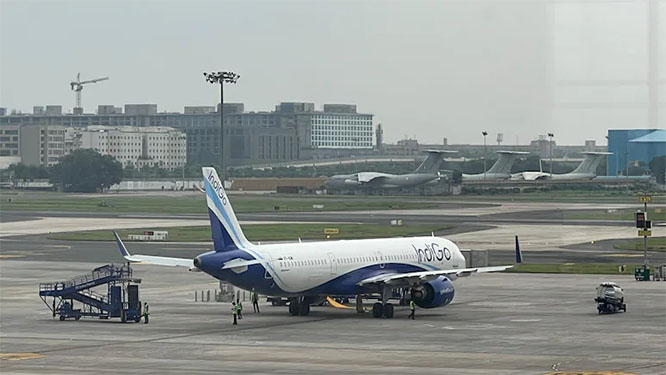
indigo.jpg

IndiGo, India’s largest airline, is battling one of its worst operational disruptions in recent years, with hundreds of delays and cancellations throwing domestic travel into chaos.

Government data on Tuesday showed its on-time performance plunging to 35%, an unusual dip for a carrier long associated with punctuality.

By Wednesday afternoon, airports in Delhi, Mumbai, Bengaluru and Hyderabad had collectively reported close to 200 cancellations, stranding travellers across the country.

Crew Shortage After New Duty Norms

A major trigger behind the meltdown is a severe crew shortage, especially among pilots, following the rollout of revised Flight Duty Time Limitation (FDTL) norms last month.

The rules mandate longer rest hours and more humane rosters — a shift IndiGo has struggled to incorporate across its vast network.

Sources said several flights were grounded due to lack of cabin crew, while some delays stretched upwards of eight hours.

With IndiGo controlling over 60% of India’s domestic aviation market, the ripple effect has impacted airports nationwide.

IndiGo Issues Apology, Lists “Compounding Factors”

In a statement, IndiGo acknowledged the large-scale disruption:

“We sincerely apologise to customers. A series of unforeseen operational challenges — technology glitches, winter schedule changes, adverse weather, system congestion and updated FDTL norms — created a compounding impact that could not have been anticipated.”

To stabilise operations, the airline has begun calibrated schedule adjustments for the next 48 hours, aiming to restore punctuality. Affected passengers are being offered refunds or alternate travel arrangements, IndiGo said.

What the FDTL Rules Require

The FDTL norms, designed to reduce pilot fatigue, cap duty and flying hours as follows:
•    Maximum 8 hours of flying per day
•    35 hours per week
•    125 hours per month
•    1,000 hours per year

Crew must also receive rest equalling twice the flight duration, with a minimum 10-hour rest period in any 24-hour window.

The DGCA introduced these limits to enhance flight safety.

Hyderabad: 33 Flights Cancelled, Long Queues Reported

Hyderabad’s Rajiv Gandhi International Airport saw heavy early-morning crowds as 33 IndiGo flights (arrivals and departures) were cancelled.

The airport clarified on X that operations were normal, advising passengers to contact IndiGo directly for latest flight status.

Cancellations included flights to and from Visakhapatnam, Goa, Ahmedabad, Delhi, Bengaluru, Chennai, Madurai, Hubli, Bhopal and Bhubaneswar.

Bengaluru: 42 Flights Disrupted

Bengaluru’s Kempegowda International Airport recorded 42 cancellations — 22 arrivals and 20 departures — affecting routes to Delhi, Mumbai, Chennai, Hyderabad, Goa, Kolkata and Lucknow.

Passengers Vent on Social Media

Irate travellers took to X to share their experiences. One passenger stranded in Hyderabad wrote: “I have been here since 3 a.m. and missed an important meeting.”

Another said: “My flight was pushed from 1:55 PM to 2:55 PM and now 4:35 PM. I was informed only three minutes before entering the airport.”

Delhi Airport Hit by Tech Glitch

At Delhi Airport, the disruption deepened due to a slowdown in the Amadeus system — used for reservations, check-ins and departure control.

The technical issue led to longer queues and sluggish processing, adding to delays already worsened by staff shortages.

Comments

Add new comment

  • Coastaldigest.com reserves the right to delete or block any comments.
  • Coastaldigset.com is not responsible for its readers’ comments.
  • Comments that are abusive, incendiary or irrelevant are strictly prohibited.
  • Please use a genuine email ID and provide your name to avoid reject.
News Network
December 6,2025

pilot.jpg

New Delhi: IndiGo, India’s largest airline, faced major operational turbulence this week after failing to prepare for new pilot-fatigue regulations issued by the Directorate General of Civil Aviation (DGCA). The stricter rules—designed to improve flight safety—took effect in phases through 2024, with the latest implementation on November 1. IndiGo has acknowledged that inadequate roster planning led to widespread cancellations and delays.

Below are the key DGCA rules that affected IndiGo’s operations:

1. Longer Mandatory Weekly Rest

Weekly rest for pilots has been increased from 36 hours to 48 hours.

The government says the extended break is essential to curb cumulative fatigue. This rule remains in force despite the current crisis.

2. Cap on Night Landings

Pilots can now perform only two night landings per week—a steep reduction from the earlier limit of six.

Night hours, defined as midnight to early morning, are considered the least alert period for pilots.

Given the disruptions, this rule has been temporarily relaxed for IndiGo until February 10.

3. Reduced Maximum Night Flight Duty

Flight duty that stretches into the night is now capped at 10 hours.

This measure has also been kept on hold for IndiGo until February 10 to stabilize operations.

4. Weekly Rest Cannot Be Replaced With Personal Leave

Airlines can no longer count a pilot’s personal leave as part of the mandatory 48-hour rest.

Pilots say this closes a loophole that previously reduced actual rest time.

Currently, all airlines are exempt from this rule to normalise travel.

5. Mandatory Fatigue Monitoring

Airlines must submit quarterly fatigue reports along with corrective actions to DGCA.

This system aims to create a transparent fatigue-tracking framework across the industry.

The DGCA has stressed that these rules were crafted to strengthen flight safety and align India with global fatigue-management standards. The temporary relaxations are expected to remain until February 2025, giving IndiGo time to stabilise its schedules and restore normal air travel.

Comments

Add new comment

  • Coastaldigest.com reserves the right to delete or block any comments.
  • Coastaldigset.com is not responsible for its readers’ comments.
  • Comments that are abusive, incendiary or irrelevant are strictly prohibited.
  • Please use a genuine email ID and provide your name to avoid reject.
