HC slams TN govt for raising ‘law and order’ fears, clears way for Deepam near Dargah

News Network
January 6, 2026

lamp.jpg

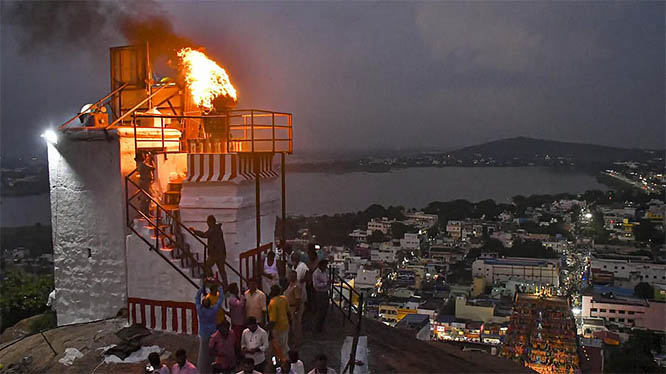
Chennai: The Madras High Court has strongly criticised the Tamil Nadu government for citing what it termed an “imaginary” law and order concern to delay the implementation of a court order permitting the lighting of the Deepam on the Deepathoon atop the Thiruparankundram hills in Madurai.

Upholding an earlier order passed by Justice G R Swaminathan, a division bench of Justices G Jayachandran and K K Ramakrishnan of the Madurai Bench dismissed the appeal filed by the state government and reaffirmed that the Deepam could be lit at the site during Karthigai Deepam.

The bench expressed displeasure over the government’s failure to implement the single judge’s directive, even after permission was granted for CISF personnel to accompany the petitioner, Rama Ravikumar, to the hilltop on December 3 to light the lamp. While allowing the ritual, the court clarified that the number of people permitted to climb the hill would be determined by the Archaeological Survey of India (ASI).

The state government had objected to the single judge’s order, arguing that allowing people to climb the hill and light the Deepam could trigger law and order issues, as the Sikkander Badusha Dargah is located about 50 metres from the Deepathoon. Meanwhile, officials of the Hindu Religious and Charitable Endowments (HR&CE) Department went ahead with lighting the lamp at the Uchipillaiyar temple at 6 pm, following established tradition.

Rejecting the government’s stand, the division bench said the apprehension of law and order problems was an “imaginary ghost” created by the authorities for their own convenience and criticised the district administration for not complying with the court’s order. The judges observed that instead of raising unfounded fears, the administration should have used the judgment as an opportunity to foster dialogue and harmony between communities.

The court also noted that neither the state government nor representatives of the dargah had produced any evidence to show that agama shastra prohibited the lighting of the Deepam at the site.

The Thiruparankundram hill has historically been a symbol of communal harmony, housing the Subramaniya Swamy temple, the Kasi Viswanathan temple and the Sikkander Badusha Dargah for centuries. However, the site became a flashpoint in February 2025 after protests by Hindu organisations over allegations that Lok Sabha MP Nawaz Kani consumed meat on the hill. Despite the controversy, local residents continue to live in peace and mutual coexistence. 

Comments

Add new comment

  • Coastaldigest.com reserves the right to delete or block any comments.
  • Coastaldigset.com is not responsible for its readers’ comments.
  • Comments that are abusive, incendiary or irrelevant are strictly prohibited.
  • Please use a genuine email ID and provide your name to avoid reject.
News Network
January 1,2026

vinjayhegde.jpg

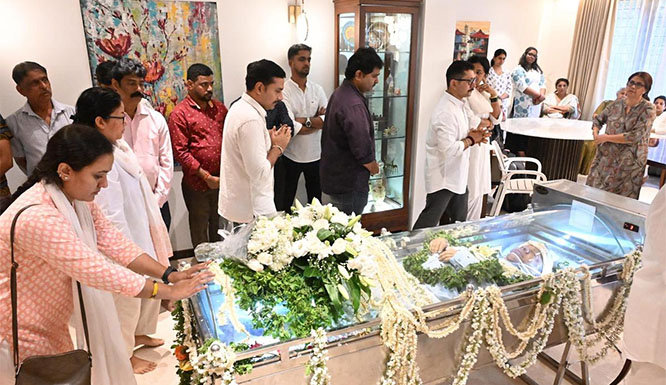
Mangaluru, Jan 1: N. Vinay Hegde, Chancellor of NITTE (Deemed-to-be University) and Managing Director of K.S. Hegde Charitable Hospital, passed away in Mangaluru in the early hours of Wednesday, January 1, 2026. He was 86.

According to sources, Mr. Hegde breathed his last at around 2 a.m. at his residence, ‘Sadanand’, located at Shivabagh in the city.

A towering figure in the field of education and philanthropy, Mr. Hegde was the founder of the Nitte Group of Educational Institutions, which grew under his leadership into a major centre for higher education, particularly in medical, dental, engineering, and allied sciences. His vision played a key role in transforming the educational landscape of coastal Karnataka and beyond.

Born into a distinguished family, Mr. Hegde was the son of former Supreme Court judge Justice K.S. Hegde. He was also the brother of former Karnataka Lokayukta and former Supreme Court judge Justice N. Santosh Hegde.

He is survived by his wife Sujatha Hegde, son Vishal Hegde, and daughter Ashwita Poonja.

The mortal remains of Mr. Hegde will be kept for public viewing at his residence until 3 p.m. on January 1. Thereafter, they will be taken to the Nitte education campus, where the public can pay their last respects between 4.30 p.m. and 6 p.m.

Condolences poured in from across academic and public circles. In a condolence message, P.L. Dharma, Vice-Chancellor of Mangalore University, said Mr. Hegde’s passing marked the end of an era in the region’s educational history.

“It is the end of an era which witnessed a great transformation in the educational sector in undivided Dakshina Kannada. Indeed, he stitched broken hearts into one to practise coexistence and mutual respect. The entire student community and staff of Mangalore University salute him for his exemplary contribution to the nation and Dakshina Kannada in particular,” the message read.

Mr. Hegde’s legacy as an institution builder, educationist, and humanitarian is expected to endure through the vast network of institutions he established and nurtured.

vinjayhegde1.jpg

Comments

Add new comment

  • Coastaldigest.com reserves the right to delete or block any comments.
  • Coastaldigset.com is not responsible for its readers’ comments.
  • Comments that are abusive, incendiary or irrelevant are strictly prohibited.
  • Please use a genuine email ID and provide your name to avoid reject.
coastaldigest.com news network
January 10,2026

Mangaluru: In a strong pitch for redefining the economic future of coastal Karnataka, Deputy Chief Minister D K Shivakumar on Saturday lamented that the region’s vast natural wealth and tourism potential remain largely underutilised, forcing thousands of coastal youth to migrate outside the state and even abroad in search of opportunities.

Speaking in Mangaluru, Shivakumar said the coastal belt—stretching from Mangaluru to Karwar—continues to be one of Karnataka’s most scenic and resource-rich zones, yet local communities are not benefiting proportionately.

“Our beaches, backwaters, forests and culture are unmatched. But people from Mangaluru and other coastal districts continue to move out because we have not capitalised on what we already have,” he said.

Emphasising the talent of the younger generation, he noted that youth from coastal Karnataka are excelling in countries across the world. “They are brilliant, skilled and globally competitive. Our priority must be to create conditions where they can build their future here, not somewhere else. Our identity should shine on our own soil,” he asserted.

Shivakumar revealed that the state government has finalised a new tourism policy aimed at transforming Karnataka—particularly the coast—into a major tourism hub.

As part of the rollout, meetings will be held with investors, builders, tourism operators, entrepreneurs and local business communities.

“The government will extend full support to tourism development. Before implementing the policy, we will take inputs from stakeholders across Karnataka, especially from the coastal belt. Locals should be the prime beneficiaries of tourism growth,” he said.

He stressed that development must be driven by local capability, local enterprise and local initiative, ensuring that economic gains stay within the region rather than drifting outward.

Shivakumar added that Chief Minister Siddaramaiah is scheduled to visit later in the evening, urging those with concerns or suggestions regarding coastal tourism and youth opportunities to raise them directly during the visit.

Comments

Add new comment

  • Coastaldigest.com reserves the right to delete or block any comments.
  • Coastaldigset.com is not responsible for its readers’ comments.
  • Comments that are abusive, incendiary or irrelevant are strictly prohibited.
  • Please use a genuine email ID and provide your name to avoid reject.
News Network
January 14,2026

phone.jpg

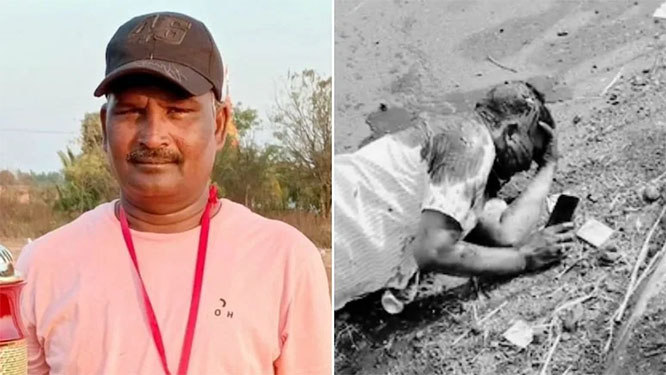
Bidar (Karnataka): A routine ride turned fatal when a nylon kite string slit the throat of a 48-year-old motorcyclist in Karnataka’s Bidar district, claiming his life in a chilling reminder of the deadly threat posed by banned kite-flying materials.

The victim, identified as Sanjukumar Hosamani, was riding near the Talamadagi Bridge when a taut kite string stretched across the road cut deep into his neck, causing profuse bleeding. Critically injured, Hosamani collapsed from his motorcycle but managed to place a final phone call to his daughter.

A disturbing video circulating on social media shows Hosamani drenched in blood, struggling to dial his daughter’s number as life ebbed away.

A passerby attempted to help by pressing a cloth against the wound to stop the bleeding. Locals said an ambulance was called immediately, but it arrived too late. Hosamani succumbed to his injuries before he could be taken to a hospital.

Family members have blamed the delay in emergency response for his death, alleging that timely medical assistance could have saved his life.

Following the incident, Hosamani’s relatives and local residents staged a protest at the accident spot, demanding strict action against the use of nylon kite strings and urgent improvements in emergency medical services.

Police have registered a case at Manna Ekhelli Police Station and said an investigation is underway.

Kite flying during Makar Sankranti is a long-standing tradition across many parts of India. While cotton strings coated with powdered glass were once common, they have increasingly been replaced by cheaper and more durable nylon strings. This durability, however, has proven lethal, as nylon can slice through skin with ease.

Commonly referred to as Chinese manjha, these strings pose a grave danger to two-wheeler riders, who often fail to notice the nearly invisible lines stretched across roads and flyovers.

The Karnataka incident is the latest in a series of such deaths reported across the country. Just this week, a 45-year-old man in Indore died after a kite string slit his throat. Delhi has witnessed multiple fatalities in recent years, including the deaths of a 22-year-old businessman in 2025, a biker in 2022, and a seven-year-old child in 2023.

Despite periodic raids and seizures by authorities, the recurring deaths underline serious gaps in enforcement, raising questions about whether current measures are sufficient to prevent further loss of life.

Comments

Add new comment

  • Coastaldigest.com reserves the right to delete or block any comments.
  • Coastaldigset.com is not responsible for its readers’ comments.
  • Comments that are abusive, incendiary or irrelevant are strictly prohibited.
  • Please use a genuine email ID and provide your name to avoid reject.